
That incessant beeping from your dashboard? It's more than just an annoyance—it's one of your car's most important ways of talking to you. While your first instinct might be to silence it as quickly as possible, figuring out why it's going off is the key to stopping it for good, and safely.
Why Your Seat Belt Alarm Won't Stop Beeping
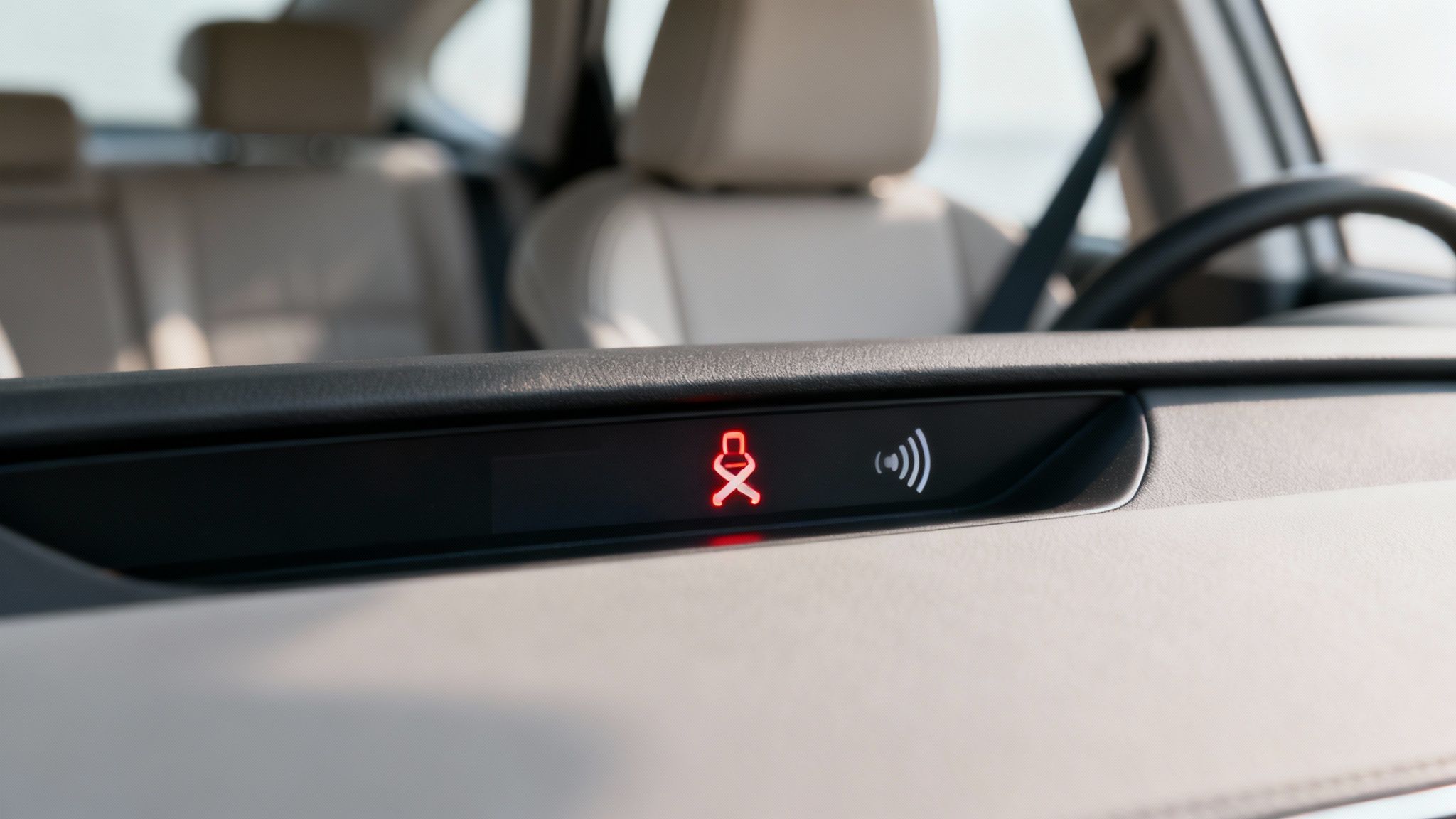
Think of your seat belt alarm as your car's built-in safety co-pilot. Its job is simple but absolutely critical: make sure everyone is buckled up before you hit the road. This isn't just a random chime; it's a carefully designed system of sensors working together to keep you safe. When you hear that beeping, it’s the system flagging a potential problem.
This persistent reminder is incredibly effective at building life-saving habits, turning the act of buckling up into second nature. And that's a big deal. Even though front seat belt use was at 91.6% in 2022, nearly half of all passengers killed in accidents were unbuckled. That simple chime is a constant nudge in the right direction. For more on how these reminders work, The Autopian has some great stats and insights.
How the System Works
Underneath the surface, the alarm system is a trio of components working together. Once you know what they are, you can start to pinpoint why your alarm is acting up.
- The Buckle Switch: Tucked inside the buckle itself, this tiny sensor knows whether the metal tongue of the seat belt is clicked in all the way.
- The Occupancy Sensor: This is a pressure sensor in the seat cushion that tells the car if someone—or something heavy—is in the seat.
- The Electronic Control Unit (ECU): Basically the car's central computer. It takes the information from the other two sensors and decides whether to sound the alarm and flash the warning light.
So, when you sit down, the occupancy sensor alerts the ECU. If the ECU doesn't get a signal from the buckle switch confirming you've latched in, it triggers the alarm. It's a simple, logical check.
Key Takeaway: The alarm isn't the problem; it's a symptom. It's your car's way of telling you that its safety checklist isn't complete—either because a belt is unfastened or a sensor has a fault.
More Than Just a Noise
Instead of treating the alarm like a nuisance, think of it as the start of a quick safety check. The sound is a prompt to ask a few simple questions. Is a passenger unbuckled? Is my heavy gym bag tricking the passenger seat sensor? Or could something else be wrong, like a mechanical issue causing too much seat belt tension?
By approaching it this way, you can go from frustrated to finding a real solution, making sure your ride is both quiet and safe.
Diagnosing Common Causes of a Persistent Alarm

When your seat belt alarm starts chiming even after you've buckled up, it’s more than just an annoyance. It’s your car’s way of telling you something isn’t right in its safety check system. The good news is that you can often play detective and figure out the culprit without a trip to the shop.
Think of it like a simple circuit. When you click your belt in, you complete the circuit, and the car knows you're secure. If there’s a break or a false signal anywhere in that chain, the alarm will start beeping. Let's look at the usual suspects.
The Overly Sensitive Passenger Seat
One of the most common false alarms comes from the seat occupancy sensor in the front passenger seat. This is basically a pressure pad that detects when someone is sitting there. The problem is, it can’t always tell the difference between a person and your heavy gym bag.
These items often trick the sensor:
- A heavy backpack or briefcase
- A gallon of milk or case of water from a grocery run
- Even a medium-sized dog who loves to ride shotgun
If the weight on the seat hits the manufacturer's threshold (usually around 30-40 pounds), the car thinks there’s an unbuckled passenger. The easiest first step? Clear everything off the seat and see if the noise stops.
Debris Inside the Buckle Mechanism
Your seat belt buckle has a thankless job. It's a magnet for dust, crumbs, and the occasional coffee spill. Over time, all that gunk can build up inside and prevent the metal tongue from making a solid connection.
Imagine a tiny switch inside the buckle. When you click the belt in, the tongue should press that switch and tell the car’s computer, “We’re good!” But if a bit of lint or a stray french fry is in the way, the switch might not fully engage. The computer never gets the all-clear signal, so the alarm keeps going. Even a tiny piece of plastic, like a broken seat belt stop clip, can fall in and cause trouble.
Faulty Sensors and Wiring Issues
If the passenger seat is empty and the buckle is clean, the problem might be a little deeper. Wires run from the buckle and seat sensor to your car’s main computer, and these can get damaged. They're usually tucked under the seat, where they can get pinched or disconnected from years of seat adjustments or things getting shoved underneath.
A loose connection sends a confusing, intermittent signal, which can make the alarm go on and off randomly. The sensor inside the buckle can also just wear out over time. These electrical issues usually require a professional to diagnose accurately.
Expert Insight: Remember, these aren't just annoying beeps. In many modern cars, the seat belt sensors are tied directly to the airbag system. A faulty sensor could potentially affect how an airbag deploys in an accident, so it's a safety issue worth fixing.
The market for these safety systems is huge—projected to hit $2.5 billion by 2025—thanks to strict safety regulations. With North America and Europe accounting for about 65% of that market, the technology is always evolving.
To help you narrow down the issue, here's a quick reference table.
Quick Guide to Alarm Triggers
This table can help you quickly identify the likely cause based on what you're seeing (and hearing).
| Symptom | Potential Cause | What to Do First |
|---|---|---|
| Alarm goes off when something is on the passenger seat. | Seat Occupancy Sensor is being triggered. | Remove all items from the seat and see if the alarm stops. |
| Alarm stays on even when buckled; feels "mushy." | Debris in the Buckle is blocking the sensor. | Inspect the buckle for foreign objects and try to clean it. |
| Alarm is intermittent or stays on for no clear reason. | Faulty Sensor or Wiring issue under the seat. | Check for loose wires under the seat, but consult a pro. |
| Alarm sounds when the driver's belt is buckled. | Faulty Driver-Side Buckle or sensor. | Clean the driver's buckle and check for loose connections. |
While this table covers the most frequent issues, complex electrical problems should always be handled by a qualified mechanic.
Practical Troubleshooting Steps You Can Do at Home
Before you book a pricey appointment at the dealership, it’s worth knowing that most nagging seat belt alarms can be fixed with a few simple checks right in your driveway. You don't need to be a mechanic. Just think of yourself as a detective, methodically ruling out the usual suspects. This hands-on approach can save you a surprising amount of time and money.
Each step here is safe, simple, and designed to help you logically pinpoint the problem. We'll start with the most common culprits and go from there. This process of elimination is the fastest way back to a quiet, beep-free drive.
Start With a Visual and Physical Inspection
Your first move should always be the simplest one. Let's focus on the buckle mechanism itself—it’s the source of the trouble more often than not.
-
Listen for the Click: First, buckle and unbuckle the seat belt a few times. You should hear a solid, satisfying click every time you latch it. If the connection feels soft, mushy, or makes no sound at all, something is likely obstructing the internal latch.
-
Inspect for Debris: Grab a flashlight and take a good look down into the buckle's opening. It's amazing what can end up in there. You're looking for crumbs, lint, dirt, and even tiny coins that can prevent the metal tongue from fully engaging the sensor switch.
-
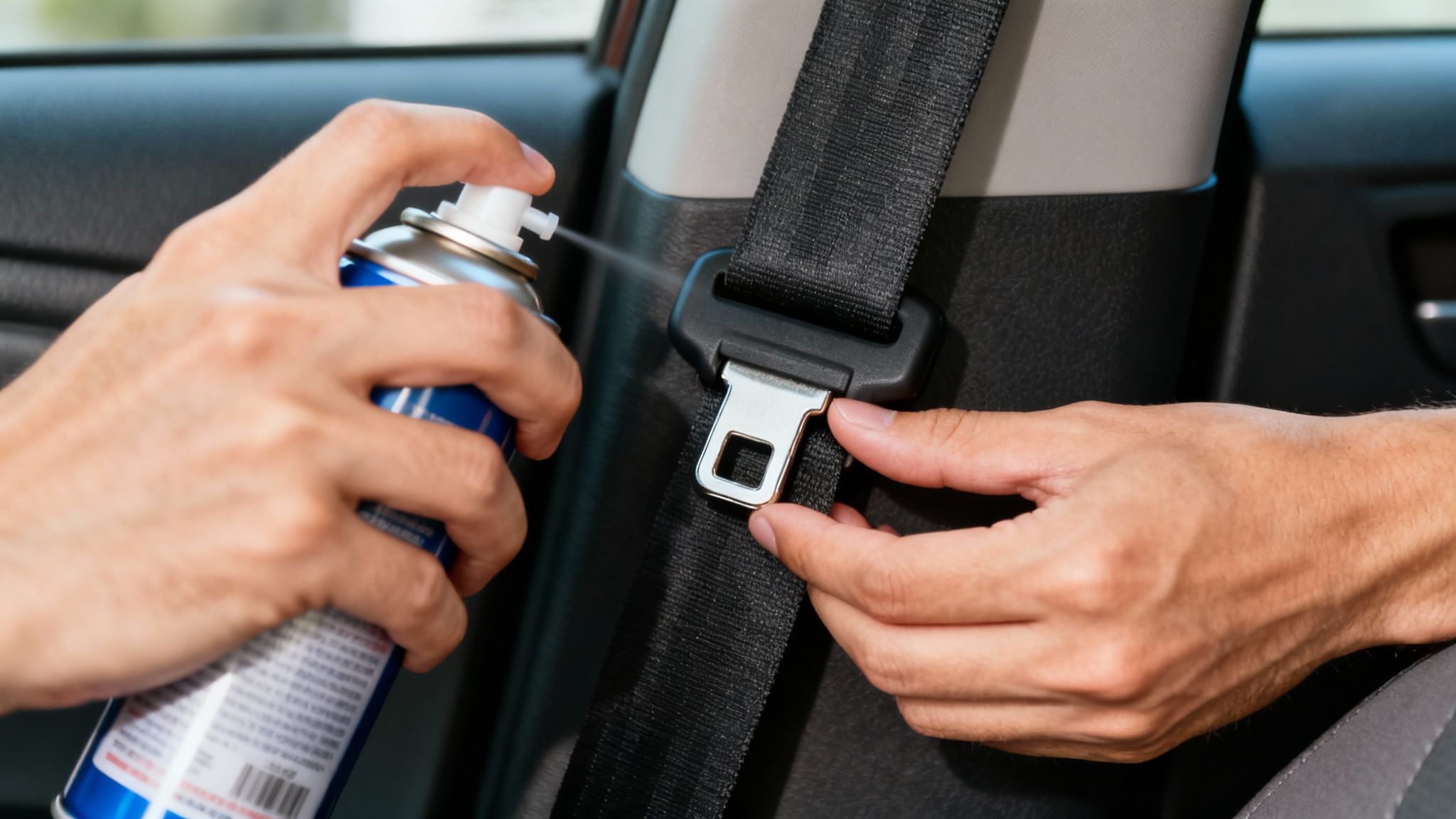
Clear the Buckle: See something in there? A can of compressed air is your best friend. Use short, sharp bursts to blow out any loose debris. If you're dealing with sticky residue from a spilled drink, a cotton swab with a little rubbing alcohol can do the trick. Just make sure the buckle is completely dry before you use it again.
Test the Seat Occupancy Sensor
If the buckle checks out, the next culprit is usually the passenger seat's occupancy sensor. This pressure-sensitive pad can be surprisingly easy to fool, which is why your car sometimes yells at you when no one is even sitting there.
The test is easy: remove everything from the passenger seat. That means your backpack, the grocery bags, your phone, even a heavy winter coat. If the alarm goes silent, you've found the issue. The weight threshold on these sensors can be quite low, and sometimes an item weighing less than 20 pounds is enough to set it off.
Pro Tip: Many newer cars, like the 2021 Subaru Forester, also have sensitive sensors in the back seats that pets can trigger. If your dog is setting off the alarm, the easiest fix is often to just buckle the empty seat belts before your furry co-pilot hops in.
Check for Loose Connections
The last thing to check yourself involves the wiring underneath the front seats. Think about how often you adjust your seat—all that back-and-forth movement can sometimes wiggle a connection loose over time.
Make sure the car is off, then carefully reach under the driver and passenger seats. You should be able to feel a small bundle of wires leading to a plastic connector. Don't unplug anything. Just give the connector a gentle push to make sure it's clicked in firmly. A slightly loose wire can be the cause, and this little jiggle is often enough to re-establish the connection.
If you’ve tried all these steps and the alarm is still going off, it’s a good sign that the problem is a faulty sensor or a more complex electrical issue that needs a professional look. While you're working on these issues, you might also realize your belt's fit isn't quite right. You can learn more about how to get the perfect fit with our guide on seat belt adjuster clips, which can help position the belt more comfortably across your body.
The Dangers of Improperly Disabling Your Alarm
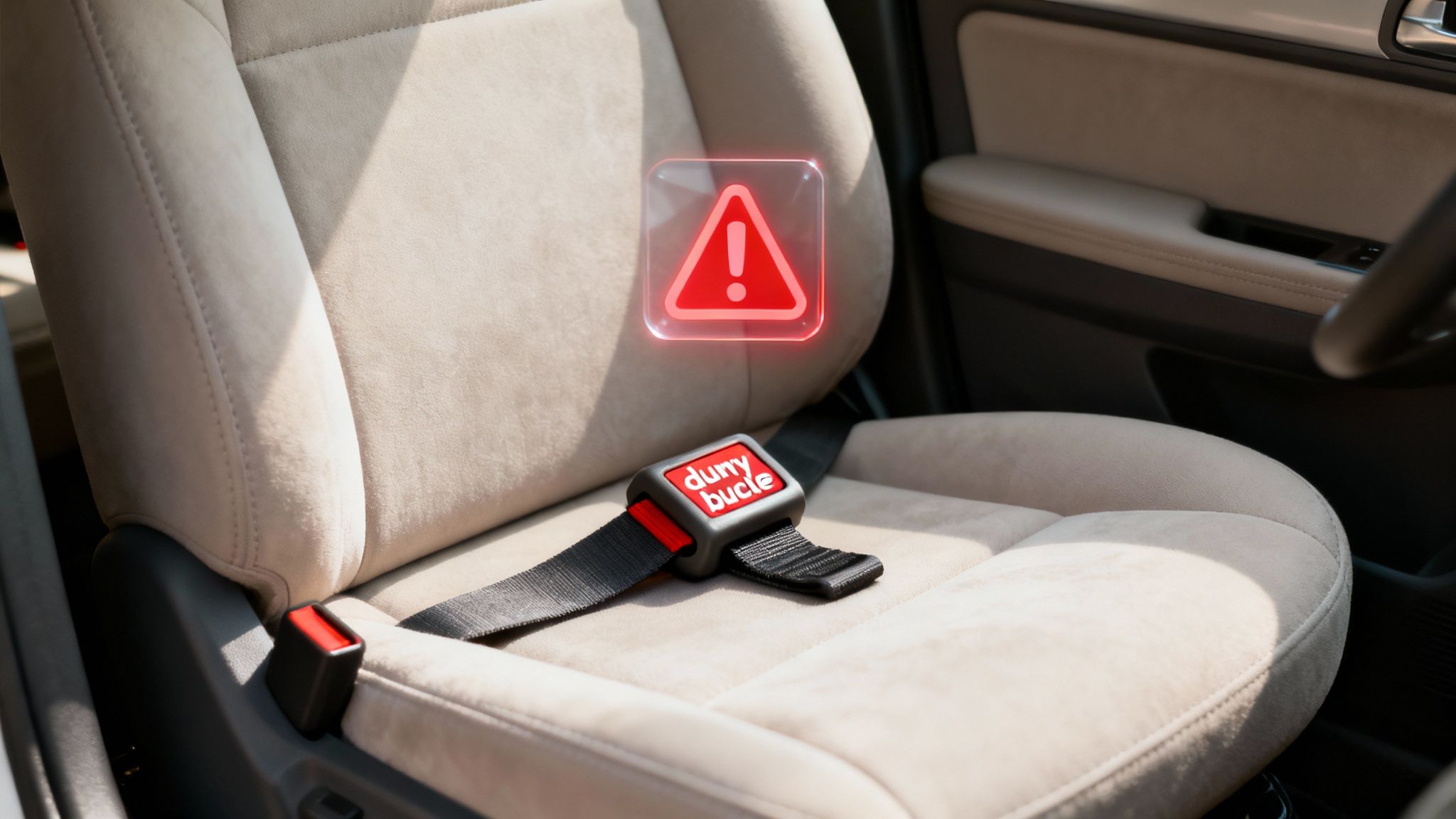
When that persistent ding-ding-ding of a seat belt alarm won't quit, it's tempting to search for a quick fix. You'll likely come across cheap and simple "alarm stoppers" or "dummy buckles" online. These little metal clips slide into the seat belt receptacle and instantly trick your car into thinking the belt is latched, silencing the noise. It seems like the perfect solution, but it’s an incredibly dangerous one.
Using one of these clips is like putting tape over a smoke detector because you don't like the noise it makes when you burn toast. Sure, you've stopped the annoying sound, but you've also completely disabled a life-saving safety system. The real problem isn't just that the alarm is off; it's that you're feeding your car's central computer false information.
The Hidden Connection to Your Airbags
In modern cars, all the safety features work together as a single, intelligent system. The seat belt sensor does more than just trigger that chime—it sends critical data to the Supplemental Restraint System (SRS), which controls your airbags.
Here’s a breakdown of what that sensor is really doing:
- When You're Buckled: The sensor signals to the SRS that you're properly secured. If a crash occurs, the airbags deploy with a specific force calculated to work in partnership with the tension of the seat belt, cushioning you safely.
- When You're Unbuckled (or the System is Tricked): If the car thinks you're buckled but you aren't, the results can be catastrophic. The airbag might deploy with the force intended for a restrained passenger, slamming into you with no seat belt to hold you back. This can cause severe, and sometimes fatal, injuries.
Critical Safety Warning: Think of your car's seat belt and airbag as a team. They are designed to work together. Using a dummy buckle effectively breaks up that team, which can make the airbag deployment far more dangerous in an accident. You aren't just choosing to ride unbuckled; you are actively sabotaging your car's entire crash response system.
This simple act of deception turns a federally mandated safety feature into a serious liability. The system is no longer operating as its engineers designed it to, placing you and any passengers in far greater danger.
Legal and Insurance Repercussions
Beyond the grave physical risks, trying to bypass your seat belt alarm can land you in a world of legal and financial trouble. Tampering with a vehicle's safety equipment is illegal in many places and can come with hefty fines. Should you get into an accident, things get even worse.
- Voided Warranties: Modifying your seat belt system is a surefire way to void your vehicle's warranty. That means you'll be on the hook for what could be very expensive repairs down the line.
- Insurance Claim Denials: If an insurance investigation reveals that you intentionally disabled a key safety feature, your provider may have grounds to deny your claim entirely. You could be left paying for all the vehicle damage and medical bills out of your own pocket.
The law is not on your side here. To see how safety devices are treated legally, it's helpful to understand why certified seat belt extenders are legal while alarm stoppers are not. The difference is night and day: one is a safety-tested tool designed to ensure a proper fit, while the other is a gadget designed to defeat a safety system.
At the end of the day, the urge to disengage a seat belt alarm should never lead you down a path that puts safety on the back burner. The quick fix offered by a dummy buckle is a dangerous illusion that puts your life, your warranty, and your financial security at risk.
When It's Time to Call a Professional Mechanic
So, you’ve cleaned the buckle, made sure the passenger seat is clear, and even given the under-seat wiring a gentle once-over. But that maddening ding, ding, ding just won’t quit. This is the moment to put the tools down. When the simple fixes don't work, it's a strong hint that the problem is more than skin deep, and it's time to bring in someone with the right training and equipment.
Trying to venture further into your car's electrical system without the proper know-how is a classic recipe for disaster. You can quickly turn a small nuisance into a very expensive repair. The components that make up your car's safety system are incredibly complex and tied directly into its main computer, which is precisely why some jobs are best left to the pros.
Why Some Problems Require an Expert
Think of your car's safety system like the human body's nervous system. The sensors are the nerve endings, the wires are the pathways, and the Electronic Control Unit (ECU) is the brain. You can easily put a bandage on a scrape, but you wouldn’t try to perform your own brain surgery. The same logic holds true for your car.
A mechanic is needed when the issue involves things like:
- A Faulty Buckle Sensor: The little switch mechanism inside the buckle can fail electronically. This isn't a part you can just swap out; it usually means the entire buckle assembly has to be replaced.
- Damaged Wiring Harness: A wire could be frayed, pinched, or shorted out somewhere deep inside the seat or under the carpeting. Finding that exact spot without specialized diagnostic tools is like finding a needle in a haystack.
- ECU Glitches: Sometimes, the fault isn't with a physical part at all but with the car's central computer. It might need a software update or a hard reset that only a dealer or a well-equipped shop can perform.
These aren't problems you can spot with a quick look. Poking around in these systems is a risky game—you could easily trigger an airbag light or cause even more electrical gremlins to appear.
What to Expect at the Repair Shop
When you take your car to a good mechanic, the first thing they'll do is plug an OBD-II (On-Board Diagnostics) scanner into the port under your dashboard. This device is a direct line to your car's ECU, letting the technician pull up any specific trouble codes logged by the safety system.
What the Codes Reveal: An OBD-II scanner gives far more detail than just "seat belt broken." It will spit out a specific code, something like "B1022 - Driver Seat Belt Sensor Circuit Open," which tells the mechanic exactly which part of the system is failing. This takes all the guesswork out of the equation.
With that code in hand, the mechanic knows precisely which sensor, circuit, or component to test. It’s a targeted, efficient approach that beats trial-and-error every time.
To make the process smoother and faster, be ready to give your mechanic a clear description of the problem. Tell them:
- Which seat is setting off the alarm (driver, passenger, or even a rear seat).
- When the alarm goes off (constantly, only on bumpy roads, or randomly).
- What steps you’ve already taken to try and fix it.
Knowing when to step back from your own troubleshooting and call in a professional is key. It protects your car's vital safety systems and, frankly, saves you from the massive headache and expense of a mistake.
Using Certified Seat Belt Extenders the Right Way
Sometimes, that relentless chiming from your dashboard isn't a sign of a broken part. It's often just a signal that the seat belt isn't fitting properly. For many people—like plus-sized drivers, those with limited mobility, or even parents wrestling with a bulky car seat—the factory belt just isn't long enough to buckle up securely.
In these situations, a certified seat belt extender is a perfectly safe and effective solution. It provides the extra length needed for the original belt's metal tongue to click firmly into the buckle, which completes the electrical circuit and tells your car's computer everything is secure. The beeping stops, but more importantly, you've maintained the integrity of your car's safety system instead of just bypassing it.
Choosing Safety Over Shortcuts
A quick online search will show you a flood of cheap, uncertified alarm stoppers and knock-off extenders. It is absolutely critical to know the difference between these dangerous gadgets and legitimate, safety-certified equipment. A cheap alarm stopper might silence the chime, but it has not been tested to withstand the incredible forces of a crash and could completely fail when you need it most.
To make sure you're getting a safe product, always look for extenders that meet or exceed official safety standards. The most important certifications to look for are:
- E-Mark Certification (E4/E8): This is a European standard recognized worldwide. It means the product has gone through intense testing for strength, durability, and performance in crash conditions.
- Federal Motor Vehicle Safety Standards (FMVSS): While the U.S. doesn't regulate extenders directly like factory seat belts, reputable companies design and test their products to meet these strict requirements.
Safety First: A certified extender is engineered to be just as strong as your car's original seat belt components. It’s not just a piece of metal and webbing; it’s a purpose-built safety device designed to work seamlessly with your existing system.
How to Select the Right Extender
Finding the right extender is about more than just adding a few inches—it’s about getting a perfect, secure fit for your specific vehicle. Believe it or not, car manufacturers use dozens of different buckle designs, so any company offering a "one-size-fits-all" product is a major red flag.
A trustworthy provider will help you find an extender based on your car's exact make, model, and year. This is the only way to ensure the metal tongue's shape, width, and locking mechanism are a perfect match for your car's original parts, giving you that secure "click" every single time. To really get into the weeds on different designs, check out our guide on seat belt extender types to see why a precise match is so crucial.
By prioritizing certified products and a vehicle-specific fit, you can safely disengage a seat belt alarm that's going off simply because the belt is too short. This approach doesn't trade safety for silence—it actually improves both your comfort and security, ensuring your car's most important safety features can do their job as designed.
Your Top Questions About Seat Belt Alarms Answered
Even after trying a few fixes, you might still be wondering about the nuts and bolts of your seat belt alarm system or how much a repair will set you back. Let's tackle some of the most common questions drivers have when that persistent chime just won't quit.
Getting clear, straightforward answers can take the mystery out of the repair process and help you understand the safety lines you should never cross.
What’s the Repair Bill for a Faulty Seat Belt Sensor?
The cost to fix a seat belt sensor can be all over the map, depending heavily on your car's make and model and what’s actually broken. Sometimes, you get lucky. A simple fix, like a technician cleaning debris out of the buckle or re-securing a loose wire, might only cost you around $100 at a trusted local shop.
However, if the sensor has given up the ghost and the whole buckle assembly needs to be swapped out, the price tag gets bigger. For most everyday cars and SUVs, expect the repair to land somewhere in the $150 to $250 range for parts and labor. If you're driving a luxury vehicle with more sophisticated electronics, that cost can easily jump north of $400.
Can a Weak Car Battery Make My Seat Belt Alarm Go Haywire?
Yes, it absolutely can. A weak or dying battery is notorious for causing all sorts of strange electrical gremlins in modern cars, and the seat belt alarm system is no exception. Your vehicle's computers and sensors are designed to run on a stable, consistent voltage.
When a battery starts to fail, that voltage can dip and spike unpredictably. This electrical chaos can easily confuse the modules that monitor your seat belts, causing them to trigger the alarm for no reason. If your seat belt chime is acting up and you've also noticed dimming headlights, a sluggish engine start, or a flickering dash, get your battery tested. It might just be the simple answer to a very annoying problem.
Key Insight: Before you jump to conclusions about a failed sensor, always check the most basic electrical component first. A new battery is a much cheaper and easier fix than chasing down what seems like a mysterious sensor-specific issue.
Is It Illegal for the Seat Belt Alarm to Keep Beeping?
No, the sound itself isn't illegal. But what it represents often is. The alarm is your car's way of warning you that someone is likely breaking the law by not wearing their seat belt. In almost every state, driving unbuckled is illegal and is a primary offense in many places—meaning a police officer can pull you over for that reason alone.
Think of the alarm as a safety feature designed to help you avoid a hefty fine and, more importantly, a serious injury. While it can be tempting to find a way to disengage the seat belt alarm, ignoring it means ignoring the law and putting yourself at much greater risk in an accident. The chime isn't the legal problem; it's the reminder to solve one.
If your alarm is chiming because of a poor fit, not a mechanical fault, Seat Belt Extenders offer a safe, certified solution. Find the perfect, vehicle-specific extender for your car and get back to enjoying a quiet, comfortable, and secure ride. Shop now at https://seatbeltextenders.com.