
Have you ever noticed that little stitched-down fold on your car's seat belt and wondered what it was for? It’s not a mistake or a stray piece of fabric. That extra loop on seat belt webbing is a fascinating and intentional safety feature called an expansion loop or, more technically, a mechanical load limiter.
What Is That Extra Loop on a Seat Belt?
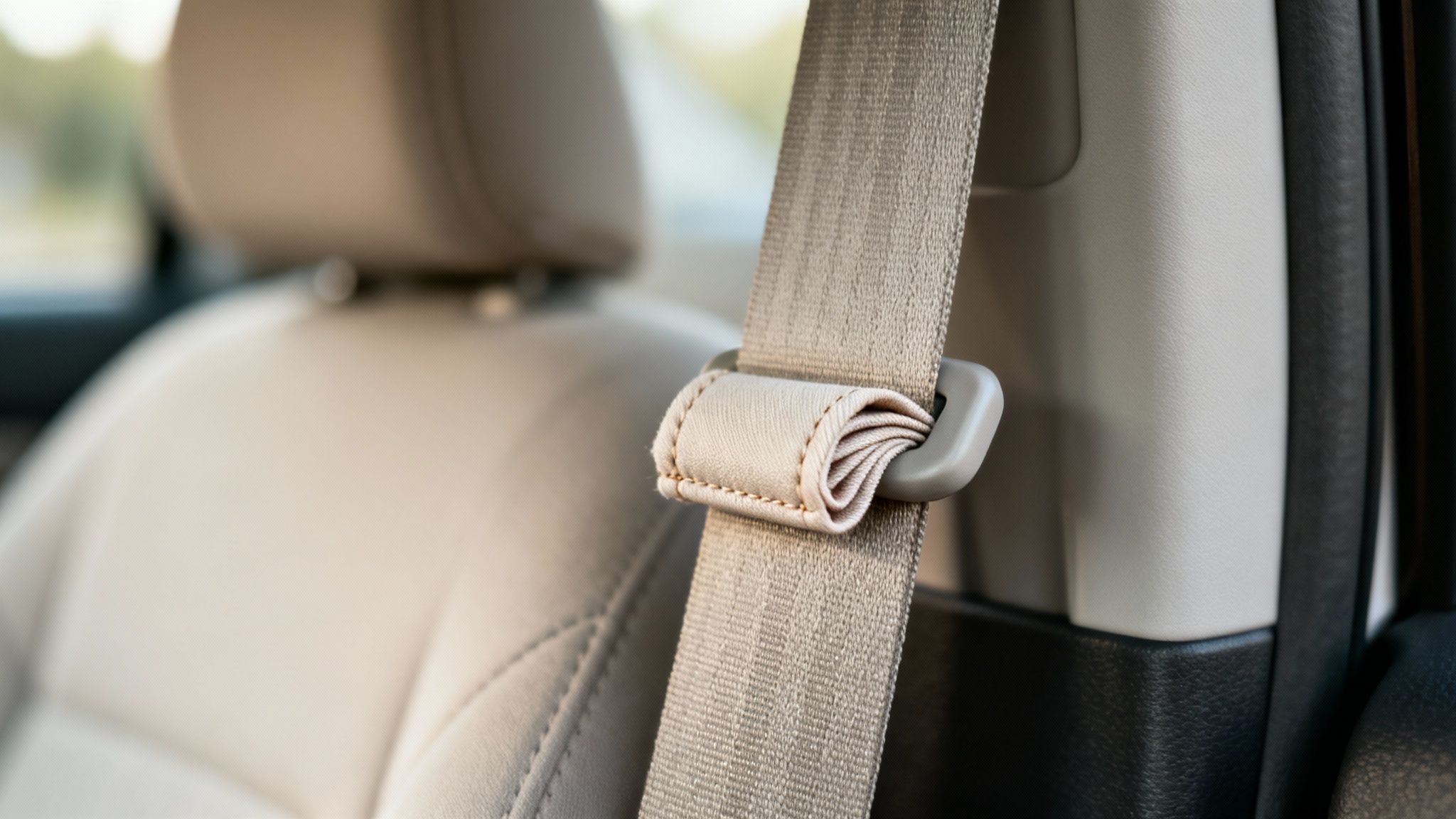
If you're someone who pays attention to detail, you might have spotted a small, folded section on the shoulder part of a seat belt, neatly stitched together. It doesn’t seem to do anything during your daily commute, and that’s exactly the point. This little loop is a clever bit of passive safety tech, mainly from a specific era of car manufacturing.
Think of it as a built-in shock absorber designed for the worst-case scenario. During normal driving, it just sits there, tightly stitched. But in a high-impact collision, the incredible force yanking on the belt is strong enough to rip the special stitching apart.
This controlled tearing is the entire point. By ripping open, the loop releases a few crucial inches of webbing right at the moment of peak force, helping to soften the violent jolt to your chest and torso.
This process is all about managing the immense energy of a crash. By adding just a tiny bit of "give" at the right second, it helps reduce the risk of serious injuries to the ribs and internal organs.
Why Is It There and How Common Is It?
At its core, the extra loop is a load limiter. It’s a simple, mechanical answer to a complicated physics question: how do you slow a person's body down during a sudden stop without causing more harm?
You'd most likely find this feature in cars made during the 1990s and early 2000s. Back then, engineers used these stitched loops as a straightforward way to manage crash forces. It wasn't a feature in every car, but it did appear in a number of vehicles, often on the passenger side. Forensic analysis of accidents, like those detailed on plaintiffmagazine.com, has shed light on how these loops perform in real-world situations.
Is This Loop a Stop Clip?
It’s easy to mix this loop up with other things on the seat belt, but they have very different jobs. For example, that little plastic button that keeps the buckle from sliding all the way down the belt is something else entirely. We cover that in our guide to seat belt stop clips.
The expansion loop, however, is woven right into the belt fabric itself and is solely dedicated to absorbing energy in a crash. It’s a one-time-use safety feature.
The table below provides a quick summary of this unique safety component.
Expansion Loop At a Glance
| Feature | Description | Intended Outcome |
|---|---|---|
| Common Name | Expansion Loop or Load Limiter | Reduce peak forces on the occupant. |
| Appearance | A small, folded, and stitched section of the seat belt webbing. | Soften the initial jolt of a severe impact. |
| Location | Typically on the shoulder portion of the belt. | Minimize chest and torso-related injuries. |
This clever piece of engineering highlights how even the smallest details in vehicle design are focused on keeping you safe.
The Physics of a Crash and How Your Car Manages It
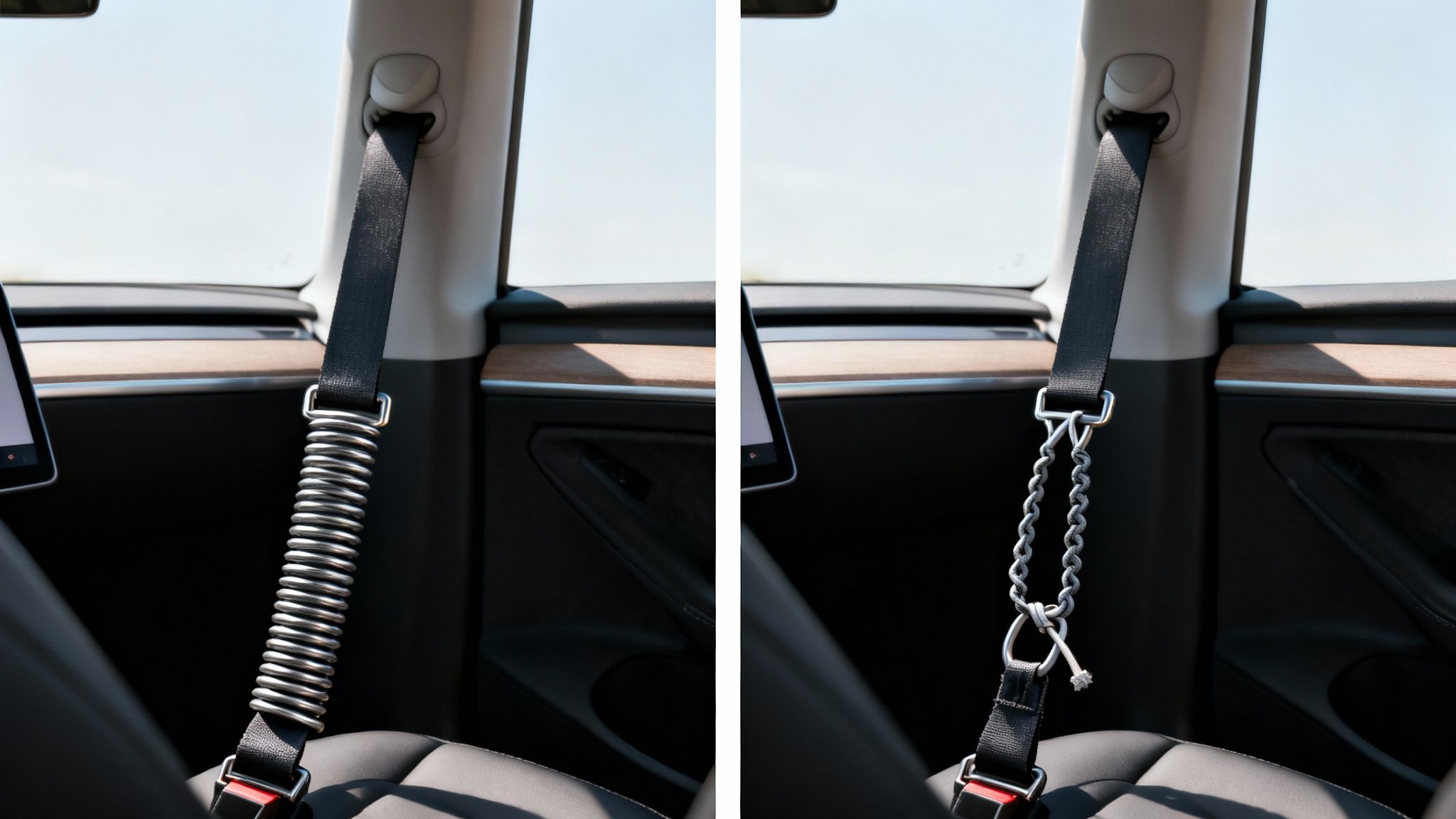 To really understand why that extra loop on seat belt webbing is there, you first have to appreciate the brutal physics of a car crash. The instant an impact happens, the vehicle’s job switches from getting you somewhere to keeping you alive. The number one rule of occupant safety is to slow your body down as gently as possible, a principle engineers call "ride-down."
Your seat belt is what tethers you to the car during this ride-down, managing the incredible forces of deceleration. The problem is that the webbing itself doesn't have much give. In a high-speed crash, a rigid belt could stop you with the same unforgiving jolt as hitting a wall.
That's where the genius of the expansion loop comes in. It introduces a tiny, but life-saving, bit of "give" at the very moment the forces are most violent.
Think of it Like a Bungee Cord
Imagine you're running at top speed and you're tied to a post with a metal chain. When you hit the end of that chain, the stop is going to be painfully abrupt. Now, imagine the same scenario, but instead of a chain, you’re attached to a heavy-duty bungee cord. The cord stretches, soaking up the energy and bringing you to a much smoother, more controlled stop.
The expansion loop is that bungee cord. Its specialized stitching is designed to do something that sounds counterintuitive: it's made to break. Under the extreme load of a crash, those stitches are engineered to rip apart.
This controlled tearing action releases just a few extra inches of webbing, but it makes a world of difference. It stretches out the time and distance over which your body slows down. Even adding a fraction of a second to that process can drastically lower the peak force slamming into your chest, neck, and vital organs.
This is energy management in its purest form. The loop converts some of the crash's raw kinetic energy into the thermal energy needed to tear the stitches, essentially softening the blow your body has to take.
This clever little feature is a crucial part of a much bigger safety system, all working in concert.
Part of an Integrated Safety System
That extra loop isn't acting alone. It's a key player in your vehicle's overall "energy management" game plan. It works alongside other critical components:
- Crumple Zones: The front and rear of your car are built to crush and deform in a crash, absorbing a huge amount of impact energy before it can ever reach you in the passenger compartment.
- Pretensioners: The moment a crash is detected, these devices use a tiny explosive charge to instantly pull the seat belt tight, removing all slack and pinning you firmly and safely against your seat.
- Airbags: These deploy in milliseconds to create a cushion between you and the hard surfaces of the car, like the steering wheel or dashboard.
Each of these parts has a specific job in taming the violent forces of an accident. The expansion loop was an ingenious mechanical solution to fine-tune the system, specifically to handle the final, crushing seat belt tension at the peak of the impact. If you'd like to dive deeper, you can learn more about how seat belt tension works and why it's so vital for your safety. By adding that moment of calculated give, the loop helps the entire system protect you more effectively.
Understanding the Safety Tradeoffs and Debates
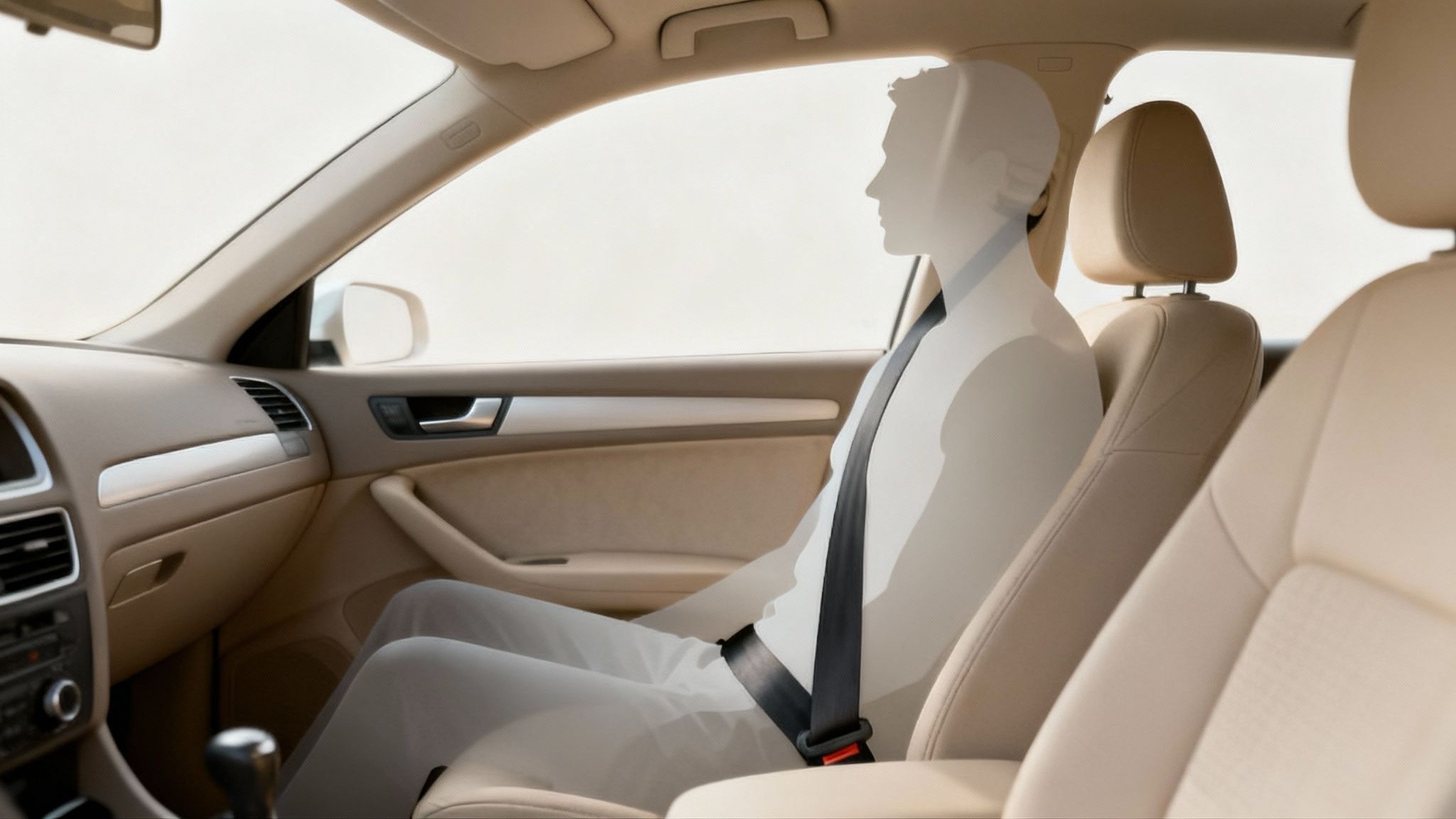
The extra loop on seat belt webbing isn't just a simple design choice; it’s a complex engineering compromise. Automotive safety is a constant balancing act, and this feature is a perfect example of the tough decisions engineers have to make. Its whole purpose is to manage the intense forces of a crash to prevent one specific, and very serious, type of injury.
The idea behind it is pretty clever. When a collision happens, the special stitching in the loop is designed to tear open. This controlled release acts like a built-in shock absorber, softening the peak impact forces on a person's body. It's a mechanical cushion woven directly into the restraint, meant to reduce the severe chest and head injuries that are often life-threatening in frontal crashes.
But there’s a catch. This design introduces a significant downside known as occupant excursion. In plain English, that’s how far your body travels forward before the seat belt catches you and brings you to a stop. When that expansion loop deploys, it adds a few inches of slack to the belt, which means you move forward just a little bit more.
The Problem of Occupant Excursion
In a car crash, inches matter. A lot. Even that small amount of extra forward movement can be the difference between stopping safely and having your knees, shins, or lower body slam into the dashboard or center console.
What engineers did was trade a reduction in force on the upper body for a potential increase in the risk of lower-body impacts. It’s a stark reminder of just how difficult it is to protect the human body from the violent, unpredictable dynamics of a collision.
This engineering choice has made the extra loop on seat belt systems a focal point in forensic crash investigations and even litigation. It underscores the constant debate in safety design: does solving one problem inadvertently create another?
For decades, the standard lap-and-shoulder belt has been the single most effective safety device in our cars. Study after study confirms that wearing a seat belt properly reduces the risk of fatal injuries for front-seat passengers by 45% to 60%. Still, forensic experts have documented specific crashes where a deployed expansion loop led to more severe lower-limb injuries because the webbing got longer. You can read more about the biomechanics of these situations in this detailed research analysis.
Balancing Benefits and Risks
Just because this debate exists doesn't mean the feature was a bad idea. It just reflects the safety philosophy of its time. The design prioritized preventing the most catastrophic, often fatal, thoracic injuries by accepting a calculated risk of less critical—though still serious—lower-body injuries.
This is a key concept in any safety system, including aftermarket products. It's vital to understand the balance between what a device is supposed to do and its potential side effects. For instance, our guide on seat belt extender safety dives into similar principles, covering how proper use is essential to maintaining the integrity of the entire system.
Ultimately, the expansion loop was a stepping stone. It was a mechanical solution to a problem that modern, electronically controlled safety systems now solve with much greater precision.
How to Check Your Vehicle for This Feature
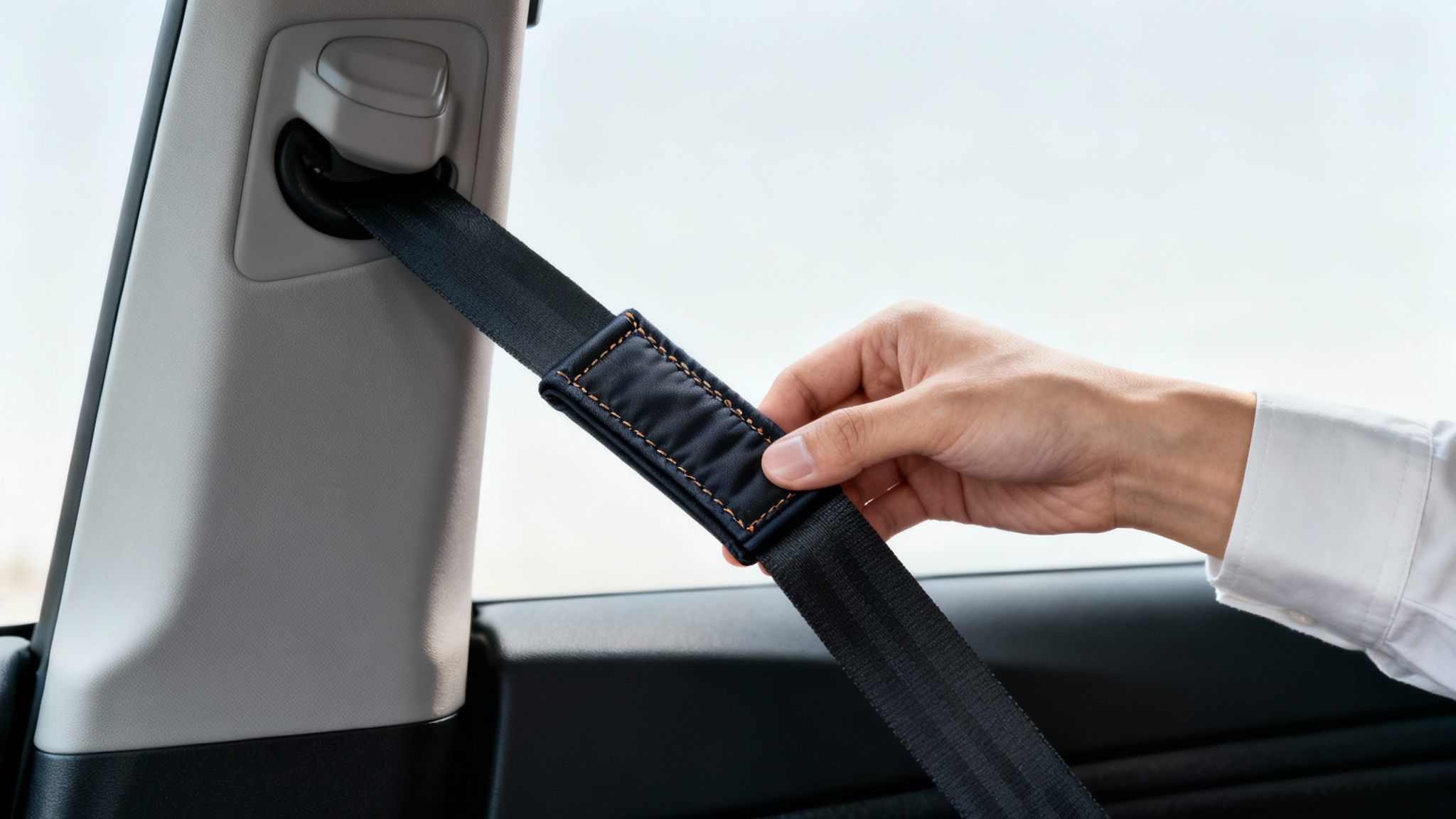
So, is your car equipped with one of these old-school energy absorbers? Finding out if you have an extra loop on your seat belt is easy and only takes a minute. You can do a quick visual check right in your own driveway.
First things first, you'll need to give yourself enough slack to see everything. Pull the shoulder part of the seat belt all the way out from the retractor, just like you would if you were leaning way forward to grab something from the glove box.
Once the belt is fully extended, just run your eyes—and even your fingers—along the entire length of the webbing. What you’re looking for is a small, specific section where the belt material is folded over on itself and sewn down with some really heavy-duty stitching. That's the loop.
Where to Look and What to Check
This little feature can be in a couple of different spots, but most automakers tended to place it in one of two areas. Knowing where to focus your search makes it much easier to spot.
- Near the Top Anchor: Start by looking up near where the belt attaches to the car's frame, right by your shoulder on the vertical pillar between the front and back doors.
- Closer to the Retractor: If it's not up top, the loop might be located much lower down, closer to the spool mechanism that pulls the belt back in at the base of that same pillar.
And here’s a pro tip: don’t just check the driver’s side. For a variety of engineering reasons back in the day, some car makers in the 1990s and early 2000s only installed this feature on the passenger-side seat belt. It’s crucial to inspect both front seat belts to know for sure.
It's important to remember this loop is a crash-specific safety feature, not something designed for everyday comfort or fit. If you're actually looking for a way to make your seat belt fit better, our guide on seat belt adjusters for adults has some great information on that topic.
If you’ve given both belts a thorough look and can't find that distinctive stitched loop, it's very likely your vehicle doesn't have this particular feature. For the final, definitive answer, your car's owner's manual is always the best resource; it will detail all the safety systems specific to your model.
The Evolution of Seat Belt Safety and Design
That extra loop on seat belt webbing is a fascinating little relic from a specific moment in automotive safety history. To really get why it was there, you have to look at how seat belts grew up—from a simple strap to the smart systems we have today. The whole story of keeping people safe in cars is one of constant learning and tweaking, driven by real-world crash data and new technology.
The very first seat belts were just basic two-point lap belts. Their only job was to keep you from flying out of the car in a wreck. A huge step forward at the time, for sure, but they offered zero protection for your upper body. The real game-changer was the modern three-point seat belt, which anchors you at the hips and across your chest, spreading out the brutal forces of a crash much more safely.
From Mechanical Fixes to Smart Systems
As car engineering got more sophisticated, the goal shifted from just holding you in place to actively managing the energy of a collision. This is where features like the expansion loop came in. It was a clever mechanical solution from an era before advanced electronic sensors were commonplace. This stitched loop was a physical, one-time-use feature designed to rip apart and absorb the most intense impact forces.
These mechanical designs were all tested against strict rules, like the Federal Motor Vehicle Safety Standards (FMVSS), which set the bar for how well a car should protect you. But the real world kept providing new data, pushing engineers to do better. There's no denying that the seat belt is the single most effective safety device ever put in a car.
In the U.S. alone, seat belts have saved hundreds of thousands of lives since the 1960s. But on the flip side, some crash reports have pointed to these expansion loops as a point of failure, suggesting they can sometimes make injuries worse by letting a person move too far forward.
How We Handle Occupant Safety Today
Modern cars have moved far beyond a simple stitched loop. Today’s vehicles use a whole suite of technologies working together to keep you safe:
- Advanced Load Limiters: Instead of a loop that tears, modern belts have special mechanisms built right into the retractor that spool out webbing in a controlled way.
- Dual-Stage Pretensioners: These gizmos instantly tighten the belt at the first sign of a crash and can even adjust how much they tighten based on how bad the impact is.
- Smart Airbags: Airbags aren't just one-size-fits-all anymore. They can deploy with different levels of force depending on the crash intensity and even the size and weight of the person in the seat.
This constant push for better safety isn't just for cars. The basic idea of keeping people safely restrained is just as critical on airplanes, even though the designs are quite different. You can dive deeper into the specifics of how plane seat belts are designed and what makes them unique.
And of course, keeping everyone safe goes beyond just the adults in the front seats. Understanding the rules and technology behind child safety is crucial for any caregiver. Resources like a guide on Texas Car Seat Laws show just how detailed these regulations can be. It all points to a deep commitment to protecting every single passenger, no matter their age or size.
Questions People Often Ask About Seat Belt Loops
Once you understand the history behind that extra loop on seat belt webbing, a few practical questions usually pop up. It was a clever piece of engineering for its time, but let's face it, it can look a little strange. Let's clear up some of the most common curiosities and concerns.
Is This Loop on My Seat Belt Some Kind of Defect?
Nope, that expansion loop isn't a defect or a sign that your seat belt is broken. It was a completely intentional design feature used by certain car manufacturers, especially in vehicles from the 1990s and early 2000s. Think of it as a mechanical load limiter.
It was engineered to rip open, but only during a very severe collision. By tearing, it was designed to absorb some of the most extreme crash forces, providing a specific kind of protection. While modern safety systems have evolved, this loop was a deliberate part of the car's original safety equipment.
Should I Just Cut the Extra Loop Off?
Absolutely not. You should never, ever cut, modify, or tamper with any part of your seat belt system. That expansion loop is structurally woven into the belt's webbing and is critical to its performance in a crash.
Attempting to remove it could seriously compromise the entire restraint system, leading to a catastrophic failure right when you need it most. If you have any concerns about its condition, the only safe move is to have it inspected by a certified automotive technician.
Messing with your car's safety equipment not only puts you in danger but can also land you in hot water legally and with your insurance company.
Do New Cars Still Have This Type of Loop?
You'll almost never see this specific stitched-loop design in modern vehicles. Automotive safety has come a long, long way since this feature was common.
Today's cars use much more sophisticated and responsive safety systems that give engineers far more control. These include things like:
- Electronically Controlled Load Limiters: These are built right into the retractor mechanism and can adjust the belt's tension based on real-time crash data.
- Multi-Stage Airbags: These can inflate with different levels of force depending on the crash severity and even the occupant's size.
- Advanced Pretensioners: These use tiny pyrotechnic charges to instantly pull slack out of the belt, securing you in your seat milliseconds before the full impact.
These newer technologies offer a much more dynamic and fine-tuned approach to keeping you safe than the simple mechanical loop ever could.
Does Having This Loop Make My Car Unsafe?
Not at all. The presence of an expansion loop just means your car is equipped with the safety technology of its era. Any car that rolled off the assembly line with this feature met or exceeded all government safety standards at the time it was sold.
It was an engineering trade-off—designed to reduce the risk of certain chest and shoulder injuries, even if it meant a slightly different interaction with the dashboard. Ultimately, the single most important factor for your safety hasn't changed, no matter how old your car is: always wear your seat belt correctly every single time you're in the vehicle. The whole system was designed to work together, and it can only protect you if you use it properly.
At Seat Belt Extenders, we believe everyone deserves to be safe and comfortable in their vehicle. If you need a bit of extra length for a proper fit, our E-4/E-8 certified extenders provide a secure, reliable solution. Find your perfect match today at https://seatbeltextenders.com.