
That familiar click of the airplane seat belt is more than just a sound—it's the culmination of decades of safety engineering and strict regulations. It’s a simple action, but it’s hands-down the most important thing you can do to stay safe on a flight, especially during takeoff, landing, and unexpected turbulence.
Why Your Seat Belt Is a Lifesaving Tool
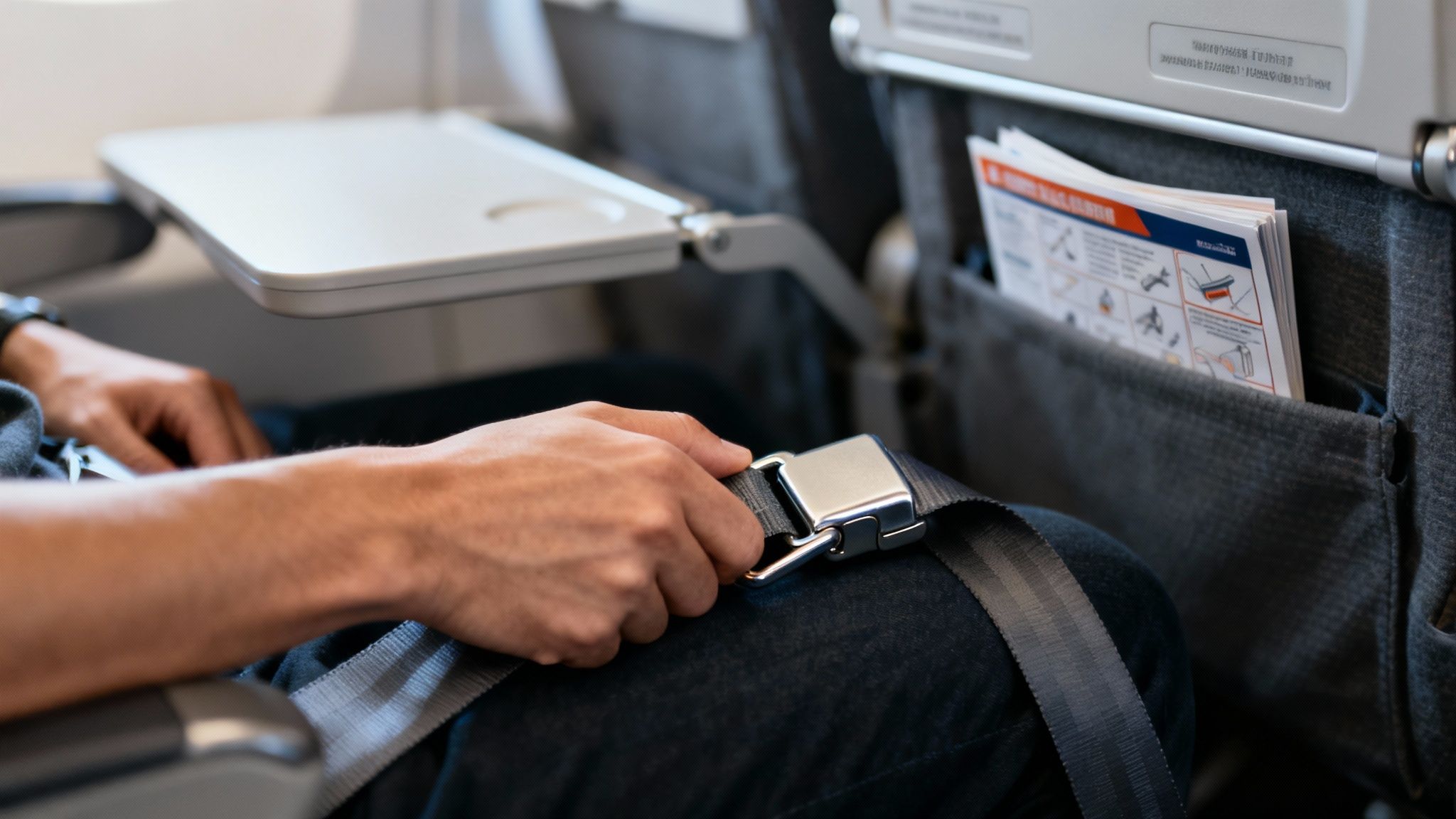
It’s easy to think of your seat belt as just another rule to follow, but it's really your personal anchor when you’re cruising at 35,000 feet. These belts are engineered to handle incredible forces, keeping you secure in your seat during sudden stops or the jarring jolts of rough air. Without it, a person can become a projectile, which is a serious risk to everyone on board.
This guide goes way beyond the basic "buckle up" instruction. We're going to dive into how these devices are actually designed, look at the history that led to today's strict aviation rules, and share some practical advice for every kind of traveler. The goal is to help you understand the science and regulations behind that click, making you a more confident and informed passenger.
Understanding the Full Picture
To really feel secure, it helps to understand the whole picture of in-flight safety. That means knowing not just how the belt works, but why there are policies for things like seat belt extenders and why you’re told to stay buckled in even when the seat belt sign is off.
Let's take a quick look at what this guide will cover to give you a clearer idea of the journey ahead.
Key Aspects of Plane Seat Belt Safety at a Glance
| Topic | What You Will Learn | Why It Matters |
|---|---|---|
| Engineering and Physics | We'll break down how a simple lap belt distributes immense force across the strongest parts of your body—your pelvis. | Understanding the science shows you it's not just a strap; it's a precisely designed safety device. |
| Regulations and History | Discover the key events in aviation history that made seat belts a non-negotiable part of flying. | Knowing the "why" behind the rules makes them easier to appreciate and follow. |
| Practical Passenger Tips | Learn about airline policies, including the typical airline seat belt size and how to properly use extenders. | This ensures every passenger can have a comfortable, secure, and dignified flight experience. |
By getting familiar with these topics, you'll be better prepared for any flight.
Just like a seat belt provides physical protection, planning for other aspects of your trip offers a different kind of security. Understanding the importance of safety for your journey can add another layer of protection against the unexpected. By the time you finish this guide, you’ll see that simple click not just as a routine, but as a deliberate act of personal safety.
How Plane Seat Belts Keep You Safe During Turbulence
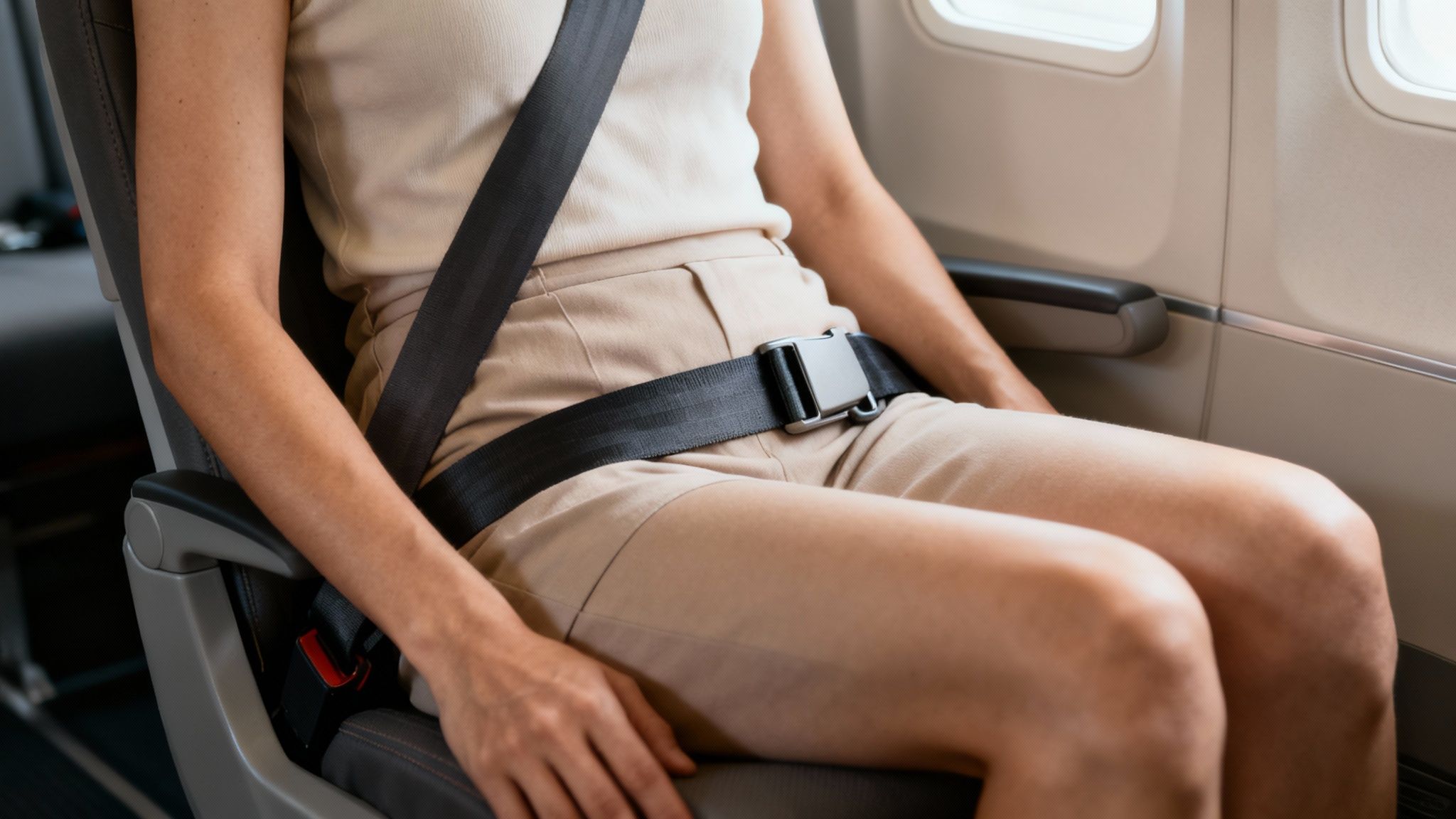
When your flight hits a patch of turbulence, things can feel a bit chaotic. But the simple device keeping you safe is a masterclass in physics. Think of it like a car suddenly hitting the brakes. Your body’s inertia wants to keep moving forward, but the seat belt holds you back, anchoring you firmly in place.
An airplane seat belt works on the same principle, but it's engineered to handle the vertical and lateral jolts of turbulence, not just forward motion. It strategically distributes those abrupt forces across the strongest part of your skeleton: your pelvis.
This bony structure is incredibly resilient. By locking you in at the hips, the belt stops you from being thrown upward into the ceiling or sideways into the aisle during a sudden drop or jolt. It's an elegant and incredibly effective solution.
The Anatomy of a Plane Seat Belt
Every piece of a plane seat belt is designed for one thing: absolute reliability. The system is refreshingly simple, with just two core components that work together flawlessly to keep you secure.
- High-Tensile Webbing: The belt strap isn't just fabric; it's a weave of durable polyester fibers designed to resist stretching and tearing under thousands of pounds of force. It absolutely will not fail.
- The Lift-Lever Buckle: The classic metal buckle is built for a secure lock that won't pop open under impact. The lift-lever is simple enough for anyone to release quickly, but it stays firmly latched when you need it most.
The materials are chosen for their sheer strength and performance under pressure. The whole system's effectiveness also depends on having the right amount of seat belt tension, which is why a snug fit is so important.
The core idea is simple: the belt has to be stronger than any force it could possibly encounter. That way, even in severe turbulence, your restraint system is an unwavering line of defense.
Engineered to Withstand Incredible Force
The immense strength of modern airplane seat belts is the result of decades of intense research and testing. It all started with foundational studies by the US Air Force back in 1947, which revealed that a properly restrained human body could handle up to 4,870 pounds of force without serious injury. This discovery kickstarted the push for much stronger belts and more secure buckles.
Later research confirmed just how vital these devices are. Studies have shown that lap belts cut the risk of major or fatal injury by around 60 percent—a statistic that proves their non-negotiable role in aviation safety. These are the kinds of findings that have shaped the stringent standards every single seat belt on a commercial plane must meet today. You can read more about these crucial safety findings from the FAA.
The History Behind Modern Seat Belt Rules
The seat belt rules we follow today didn't just appear out of nowhere. They’re the product of decades of hard-won lessons, tragic accidents, and scientific breakthroughs that have continuously shaped aviation safety. What was once an optional strap for daredevil pilots has become the single most important safety device for every single person on board.
This story starts way back, long before commercial jets crisscrossed the globe. In the early days of flight, restraints were basic, often little more than a simple leather strap. It was an era of trial and error, where safety rules were often written in response to accidents that exposed just how much we still had to learn.
The real turning point came as commercial flying started to take off. Airlines and regulators began pouring over accident data, searching for ways to save lives. One pattern became impossible to ignore: passengers who were secured in their seats during an incident had a dramatically higher chance of survival.
From Optional to Mandatory
Making seat belts a non-negotiable part of flying was a gradual process, but it was driven by solid proof. The journey from suggestion to rule is one of the biggest safety success stories in aviation history. It officially began with the US Air Commerce Act in 1926, but it wasn't until 1971 that the Federal Aviation Agency (FAA) made it mandatory for all passengers to buckle up for takeoff and landing.
Why then? Because the data was undeniable. Research at the time showed that a simple lap belt could cut the risk of serious or fatal injury by nearly 60%. That gave regulators the concrete evidence they needed to make the rule stick. You can dive deeper into the evolution of aviation seat belt rules on Aviospace.org.
This long road to today's regulations really underscores a key principle in aviation: safety rules are almost always reactive. They are constantly being updated based on real-world events and a relentless commitment to making flying safer.
Every time a flight attendant asks you to buckle up, you're hearing the echo of decades of safety history. It’s not just a polite request—it’s a life-saving lesson learned the hard way.
Understanding the Modern Context
This history has a direct impact on the rules we follow on a flight today, especially when it comes to personal equipment. Just as strict regulations were developed for the belts themselves, policies were put in place for anything related to them. This helps explain why you can't just bring your own seat belt extender on a plane, for instance. The rules are in place for a reason, and you can learn more about this in our guide on whether seat belt extenders are legal for personal use.
So, when the flight crew is insistent about those belts during takeoff, landing, or turbulence, they are honoring this legacy. The simple act of clicking your seat belt into place isn't just a routine task—it’s a nod to the decades of work that have made modern air travel so incredibly safe.
Using a Seat Belt Extender Safely and Discreetly
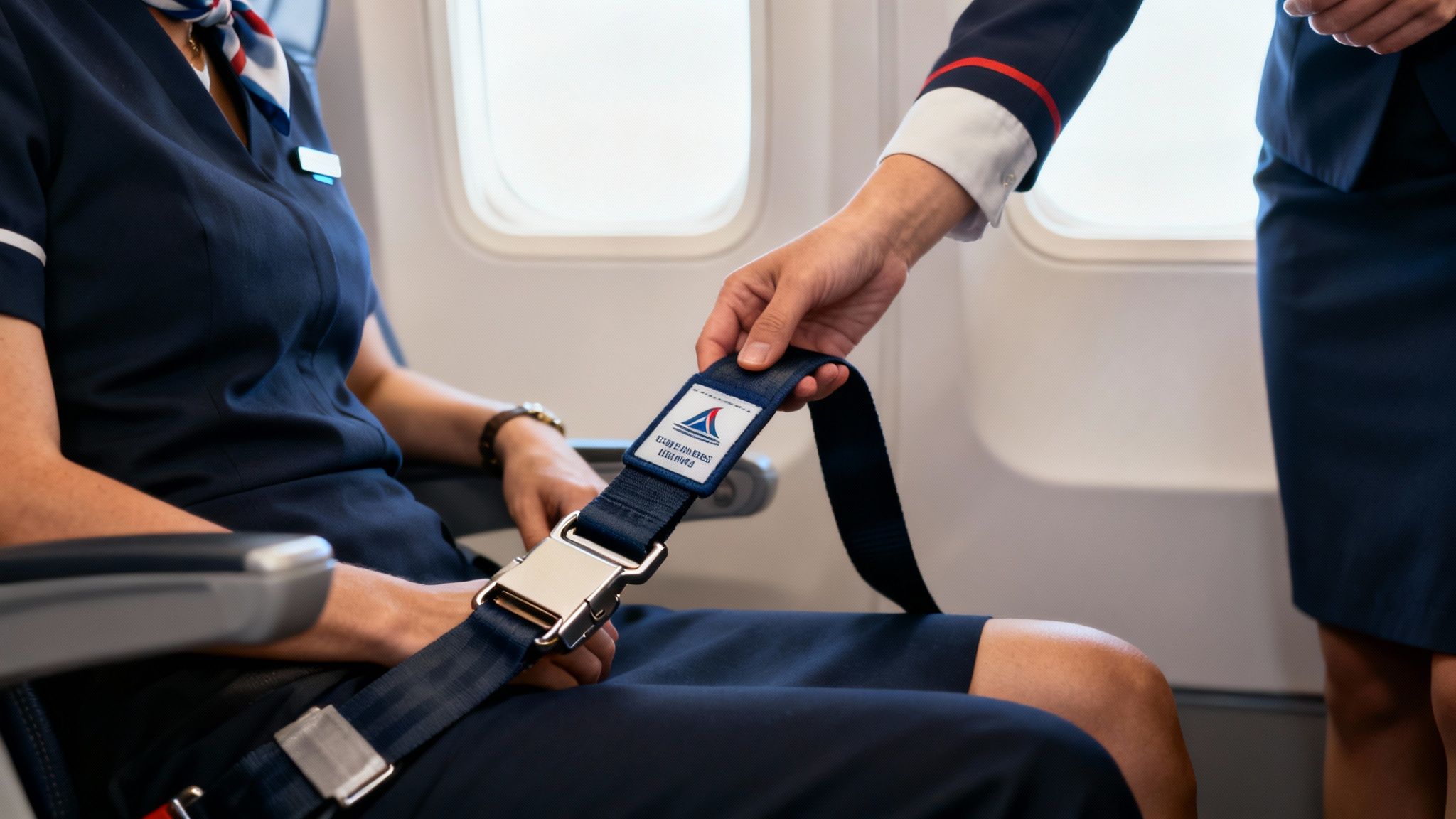
Needing a little extra length for your seat belt on a plane is far more common than you might think. Airlines are completely prepared for this, and it's important to remember that asking for an extender isn't a special request—it's just a standard piece of safety equipment, no different than the life vest under your seat.
The whole process is simple and can be handled very discreetly. The best time to ask is during boarding, as you're settling in. Just catch the eye of a flight attendant and quietly say, "Could I please have a seat belt extender?" They'll bring one right to you, no fuss involved.
Handling it this way gets you situated comfortably and safely from the get-go, avoiding any scramble when the crew is busy preparing for takeoff.
Why You Must Use the Airline's Extender
So, why can't you just bring your own extender from home? The answer boils down to one word: certification. That extender you bought online might look exactly the same, but it hasn't passed the rigorous safety and compatibility tests required by the FAA.
Every single extender on an aircraft is specifically tested and approved to work perfectly with the seat belt mechanisms on that plane. Using your own is more than a safety gamble; it's a direct violation of federal aviation regulations.
Think of it this way: your personal extender might be a key that looks right, but only the airline's key is guaranteed to fit the lock and hold tight under the immense pressure of an emergency. When you're cruising at 30,000 feet, there's absolutely no margin for error.
What “Certified” Really Means
The FAA certification process is incredibly thorough. Airline-provided extenders must meet what are known as technical standard orders (TSOs), which are strict rules governing everything from the materials and construction to the latching mechanism itself. This is how they ensure the equipment can handle the massive forces of an emergency landing or severe turbulence.
Here’s a glimpse of what that certification guarantees:
- Material Integrity: The webbing and all metal parts have been tested to meet incredibly high standards for strength and durability.
- Buckle Compatibility: The extender is confirmed to create a secure, reliable lock with the specific seat belts on that aircraft.
- Regular Inspections: The airline’s equipment is constantly checked for wear and tear, making sure every piece is in perfect working order for every flight.
Because there are various seat belt extender types, only the airline crew can give you the correct, certified one for your particular seat. By simply asking them, you’re not just following the rules—you’re making the only choice that ensures your safety restraint system is 100% compliant and ready to protect you.
How Passenger Habits Shaped Today's Safety Culture

The incredible safety record of modern air travel isn't just a testament to brilliant engineering; it's also a story about people. The simple act of fastening your seat belt, something most of us do without a second thought, is the bedrock of a shared safety culture built over decades. It’s an unspoken agreement between passengers and crew that keeping everyone safe is a team effort.
Believe it or not, it wasn't always this way. When the first mandatory plane seat belt rules came out, getting people to actually follow them was a huge hurdle. It took years of public awareness campaigns, persistent instructions from flight crews, and a growing public understanding of risks like turbulence to change habits.
Now, buckling up is an instinct. We do it because we understand that unexpected things can, and do, happen up there.
The Shift from Rule to Habit
The journey from begrudging rule-following to automatic habit is one of the biggest success stories in aviation safety. Think about how much has changed since mandatory seat belt use was introduced in the 1970s. When the FAA first required them for takeoff and landing back in 1971, compliance was spotty at best.
But as the real-world benefits became undeniable, attitudes started to change. By 2010, overall seat belt use had jumped to 85 percent. That's a massive shift in behavior, and it’s had a direct, life-saving impact. By 2016, it's estimated that seat belts had saved roughly 15,000 lives. You can get more details on the evolution of seat belt rules on Simple Flying.
This change didn't just happen on its own. It was the direct result of consistent, clear messaging about why this simple click matters so much.
The modern safety culture is built on the idea that every passenger is an active participant. Fastening your seat belt is more than just following an instruction—it's your personal contribution to a safer flight for everyone.
How Collective Behavior Enhances Safety
This widespread habit of buckling up has a powerful ripple effect, and it's directly linked to a dramatic reduction in in-flight injuries. When everyone is secured, the cabin is simply a safer place to be, especially when the plane hits an unexpected patch of rough air.
Here’s how it works:
- Minimizing Cabin Hazards: An unbuckled passenger can essentially become a projectile during severe turbulence, posing a massive risk to themselves and everyone around them. When everyone is buckled, that danger is eliminated.
- Enabling Crew Focus: Flight attendants are there for your safety. When they don't have to spend their time policing seat belts, they can focus on their other critical duties.
- Creating a Norm: It’s human nature. When you see everyone around you buckling up, it reinforces the behavior and makes it a powerful social standard.
This collective habit proves that safety isn't just about the plane's hardware. A huge part of it is about the mindset of the people on board.
Common Questions About Plane Seat Belts Answered
Even when you know the basics of how plane seat belts work, certain situations always seem to bring up new questions. Here, we’ll tackle some of the most common things travelers wonder about, giving you clear, straightforward answers so you can fly with total confidence.
Whether you're curious about the fancy seats up front or how to travel safely with kids, every scenario has its own set of rules. Let’s get into it.
Are Seat Belts in First or Business Class Different?
Yes, they often are. The seat belts you’ll find in premium cabins can be quite different from the standard ones back in economy. While a regular economy seat has that familiar two-point lap belt, the unique designs of first or business class seats often demand extra safety measures to meet FAA standards.
For instance, if you're in a lie-flat bed or a private suite, you'll likely find a three-point belt with a shoulder harness, much like the one in your car. This is because the seat's design and its ability to go completely flat mean you need more upper-body restraint during critical moments like takeoff and landing.
Some of the most modern premium seats even have tiny airbags built right into the seat belt strap itself, adding another layer of protection. All these systems are engineered to provide safety that's equal to, or even better than, the standard lap belt in a traditional upright seat.
What Are the Seat Belt Rules for Children and Infants?
When you’re flying with little ones, the FAA is crystal clear: the safest spot for a child on a plane is in their own seat, properly buckled into an approved child restraint system (CRS). This is usually a car seat that has a label saying it's "certified for use in motor vehicles and aircraft."
Airlines do allow children under two to fly as "lap infants" for a reduced fare (or sometimes for free), but this is not the safest way to travel. During sudden and severe turbulence, an adult's arms simply aren't strong enough to hold a child securely. It’s a frightening thought, but an important one.
You should also be aware of something called an "infant loop belt," which you might see on some international airlines. It’s a small belt that clips onto the adult’s belt and goes around the baby. These devices are not approved for use on any US-based airline because of major safety concerns.
Why Should I Keep My Seat Belt on If the Sign Is Off?
Think of it as your best defense against the most common cause of in-flight injuries: clear-air turbulence (CAT). Keeping your seat belt fastened whenever you're seated is the single most effective thing you can do to protect yourself.
This type of turbulence is especially sneaky because it’s invisible to weather radar. It can strike without any warning, even in perfectly clear, smooth skies. The "fasten seat belt" sign is usually for predictable events, like flying through a known weather system or during takeoff and landing. CAT, however, is completely unpredictable.
The overwhelming majority of non-fatal injuries on commercial flights happen because passengers and crew weren't buckled in during unexpected turbulence. A loosely fastened belt is all it takes to keep you from being thrown around the cabin and preventing a serious injury.
Can I Bring My Own Seat Belt Extender on a Plane?
The answer to this one is a firm no. You should never, ever use a personal seat belt extender on an airplane. It might seem like a convenient solution, but it’s a violation of federal aviation regulations and creates a serious safety risk for you and everyone around you.
The extenders provided by the airline are considered critical pieces of aircraft safety equipment. They have been rigorously tested and certified by the FAA to work perfectly with the specific buckles on that plane. An extender you buy online hasn't gone through that same intense certification and could easily fail under the incredible forces of an emergency.
To learn more, read our detailed guide explaining why you need FAA-approved seat belt extenders provided by the airline.
If you need an extender, just ask a flight attendant as you're boarding. They are happy to discreetly give you the correct, certified device for your seat, making sure your entire restraint system is 100% safe and compliant.
At Seat Belt Extenders, we are dedicated to ensuring every journey you take is safe and comfortable. While our extenders are designed for vehicles, we believe in promoting safety everywhere, including in the air. For your automotive needs, find your perfect, safety-certified extender at https://seatbeltextenders.com.