
The length of a standard airplane seat belt can feel like a roll of the dice. Will it fit? Won't it? That bit of uncertainty is a real source of anxiety for a lot of travelers.
The truth is, there's no single, standardized length across the airline industry. Most belts fall somewhere in the 39 to 47-inch range, but that's a pretty wide gap. This means the belt on your flight to Chicago might fit just fine, while the one on your connection to Denver is a completely different story.
So, How Long Are Airplane Seat Belts, Really?
Unlike cars, where seat belt lengths are fairly predictable, airplanes are a different beast entirely. The lack of a universal standard means the belt you get can change dramatically based on the airline, the specific aircraft model, and even how old the plane is. It’s not just a minor inconvenience; for millions of people, it’s a genuine comfort and safety issue.
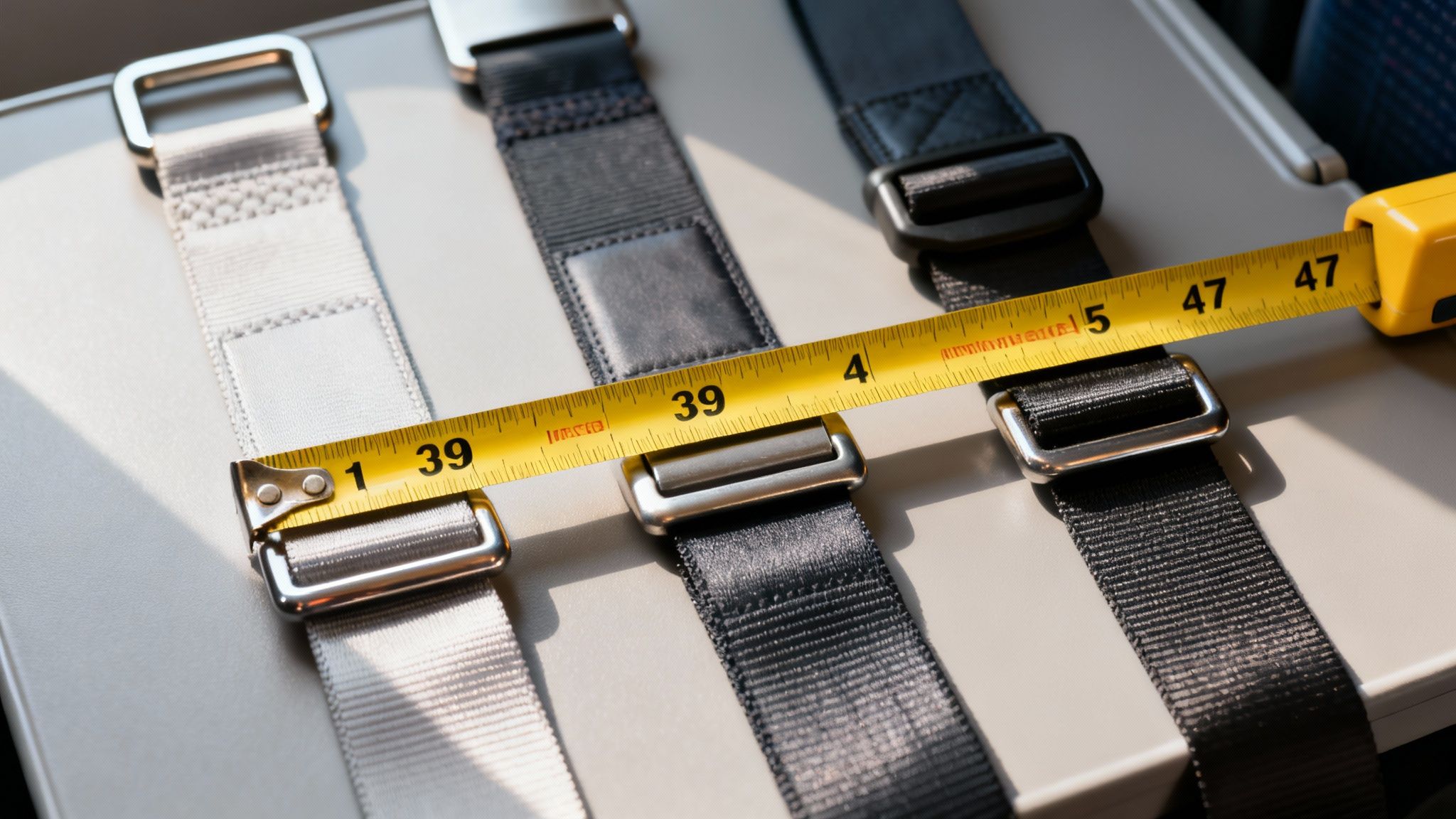
Let's look at what this means in the real world. The numbers show a surprising amount of variation between major carriers. American Airlines, for instance, tends to be on the longer side, with belts typically measuring 45 to 47 inches. On the other hand, you might find a shorter belt on a United flight, where they often come in at around 39 to 43 inches.
Interestingly, these lengths haven't changed much over the years, even as the average size of passengers has. If you want to dive deeper into the specifics, you can check out more detailed airline seat belt size comparisons to see how different airlines compare.
Average Seat Belt Length by Major U.S. Airline
Here's a quick reference guide comparing the typical seat belt lengths you'll find in economy class on some of the biggest U.S. airlines. Just remember, these are averages—the actual length can still vary from plane to plane, even within the same airline's fleet.
| Airline | Average Seat Belt Length (Inches) |
|---|---|
| American Airlines | 45-47 inches |
| Delta Air Lines | 40-45 inches |
| United Airlines | 39-43 inches |
| Southwest Airlines | 42-45 inches |
As you can see, the "one-size-fits-all" approach just doesn't work when it comes to flying. Just a few inches can be the difference between a secure, comfortable flight and a stressful, undignified struggle. Knowing about this variability is the first step in making sure you're prepared.
Why Seat Belt Lengths Are So Inconsistent
Ever boarded a plane, settled into your seat, and found the belt is way shorter or longer than the one on your last flight? You're not imagining it. This frustrating inconsistency is a real problem, and it’s caused by a mix of outdated regulations, different aircraft models, and the specific choices each airline makes.
The result is a confusing and often stressful experience for travelers, because there's simply no universal standard for how long a seat belt should be.
At the heart of the issue are safety standards that were written decades ago. The original guidelines were based on passenger sizes from the mid-20th century and, frankly, haven't kept up with the times. While regulators like the Federal Aviation Administration (FAA) and the European Union Aviation Safety Agency (EASA) have strict rules for safety performance, they don't actually tell airlines how long the belts need to be.
Outdated Standards and Modern Realities
This regulatory loophole leaves the final decision on belt length up to the airlines and aircraft manufacturers, which is why we see so much variation. A big part of the problem is that the data used to set these standards is ancient. For instance, FAA guidelines from 1994 recommended a 17.7-inch seat width for flight attendants, a measurement that became a sort of informal benchmark for economy cabins.
Meanwhile, research shows that average passenger hip widths have grown by roughly 3% per decade since the late 1960s. That gap between old standards and modern bodies is a huge reason why airplane seat belts feel so unpredictable. For a deeper dive, the EASA’s detailed report on seat belt research has some fascinating insights.
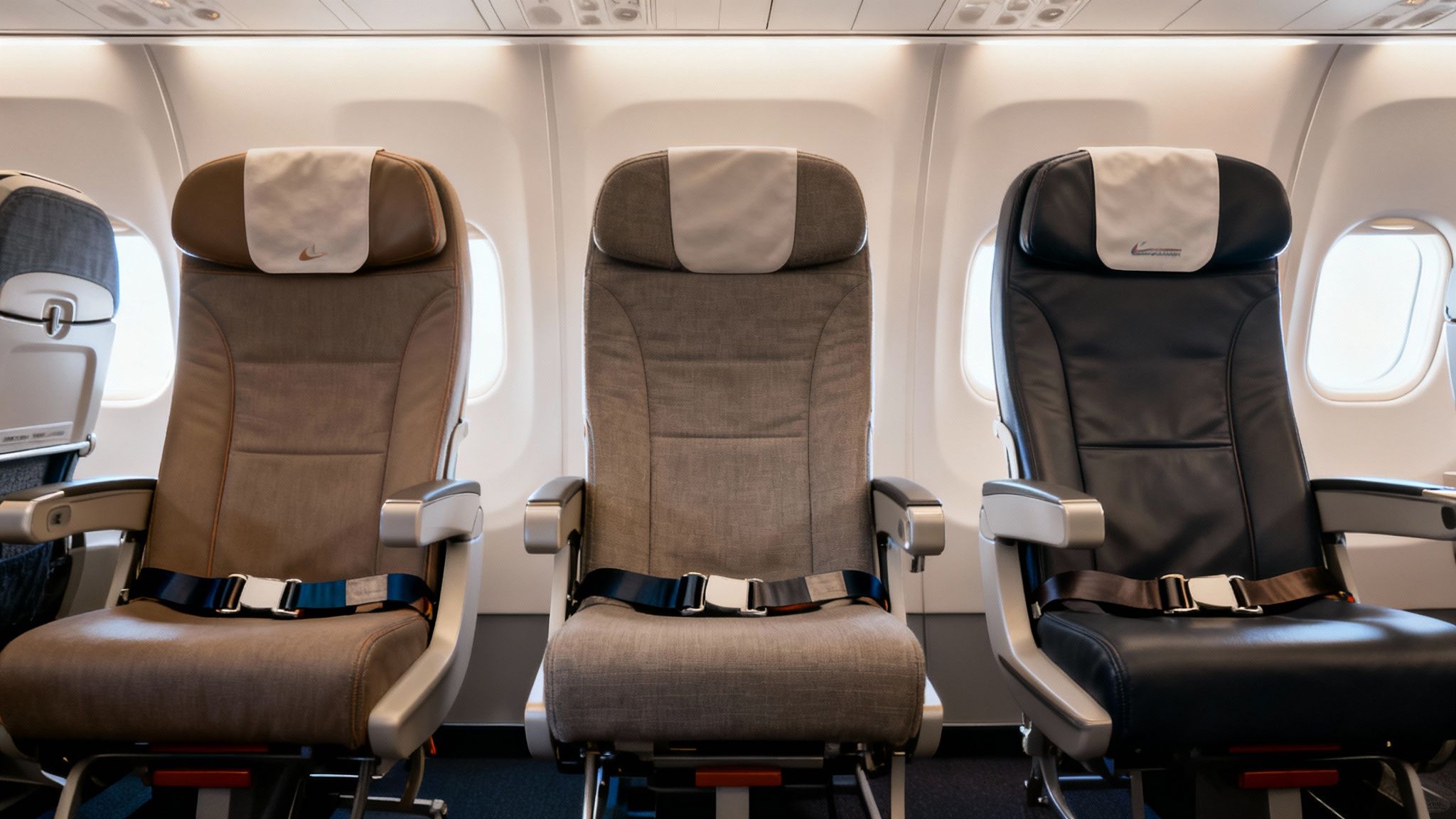
An older Boeing 737 might still have the shorter belts it was built with, while a brand-new Airbus A350 is more likely to have a slightly longer, more modern design.
The inconsistency you experience is systemic. It's not about a single airline's policy but a decades-long failure of aviation standards to keep pace with the people they are meant to protect.
How Aircraft and Airlines Create Variation
It’s not just one thing—several factors are at play, creating that unpredictable seat belt experience every time you fly. Each one adds another layer to the problem.
- Aircraft Model and Age: A Boeing 737, an Airbus A320, and an Embraer E175 are all built differently. Older planes, in particular, were often fitted with shorter belts that reflected the standards of their time.
- Airline Customization: When an airline orders new planes, they can customize all sorts of features, including seat belt length. Some might choose a slightly longer belt for passenger comfort, while others just go with the manufacturer's default option.
- Maintenance and Replacement: Seat belts get replaced due to wear and tear, not on a fixed schedule. This means a belt replaced last year could be a different length than one that's a decade old, even in the same row. Things like proper seat belt tension affect their performance and lifespan, too.
- Class of Service: It’s no surprise that first and business class seats are different. They often come with unique seat belt designs, including longer belts or even shoulder harnesses you won't find back in economy.
When you add it all up, this combination of factors pretty much guarantees that no two flights will be exactly the same. That’s why it’s so important for travelers to be prepared for anything.
Understanding Seat Belt Safety and Certification
When you're cruising at 30,000 feet, that simple strap and buckle keeping you in your seat is a highly engineered piece of safety equipment. Every single component, from the belt itself to any extender you might use, has to pass incredibly strict standards to perform when it counts. Knowing a bit about these certifications is the key to making sure your safety is never in question.
It’s no small industry, either. The market for commercial aircraft seat belts is currently valued at a staggering $2.17 billion. That number is climbing fast, driven by more people flying and even tougher safety rules worldwide. This just underscores how seriously the aviation industry takes passenger protection. You can get more details on the commercial aircraft seat belt market on marketresearchfuture.com.
What Are E-4 and E-8 Certifications
You might come across terms like "E-4" or "E-8" on aviation equipment, but what do they really mean? These aren't just random codes; they're internationally recognized safety ratings that prove a product has been through the wringer in testing.
- E-4 Certification: Think of this as a European safety standard, originally for motor vehicles. It sets a strong baseline for performance and is often a starting point for other transportation safety gear.
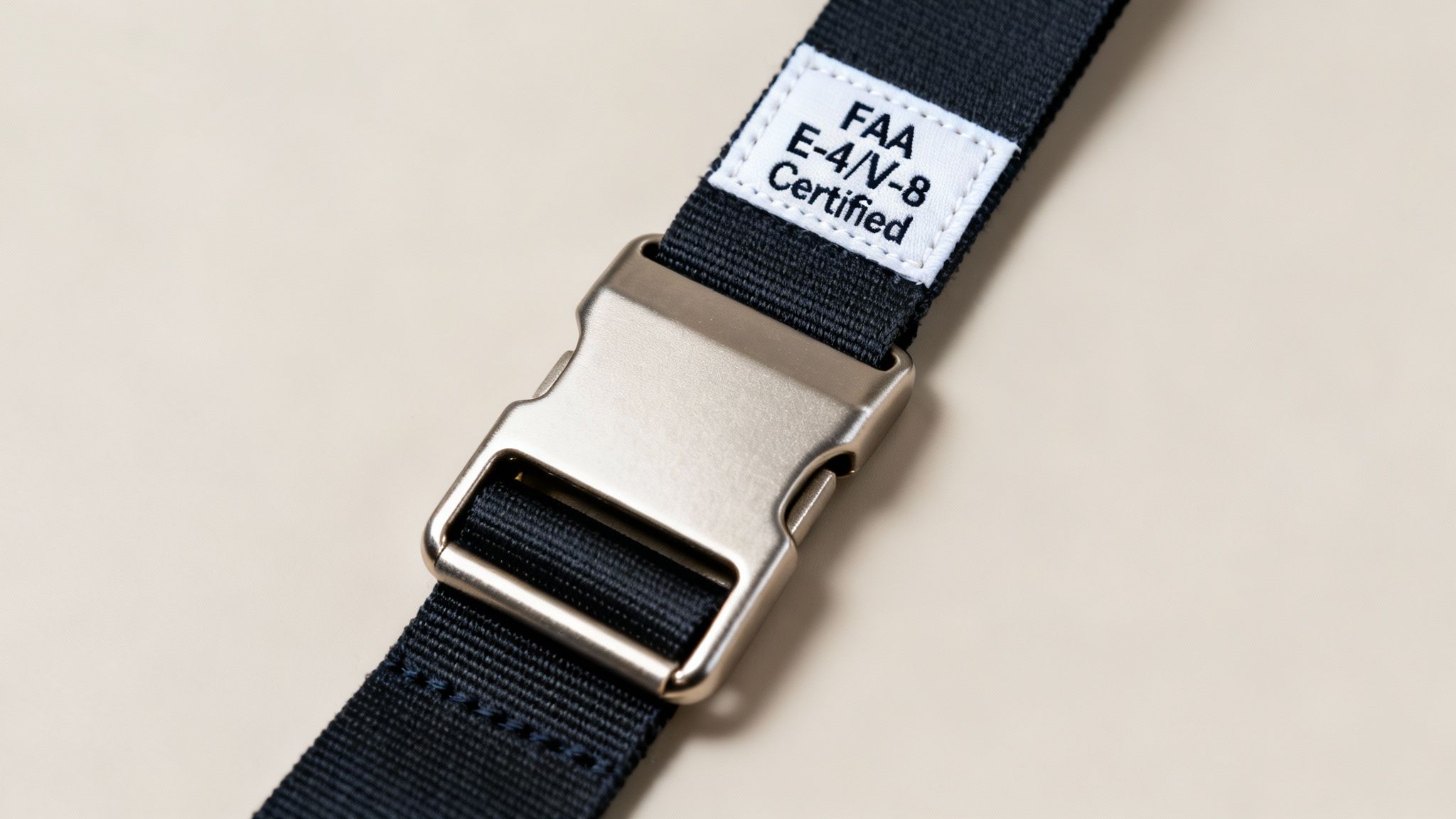
- E-8 Certification: This is the one that really matters for flying. It’s a standard specifically for aircraft restraints. If a product has this marking, it’s been tested to handle the extreme forces you’d encounter in severe turbulence or an emergency landing.
When you use an extender with these certifications, you know it was built and tested to the same high-stakes standards as the belt that came with your airplane seat. It’s your guarantee that the equipment won't fail when you need it most.
Using an uncertified extender is like trusting a lock without a key—it might look the part, but it offers no real security. The risks are simply too high when your safety is on the line.
The Dangers of Uncertified Extenders
A quick online search will turn up tons of cheap, uncertified seat belt extenders claiming to be "universal" or "airline-approved." Be warned: these products are a massive safety risk. They're typically made with cheap materials and have never been tested to withstand the forces of a real emergency.
Imagine hitting severe turbulence. A counterfeit extender could snap, break, or just unlatch without warning. The very device meant to protect you could fail under pressure, leading to serious injury. It's a gamble no traveler should ever take. Our guide on whether seat belt extenders are legal digs deeper into this critical topic.
The bottom line? Always look for official tags and labels from recognized authorities like the FAA or EASA. A legitimate, certified extender will be clearly marked, giving you peace of mind that it’s designed for your protection. Anything less is a dangerous shortcut.
How to Get the Extra Seat Belt Length You Need
So, you know that airplane seat belt lengths can be a total crapshoot. That’s the first step. The next is having a solid plan so you're never caught off guard. Thankfully, you have a couple of straightforward options to make sure you can always buckle up safely and comfortably.
It really boils down to two choices: you can either ask the airline for a seat belt extender or bring your own certified one.
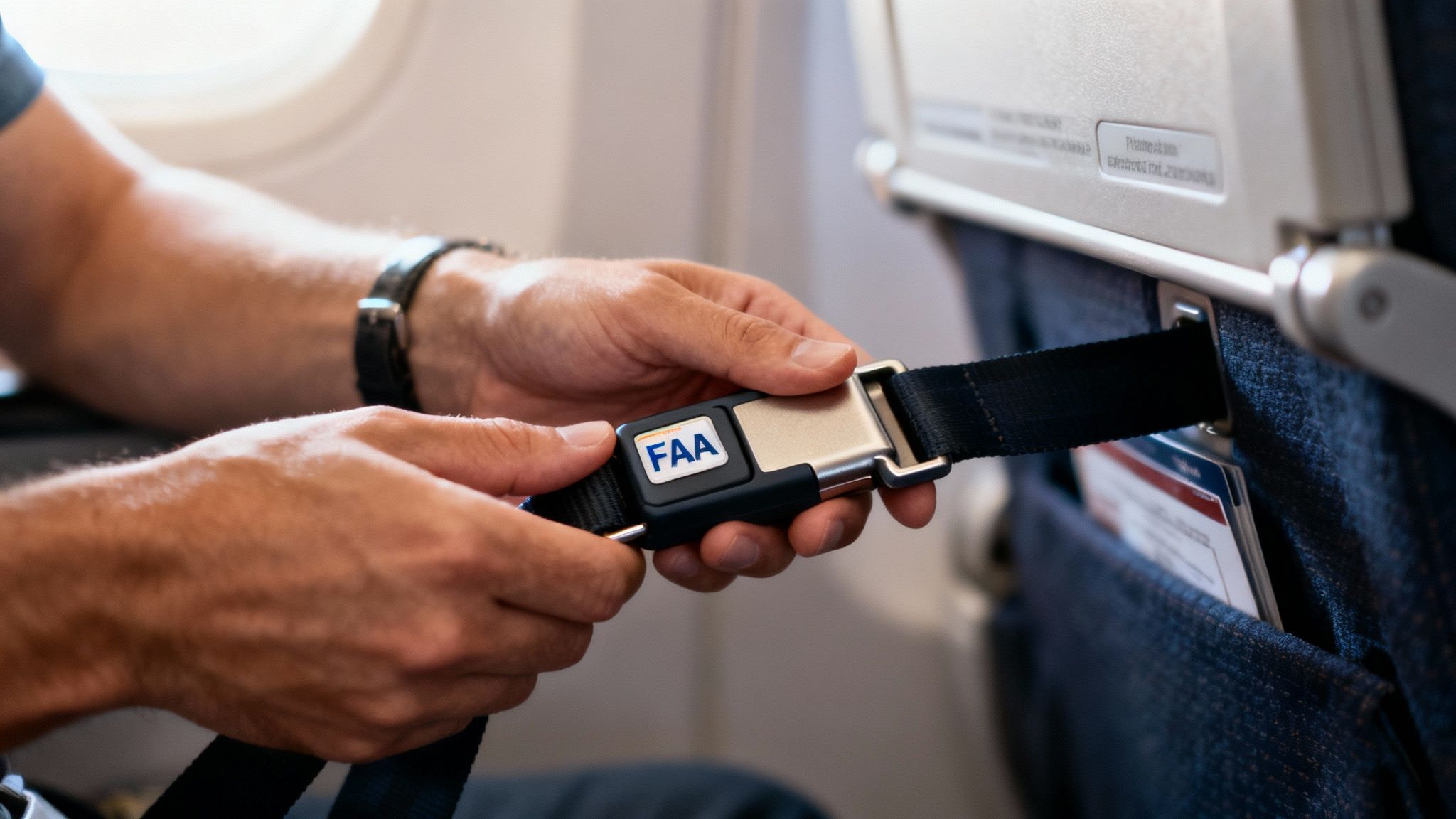
Each path has its own pros and cons. The best choice for you will depend on what you value most—convenience, privacy, or avoiding a one-time cost. Let's dig into what each option really looks like.
Asking the Airline for an Extender
The most common approach is to simply ask a flight attendant for an extender. You can quietly mention it as you're boarding the plane or after you've settled into your seat.
- The Good: It's 100% free. Airlines are obligated to provide extenders to any passenger who needs one, at no extra charge.
- The Bad: They can run out. On a packed flight, the crew only has a limited number on hand, and they might not have one for you.
- The Awkward: Let's be honest, asking can be uncomfortable. Having to publicly request an extender is an experience many travelers would rather avoid.
This option can work just fine if you’re an infrequent flyer and don't mind the possibility of a slightly awkward moment. But when you rely on the airline, you're essentially gambling with your own comfort and safety.
Bringing Your Own Certified Extender
The other route is to buy your own FAA-compliant seat belt extender. This simple move puts you back in the driver's seat, erasing all the uncertainty and stress from the equation.
Having your own certified extender completely changes the game. It turns a moment of travel anxiety into one of empowerment. You get privacy, guaranteed availability, and the confidence of knowing you're prepared for any seat on any flight.
This is about more than just convenience—it's about protecting your dignity and ensuring your safety every single time you fly. When you have your own, you'll never have to give the length of airplane seat belts a second thought.
To make the decision easier, let's look at a side-by-side comparison of your choices.
Comparing Your Options for Extra Seat Belt Length
| Feature | Requesting from Airline | Bringing Your Own Extender |
|---|---|---|
| Cost | Free | One-time purchase |
| Availability | Not guaranteed; depends on supply | Always in your bag, ready to go |
| Privacy | Involves a public request to crew | Completely private and discreet |
| Convenience | You have to wait and ask | Ready the moment you sit down |
| Peace of Mind | Dependent on airline stock and crew | Guaranteed fit, safety, and no stress |
In the end, bringing your own extender is the most reliable and stress-free solution for any regular traveler. You just need to be sure it’s the right type for the planes you fly on. To get it right, it pays to learn about the different seat belt extender types available for airplanes so you can find the perfect match for your needs. Taking this one small step can permanently remove a major source of travel anxiety.
Flying Confidently with Your Own Extender
Walking onto a plane with your own gear gives you a sense of control and preparedness. While you can always ask the airline for an extender, bringing your own certified one is a smart move that puts your comfort and safety in your own hands. The good news is, it's a practice that nearly all major U.S. airlines permit.
A lot of people get anxious just thinking about a flight attendant questioning their extender, but that worry is usually for nothing. The whole key to a smooth, hassle-free experience is making sure your extender is the real deal—truly FAA-compliant and showing its official certification tags. A flight attendant's number one job is safety, and a properly tagged device instantly signals you're on the same page.
What to Say If a Crew Member Asks
If a flight attendant does ask about your extender, a simple, confident reply is all it takes. There's no reason to get defensive; they're just following protocol to make sure every piece of equipment on board is up to code.
A calm, matter-of-fact approach is always best. Try saying something like this:
"Thanks for checking! This is my own FAA-compliant extender, just wanted to be sure I could buckle up safely. The certification tag is right here if you'd like to see it."
This kind of response immediately frames you as a safety-conscious passenger who came prepared. It turns what could be an awkward moment into a quick, positive interaction. And the best part? Having your own certified device means you never have to guess about the varying length of airplane seat belts again.
Honestly, most of the time, the crew will just see you buckle up and won't bat an eye. By carrying a certified extender, you're working with airline safety policies, not against them. It’s a common and accepted way to make sure you can fly with the dignity and peace of mind you deserve.
For a deeper dive, check out our complete guide on using seat belt extenders for airplanes to travel with total confidence.
Your Next Steps to a Comfortable Flight
So, where do you go from here? You now have a solid understanding of why airplane seat belts can be so unpredictable, but knowledge is only half the battle. It's time to put that knowledge into action so you can stop worrying about seat belt length for good.
The first, and easiest, step is to get your measurements. Grab a flexible tape measure and, while sitting down, measure around the widest part of your hips and waist. This single number takes all the guesswork out of the equation and gives you a clear baseline for what you'll need on any given flight.
Invest in Your Own Peace of Mind
Think about it: owning your own FAA-compliant seat belt extender isn't just about convenience. It’s an investment in your comfort and, more importantly, your peace of mind. It completely removes that moment of anxiety when you first sit down. No more having to discreetly flag down a flight attendant or cross your fingers that they even have an extender on board.
The real goal here is to make your safety a given, not a question mark. Bringing your own certified extender means you're prepared for any aircraft, any seat, and any airline. It puts you back in control.
Being prepared lets you focus on what really matters—enjoying your trip. It's similar to how you'd prepare for other aspects of your flight; for instance, if you're traveling with a pet, you’d need to look into specifics like airline approved pet carrier dimensions for travel safety to ensure a smooth journey for them, too.
Ultimately, carrying your own solution lets you board the plane, find your seat, click in, and just relax. It ensures your flight starts on your terms—with the comfort, security, and dignity every single traveler deserves. A small, one-time purchase can permanently solve a recurring travel headache.
Answering Your Airplane Seat Belt Questions
Even after getting the basics down, you might still have a few questions rattling around. It's completely normal. Let's tackle some of the most common things travelers ask so you can board your next flight feeling totally prepared.
Are All Airplane Seat Belt Buckles the Same?
That’s a great question, and the answer is no. This is a huge deal for anyone considering buying their own seat belt extender. While they might look similar, there are two main buckle designs you'll find on commercial planes, often called Type A and Type B.
At first glance, you might not notice a difference. But their internal locking mechanisms are totally different. This means an extender made for a Type A buckle simply won't work with a Type B buckle—and trying to force it is a serious safety risk. This is exactly why you need an extender that's either universally compatible or one provided by the airline, and it absolutely must be certified for flight.
Think of it this way: using the wrong extender is like using the wrong key for a lock. It might seem like it fits, but it won't actually secure anything. It creates a false sense of security that could fail when you need it most.
Can I Just Use My Car Seat Belt Extender on a Plane?
Please don't. The answer here is a hard and fast no. A car seat belt extender is incredibly dangerous to use on an airplane, and here’s why.
Car and airplane safety systems are built for completely different worlds. They’re engineered to handle different types of forces and impacts.
- Different Safety Standards: Airplane seat belt extenders have to pass rigorous FAA or EASA (E-8) certification tests. These tests simulate the unique forces of an aviation incident, something a car extender is never designed for.
- Incompatible Hardware: The buckles are not interchangeable. A car extender might seem to click into place, but that connection is weak and can pop open with the slightest bit of force. It’s not a secure lock.
- Airline Rules: Airlines flat-out prohibit using any equipment that isn't certified for aviation. Flight attendants are trained to look for this and will ask you to remove it immediately.
How Do I Know if an Extender Is Actually FAA Compliant?
This is the most important check you can make. A truly compliant extender will have its certification information front and center—no digging required. Be wary of vague marketing fluff like "airline friendly" or "TSA approved."
What you need to look for is a physical tag sewn right onto the extender's fabric strap. This isn't just a brand label; it's the official proof. It should clearly state that the extender meets specific aviation safety regulations. That tag tells the flight crew (and you) that your equipment is built to the same tough standards as everything else on the plane. Without that tag, it's just a gadget, not a piece of safety equipment.
Ready to fly with confidence and dignity? Seat Belt Extenders offers E-4/E-8 certified airplane seat belt extenders designed for universal compatibility and guaranteed safety. Eliminate the stress of unpredictable seat belt lengths and ensure a comfortable fit on every flight. Find your perfect travel solution at https://seatbeltextenders.com.