
Let's get straight to the point: most aftermarket seat belt protectors are not safe. They can, and often do, interfere with your car's most critical safety system. While they're marketed as a simple fix for an annoying shoulder belt digging into your neck, these unregulated add-ons can change the belt's position, and that's a huge problem in a crash. They create slack and can shift the immense forces of an impact to the most vulnerable parts of your body.
Why Comfort Should Never Compromise Safety
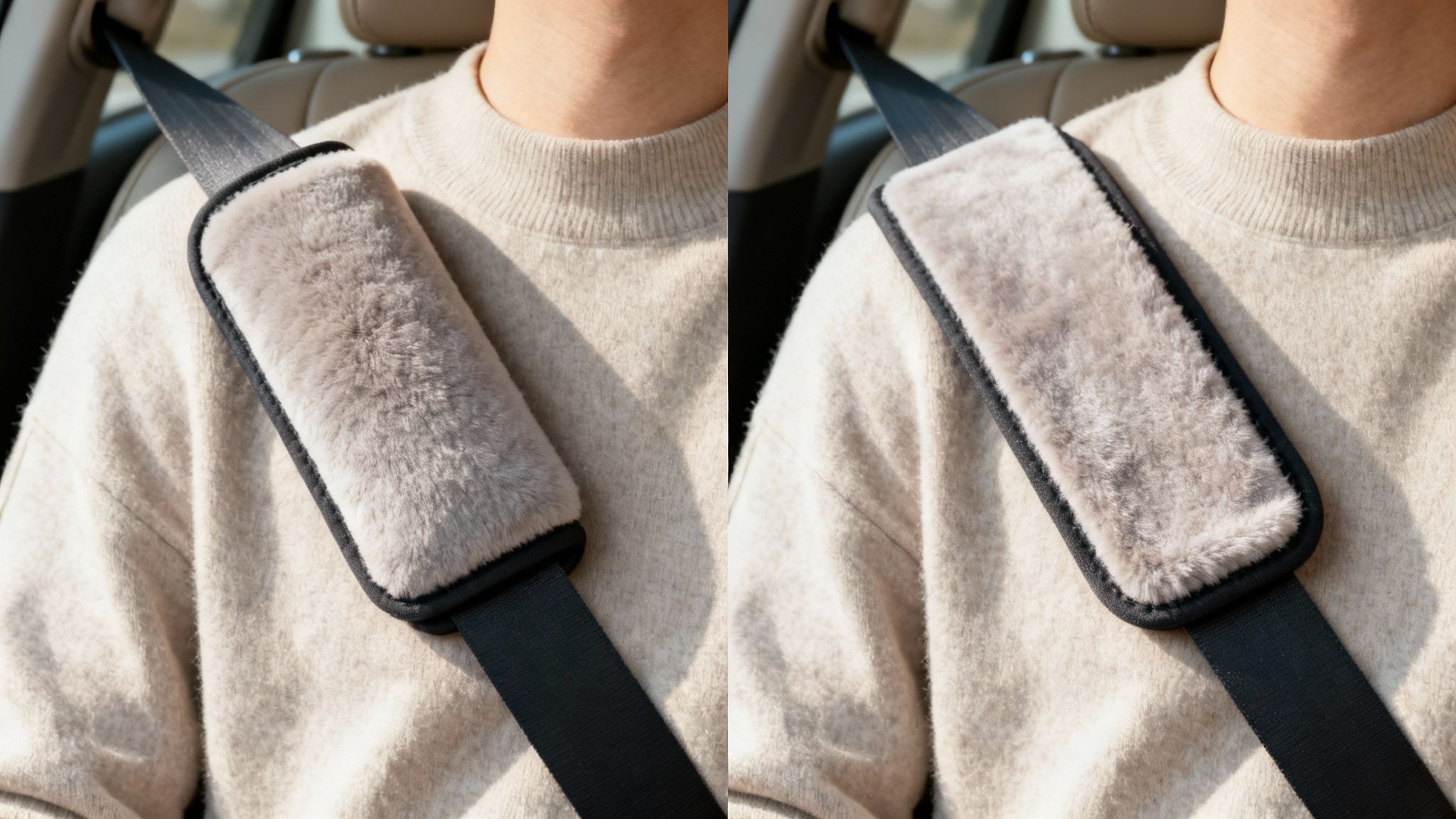
We've all been there—the seat belt webbing chafes against your neck or collarbone, making a long drive miserable. It’s a common complaint, and it's no surprise that people look for a quick solution. The market is full of products that promise to make your ride more comfortable. The term "seat belt protector" covers a wide range of these aftermarket gadgets, all designed to add a bit of cushioning or alter the belt's path.
But here's the thing: most of these devices pose serious risks. Think of your car's seat belt system as a precisely engineered safety tool. It was designed and tested to distribute catastrophic forces across the strongest bones in your body, like your pelvis and rib cage. Adding an untested cushion or clip is like trying to perform surgery with a blunt instrument; it messes with the precision and can completely undermine its life-saving job.
The Two Types of Protectors
To really understand the risks, it helps to break these accessories down into two main groups. They try to solve the comfort problem in different ways, but both can introduce dangerous flaws into the safety system.
- Padded Covers: These are the fuzzy or soft sleeves you see made from materials like fleece, neoprene, or sheepskin. They simply wrap around the shoulder belt to create a soft buffer between the webbing and your skin.
- Positioning Adjusters: These are typically plastic clips or fabric straps that actively pull the shoulder belt down and away from your neck. They physically change the angle and path of the belt across your body.
Even a seemingly innocent padded cover can be a problem. That extra bulk, no matter how soft, can create slack in the belt. In an accident, every millisecond counts, and that slack can cause a dangerous delay before the belt tightens and does its job. We go into more detail about the specific dangers of these in our guide on padded seat belt covers. Positioning adjusters are even more concerning because they intentionally move the belt away from the very path it was designed to follow.
A seat belt that is incorrectly positioned—even by a few inches—can cause severe internal injuries during a crash by concentrating force on the soft tissues of your abdomen and neck instead of your strong bone structure.
The Real Reason for Discomfort
Before you even think about buying an accessory, let’s look at the root of the problem. More often than not, a seat belt is uncomfortable because it doesn’t fit you properly. A correctly fitted belt should lie flat across the middle of your collarbone and chest, not slice into your neck.
The first thing you should do is check for your car's built-in solutions. Many vehicles have a shoulder belt height adjuster right on the B-pillar (the post between your front and back doors). By simply sliding this up or down, you can often find the perfect angle that gets the belt off your neck. This is the safest solution because it's part of the car's original, crash-tested design. You get the comfort you want without gambling with your safety.
Why Aftermarket Products Compromise Your Safety
Your car's 3-point seat belt is a finely tuned piece of safety equipment, not just a simple strap. It's an entire system, meticulously engineered to do one job in the chaos of a crash: save your life. When you add an aftermarket seat belt protector, you're introducing a completely unknown and untested element into that system, and that fundamentally compromises its ability to protect you.

This precision isn't an accident. The global automotive seat belt market was valued at around USD 19.9 billion in 2025, with the 3-point system as the undisputed champion. Its design is the result of decades of crash data, all focused on one goal: distributing the immense forces of an impact across the strongest parts of your skeleton—your pelvis and collarbone. You can get more details on the growth of the automotive seat belt market and see just how critical this technology is.
When you slip on a protector, you throw that careful balance completely out of whack.
The Safety Net Analogy
Think of your seat belt like a professional safety net, the kind used by acrobats. It's shaped perfectly to catch you in a very specific way, absorbing the impact and spreading your weight across its strongest points to prevent injury.
Now, imagine someone tossing a thick, squishy cushion into the middle of that net. When you fall, you hit the cushion first. The net’s shape distorts, it sags in ways it was never meant to, and it might not catch you correctly at all. That’s exactly what a seat belt protector does to your safety system.
An aftermarket adjuster or a bulky padded cover changes the geometry of how the belt sits on your body. It can cause the shoulder belt to slip from your strong collarbone onto your vulnerable neck, or it can push the lap belt up from your pelvis onto your soft, unprotected abdomen. Both of these scenarios are incredibly dangerous.
The Dangers of Misplaced Force
In a collision, the forces acting on your body are many times greater than gravity. A correctly worn seat belt is designed to manage those forces and channel them safely. An incorrectly positioned belt, however, can become the source of the injury itself—a phenomenon known as "seat belt syndrome."
- Abdominal Injuries: If the lap belt rides up over your stomach, the impact can crush internal organs like your spleen, liver, and intestines.
- Spinal Injuries: A poorly positioned lap belt can cause your body to "submarine," or slide forward underneath it. This can lead to devastating fractures in your lower spine.
- Neck and Head Injuries: When the shoulder belt is too close to the neck, it can cause catastrophic damage to the carotid artery, trachea, or cervical spine.
Federal agencies like the National Highway Traffic Safety Administration (NHTSA) have warned time and again against using aftermarket devices that alter a vehicle's seat belt. Your car’s entire safety suite—from the airbags to the seat belt pretensioners—was tested as a single, integrated unit. Adding an untested gadget effectively cancels out all that rigorous testing.
The entire principle of seat belt safety rests on proper fit and placement. Any product that moves the belt away from the strong skeletal structures of the pelvis and collarbone introduces a critical, and potentially fatal, flaw into the system.
Padded Covers vs. Adjusters
While both types of protectors are risky, it's helpful to know how they fail in different ways. We take a closer look at this in our article on different types of seat belt covers.
Padded Covers: These seemingly innocent fleece or neoprene sleeves add bulk, which in turn creates slack in the belt. In a crash, even an inch of slack can be the difference between walking away with a bruise and suffering a serious head injury, because it allows your body to build up more momentum before the belt finally catches you.
Positioning Adjusters: These clips and straps are even more dangerous because their entire purpose is to pull the belt into an incorrect position. By yanking the shoulder belt down for "comfort," they often introduce dangerous slack and cause the lap belt to ride up onto the abdomen, inviting severe internal injuries in a collision.
At the end of the day, these products sell a false sense of comfort at the expense of real, proven safety. Your vehicle's original equipment was designed, engineered, and crash-tested to save your life. Modifying it with an unregulated, untested accessory is a gamble no one should ever have to take.
Protectors vs. Certified Extenders: A Critical Difference
When you're looking for a way to make your seat belt fit better, it’s easy to lump all the available accessories into the same category. But that’s a serious mistake. There’s a massive, safety-defining gap between a simple seat belt protector and a certified seat belt extender. Getting this right isn't just about picking a product—it’s about knowing which accessories work with your car’s safety system and which ones actually work against it.
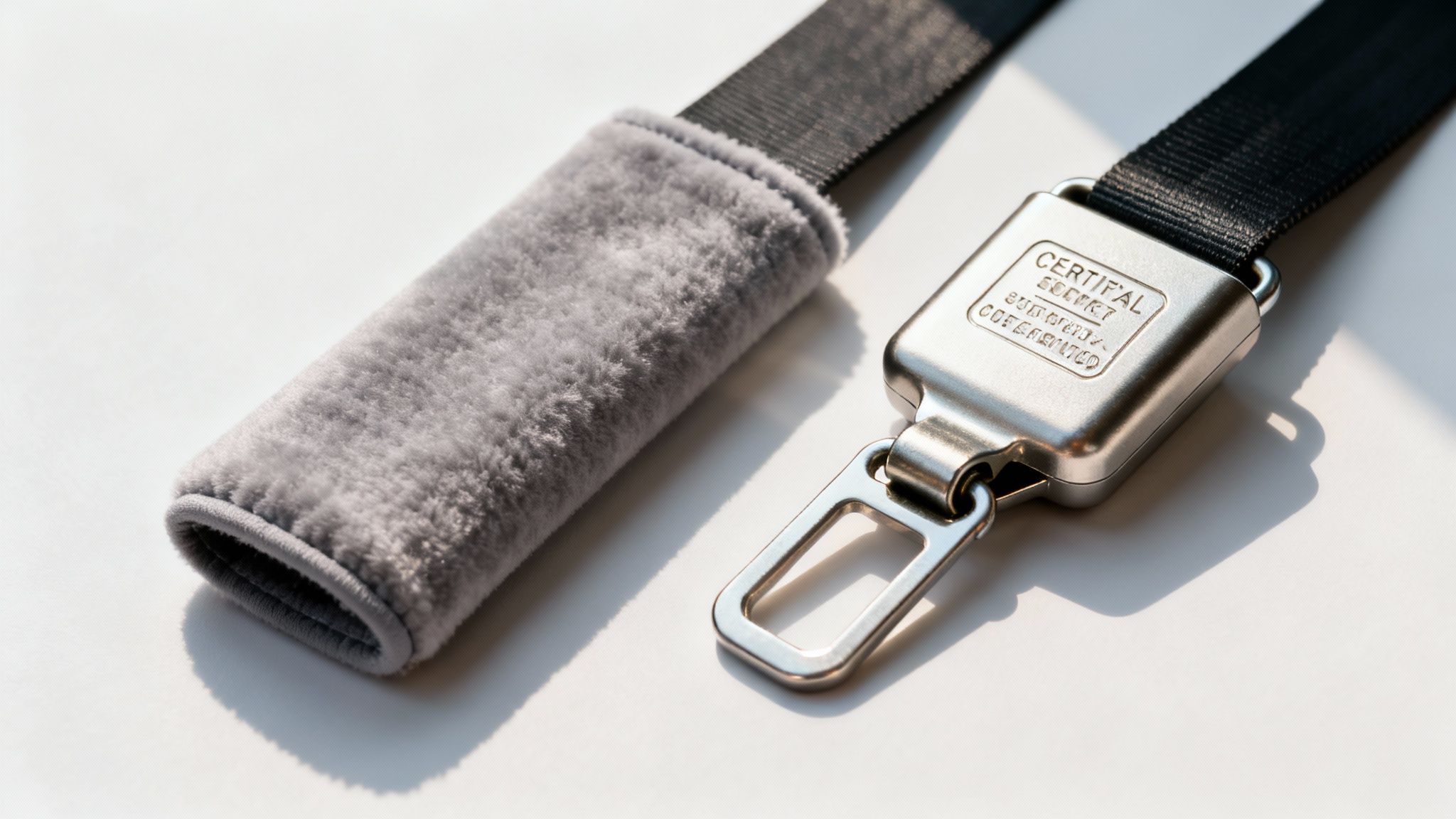
At its core, a seat belt protector is almost always an unregulated, aftermarket gadget sold for comfort. Its main job is to add a bit of padding or shift the belt's position to keep it from digging into your neck or chest. These things are simply not built to handle the immense forces of a crash and carry no safety certifications whatsoever.
A certified seat belt extender, on the other hand, is a safety device, plain and simple. It has one job and one job only: to add extra length so you can securely buckle up when the original belt is too short. It's not designed to change the belt’s path or add cushioning.
The Bridge Analogy: A Clear Distinction
Here’s a helpful way to think about it. Picture your vehicle's seat belt system as two rock-solid anchor points on either side of a river. The factory seat belt is the bridge connecting them—a structure that was meticulously engineered and tested by the car manufacturer to handle incredible stress.
- A seat belt protector is like throwing a big, untested wooden plank on top of that bridge. Sure, it might make the crossing feel a little more comfortable underfoot, but it adds weight, changes the dynamics, and was never part of the original design. When a storm hits (a crash), that plank could snap or even cause the entire bridge to fail.
- A certified seat belt extender is like an officially approved segment of the bridge itself. It's constructed from the same high-strength materials and tested to the exact same demanding standards as the original structure. It’s designed to seamlessly connect the two anchor points when the original span is just a little too short, maintaining the integrity of the whole system.
This difference is everything. One is a modification for comfort, while the other is an extension built for safety and compliance.
A certified extender is engineered to become part of the vehicle's safety system. An unregulated protector is an uninvited guest that can disrupt the entire system's performance during a critical moment.
Regulation and Testing: The Non-Negotiable Standard
The biggest difference boils down to regulation and testing. Certified seat belt extenders have to go through intense testing to meet strict safety standards, like the E4 or E8 certifications recognized worldwide. These tests guarantee that the extender's buckle, webbing, and latching mechanism can withstand the brutal forces of a collision.
In stark contrast, the vast majority of seat belt protectors you see on major online marketplaces have zero safety testing. They are cranked out with a focus on cheap materials and looks, not on life-saving performance. There are no rules governing their construction or their ability to hold up in an impact. When you use one, you’re putting your trust in a product that has never been proven safe.
It's also crucial to understand that there are different tools for different jobs. For anyone needing a safe and proper fit, you can learn more about the various seat belt extender types to see how each is designed for a specific, safety-first purpose.
Protector vs. Extender: What You Need to Know
To make it even clearer, let's break down the key differences side-by-side. This table shows you exactly why these two products are worlds apart.
| Feature | Seat Belt Protector | Certified Seat Belt Extender |
|---|---|---|
| Primary Purpose | Comfort and repositioning | Safety and providing length |
| Regulation | Generally unregulated and untested | E4/E8 certified and rigorously tested |
| Function | Alters the path of the original belt | Extends the length of the original belt |
| Safety Impact | Compromises safety by creating slack and misplacing forces | Maintains safety integrity when used correctly |
| Materials | Soft fabrics, plastic clips (not for crash forces) | High-strength steel and automotive-grade webbing |
| Vehicle Integration | Interferes with the OEM safety system | Integrates with the OEM safety system |
At the end of the day, choosing between these accessories is a decision between a feeling of comfort and proven safety. A seat belt rubbing your neck is annoying, but the solution should never introduce a life-threatening risk. A certified extender solves a real fit problem without compromising the system's integrity, making it the only responsible choice when you need more length.
How Modern Seat Belts Outsmart Aftermarket Add-Ons
To really grasp why a simple seat belt protector can be so dangerous, you have to look past the fabric strap you see every day. The real magic is the brilliant engineering hidden inside your car's pillars. A modern seat belt isn't just a passive strap; it's an intelligent, active system built to react in the blink of an eye during a crash. It's a technological marvel that aftermarket gadgets can easily interfere with—and not in a good way.
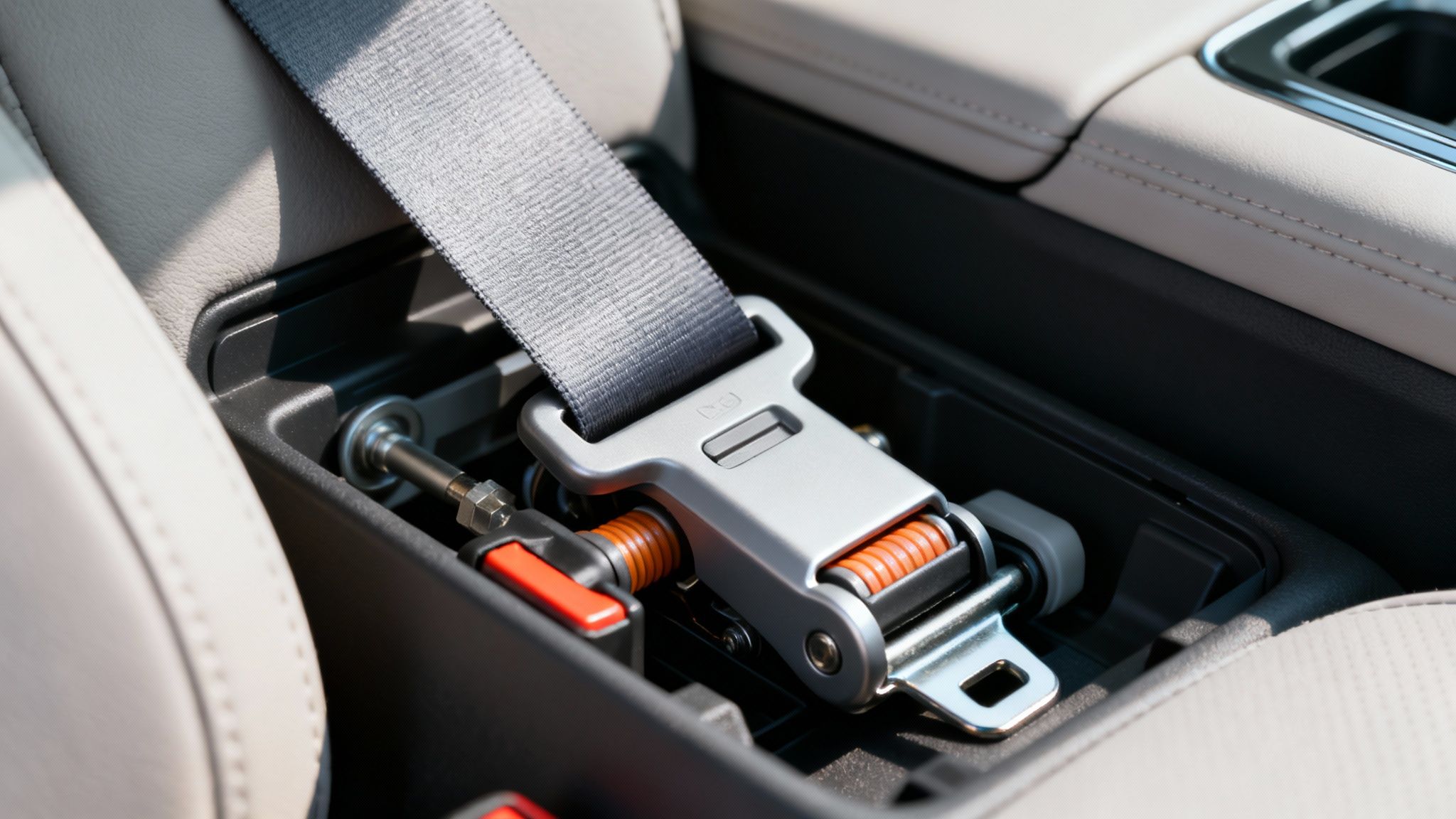
This system's success hinges on two key technologies working in perfect sync: pretensioners and load limiters. These are the unsung heroes of car safety. Once you understand what they do, it becomes crystal clear how a bulky protector can turn them from lifesavers into liabilities.
The Split-Second Action of a Pretensioner
Think of a pretensioner as a tiny, lightning-fast rocket motor for your seat belt. The very instant a crash is detected—often before your brain has even registered the impact—the pretensioner fires. It uses a small pyrotechnic charge to yank the seat belt webbing tight, instantly removing all slack and pinning you firmly to your seat.
This single action is absolutely critical. By getting rid of that slack, the pretensioner makes sure your body begins to slow down with the car, not a split second later. This prevents you from flying forward into the dashboard or steering wheel. This tech is so essential that in 2023 alone, 15.3 million automotive seat belt pretensioners were installed in new vehicles in the U.S., a clear sign of their effectiveness. For a deeper dive, you can explore the market trends in this detailed industry report.
Now, let's add a thick, padded seat belt protector into this high-speed equation.
- It creates fake slack: All that padding creates a gap between the belt and your body. The pretensioner now has to waste precious time crushing the protector before it can even start restraining you.
- It delays the response: Those crucial milliseconds lost while compressing the protector allow your body to build up dangerous forward momentum.
- It can jam the works: A poorly designed cover could bunch up and physically interfere with the retractor, potentially stopping the pretensioner from firing correctly at all.
This interference completely neutralizes the pretensioner's main job, leaving you exposed to the very injuries it was engineered to prevent.
The Gentle Giant: The Load Limiter
Right after the pretensioner locks you in place, the load limiter takes over. It’s best to think of it as a sophisticated shock absorber woven directly into the seat belt. As the force of the crash pushes your body against the belt, the load limiter detects when the pressure on your chest reaches a specific, carefully calculated threshold. At that point, it strategically lets out a tiny bit of webbing.
Sounds strange, right? Why loosen the belt in a crash? It’s all about preventing injury. By giving just a little, the load limiter dramatically reduces the peak force hitting your rib cage and internal organs. It’s what stops the belt itself from causing fractures or other severe trauma.
A load limiter is like a safety valve. It manages the immense pressure of a crash to protect your body from the very system designed to save you. It’s the perfect balance between restraint and preventing harm.
A seat belt protector throws this delicate balance completely out of whack. The extra bulk and friction can easily confuse the load limiter's sensors. It might not deploy at the right pressure or could release too much slack at the wrong time. On top of that, the protector's placement messes with the belt's tension, which is a key piece of data for these systems. You can learn more about the importance of proper seat belt tension in our detailed article.
At the end of the day, your vehicle’s seat belt is a highly integrated system. Every single part is designed to work together in a fraction of a second. Adding an untested, unregulated accessory like a seat belt protector is like throwing a wrench into a high-performance engine. It disrupts the timing, gums up the works, and ultimately undermines the very safety features you rely on to protect your life.
Safe and Simple Ways to Improve Seat Belt Fit
If your seat belt feels uncomfortable, that’s a clear signal something isn't right. But before you reach for an aftermarket seat belt protector, you should know it's not the answer. The good news is your vehicle probably already has a built-in feature designed to fix the very problem you're having, letting you stay comfortable without messing with your car's safety engineering.
The first place to look is the shoulder belt height adjuster. It’s a little sliding tab on the B-pillar—that’s the post between your front and back doors. So many people don't even know it's there, but it's specifically designed to let you customize how the seat belt fits your body.
Just slide it up or down. You'll see how it changes the angle of the shoulder strap. You’re aiming for the sweet spot where the belt lays flat across the middle of your collarbone, right between your neck and your shoulder. It takes seconds to adjust and it’s the safest, simplest way to stop the belt from digging into your neck.
Using Your Car’s Built-In Adjuster
Getting the shoulder belt positioned correctly isn't just about comfort; it's critical for how it performs in a crash. A poorly positioned belt can cause serious harm.
- Too High: Is the belt cutting into your neck? The adjuster is probably set too high. That's a huge risk, as it could cause severe neck and throat injuries in an accident.
- Too Low: Is the belt constantly slipping off your shoulder? It's set too low. This is also dangerous because it allows your upper body to lurch forward too much during an impact, putting you at risk for head and chest injuries.
The ideal placement is flat across your collarbone. This ensures that in a sudden stop, the immense forces are distributed across your strong skeletal structure, not your vulnerable neck or abdomen.
Of course, a proper seat belt fit is just one piece of the puzzle. Overall safe driving habits are what prevent accidents in the first place. For more advice on staying safe behind the wheel, you can Discover more essential driving safety tips.
When You Need More Length Safely
Sometimes, the problem isn't the belt's position but its actual length. For some people, whether due to body size, bulky winter coats, or medical equipment, the factory belt just won't click. In these cases, the only safe solution is a certified, vehicle-specific seat belt extender.
Unlike a generic seat belt protector, a certified extender is engineered and tested to meet the same tough safety standards as your car's original belts. It’s designed to latch perfectly and maintain the full integrity of your vehicle's safety system. We cover this in more detail in our guide on safe seat belt adjusters for adults.
To get the right one, you should contact your vehicle’s manufacturer or a reputable, safety-compliant supplier. They can match an extender to your car's specific make, model, and year. This is how you find a real solution that works with your car's safety features, not against them.
Your Top Questions About Seat Belt Safety, Answered
It's easy to get lost in the sea of seat belt accessories out there, but when you put safety first, the right choices become much clearer. Let's tackle some of the most common questions we get, cutting through the myths to focus on solutions that are actually tested and certified.
Are Seat Belt Protectors Illegal?
This is a bit of a gray area, but the answer leans toward "don't use them." While you probably won't find a state law that specifically bans a fuzzy seat belt protector, the real risk isn't a traffic ticket—it's what happens in a crash.
Federal law is crystal clear: your car's safety systems have to meet strict performance standards. When you add a protector, you're introducing an untested element into that system. If you get into an accident and that protector is found to have worsened an injury by causing slack or changing the belt's position, you could be held liable. Even worse, your insurance company might have grounds to deny your claim, leaving you with massive bills.
Can I Use a Protector for My Child?
No, you absolutely should not. This is one of the most dangerous misuses of these products. If a child says the seat belt is digging into their neck, it's a huge red flag. It means they're not big enough to use the adult seat belt, and they need to be in a booster seat. A seat belt protector just masks a very serious safety problem.
A booster seat has one critical job: to position a child correctly so the vehicle's 3-point seat belt fits them like a small adult. The lap belt should be low across their hips (not their stomach), and the shoulder belt should cross their collarbone. This is the only proven way for a child who has outgrown a forward-facing car seat to ride safely.
How Do I Know a Seat Belt Extender Is Safe?
This is a great question, and the answer comes down to certification and vehicle-specific design. A safe seat belt extender is never a generic, "one-size-fits-all" gadget you'd find in a bargain bin.
Here’s what to look for to make sure you're getting a reliable product:
- Safety Certification: The extender must be clearly marked with an E4 or E8 safety certification. This is a European standard, but it's recognized worldwide for its demanding tests.
- Vehicle-Specific Fit: Reputable sellers won't offer a "universal" extender. They'll ask for your vehicle's exact make, model, and year to match the extender's latching mechanism perfectly to your car's.
- Detailed Specifications: A trustworthy company will be transparent about the materials they use, like automotive-grade steel for the buckle components and webbing that meets OEM quality standards.
Steer clear of extenders sold on huge online marketplaces where this crucial information is missing. Those products are often unregulated and can be incredibly dangerous.
What Are Safe Alternatives for an Uncomfortable Belt?
If your seat belt is digging in or feels awkward, the first place to look is your own car. Check the post right next to your shoulder (it's called the B-pillar) for a height adjuster. Sliding this up or down can often solve the problem by making the belt sit comfortably on your collarbone.
If the belt is simply too short to buckle, the only safe solution is a certified, vehicle-specific extender from a reputable source.
For a secure fit that you can trust on every drive, Seat Belt Extenders offers E4-certified, vehicle-specific extenders designed to work flawlessly with your car’s original safety system. Find the right fit for your vehicle and drive with peace of mind by visiting https://seatbeltextenders.com.