
That little chime you hear when you don't buckle up? It’s powered by a seat belt sensor, and that sensor does a lot more than just annoy you. It’s a key player in your car's safety network, constantly communicating with the main computer to report whether or not your seat belt is fastened. This simple piece of information is absolutely vital for deciding if airbags should deploy in a crash.
The Unsung Hero of Your Car's Safety System
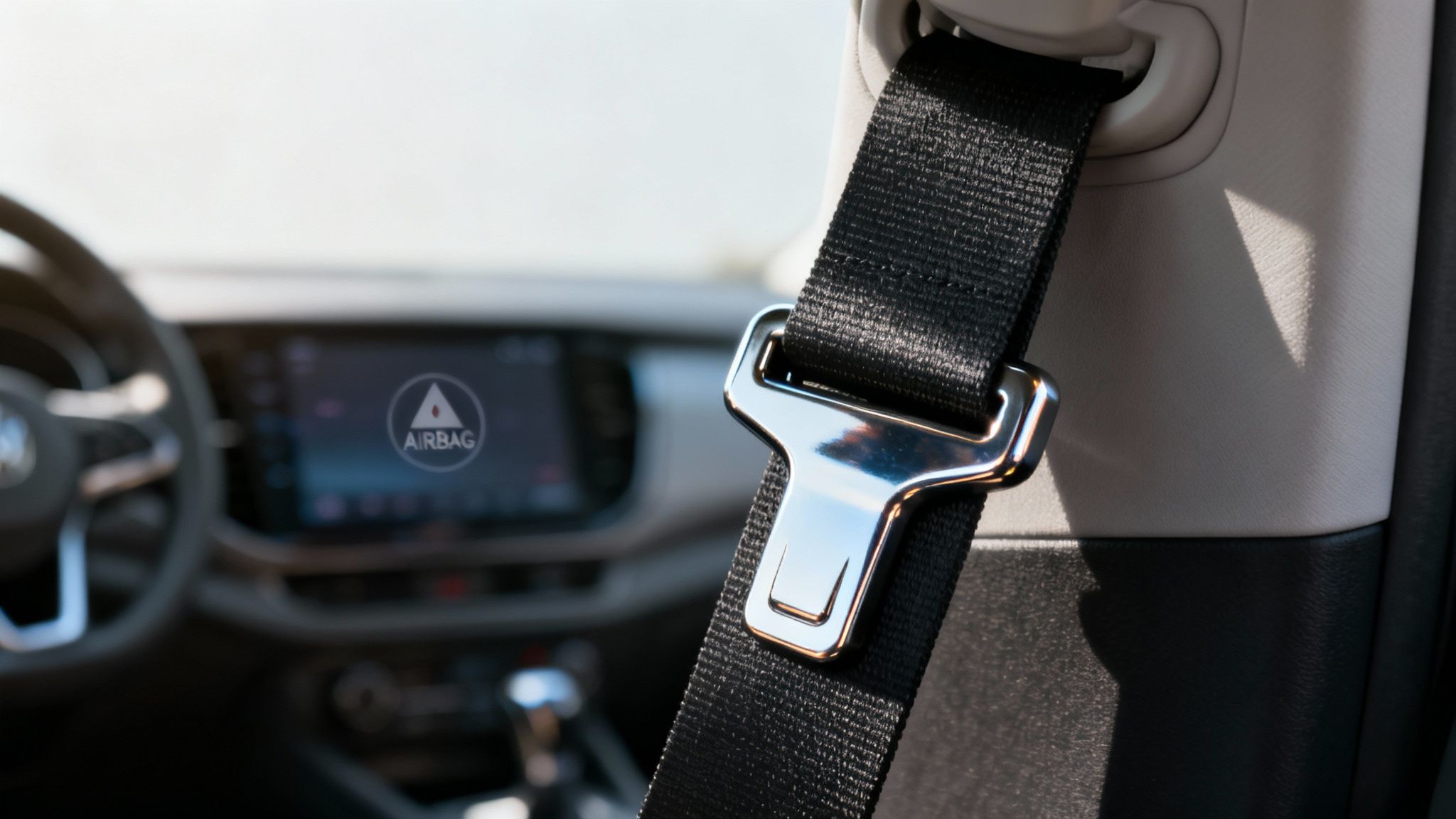
Think of the seat belt sensor as a silent but watchful guardian. Its entire purpose is to tell the car's central safety brain—the Supplemental Restraint System (SRS) module—one crucial thing: "Is this person buckled in?" That's it.
But that one answer changes everything. Without that signal, the SRS is essentially flying blind. It needs that confirmation to make the life-or-death, split-second decisions that protect you during an accident.
To really nail down its importance, let's look at the sensor's main jobs.
Table: Key Functions of a Seat Belt Sensor
| Function | Description | Impact on Safety |
|---|---|---|
| Occupant Status Detection | Senses when the seat belt buckle is engaged or disengaged. | Provides the core "buckled" or "unbuckled" status to the vehicle's computer. |
| Airbag System Integration | Informs the SRS module whether an occupant is restrained. | Can alter airbag deployment force or even prevent it from firing to avoid injuring an unbuckled passenger. |
| Warning Chime Activation | Triggers the audible and visual seat belt reminder on the dashboard. | Acts as the primary alert to remind drivers and passengers to buckle up. |
| Pre-Tensioner Control | Works with the SRS to activate pre-tensioners that tighten the belt just before an impact. | Ensures the occupant is held securely in their seat for maximum protection. |
As you can see, this isn't just a simple on/off switch. It's an integral component that ensures all your safety systems work in perfect harmony when you need them most.
Why This Tiny Sensor Matters So Much
The link between your seat belt sensor and the airbag system is non-negotiable. If the sensor tells the SRS module that you're not buckled in, the system might change its plan for that specific seat. In some vehicles, it may deploy the airbag with less force or even stop it from deploying at all, as an airbag hitting an unrestrained person can cause serious harm.
This smart collaboration is what makes modern safety systems so effective. It also explains why a broken sensor often triggers the airbag warning light on your dash—it’s your car’s way of saying, "I can't trust the data I'm getting, so the whole system might be compromised." For a closer look at how these components interact, our article on https://seatbeltextenders.com/blogs/articles/seat-belt-tension sheds more light on the subject.
A Growing Role in Modern Vehicles
As cars get smarter, so does the seat belt sensor. Its job now extends far beyond just managing chimes and airbags.
A malfunctioning seat belt sensor can do more than just silence a chime; it can compromise the effectiveness of your entire airbag system, turning a life-saving feature into an unknown variable.
In today's cars, this sensor is part of a much larger network of advanced driver-assistance systems (ADAS) that all depend on accurate data to function correctly. If you're interested in how these complex systems are maintained, learning about ADAS Calibrations offers some great insight.
The growing reliance on this technology is clear from market trends. The global market for these sensors was recently valued at USD 3.69 billion and is expected to rocket to USD 6.54 billion by 2035, all thanks to tougher safety laws and the continuous push for smarter vehicle technology.
How Your Seat Belt Sensor Works
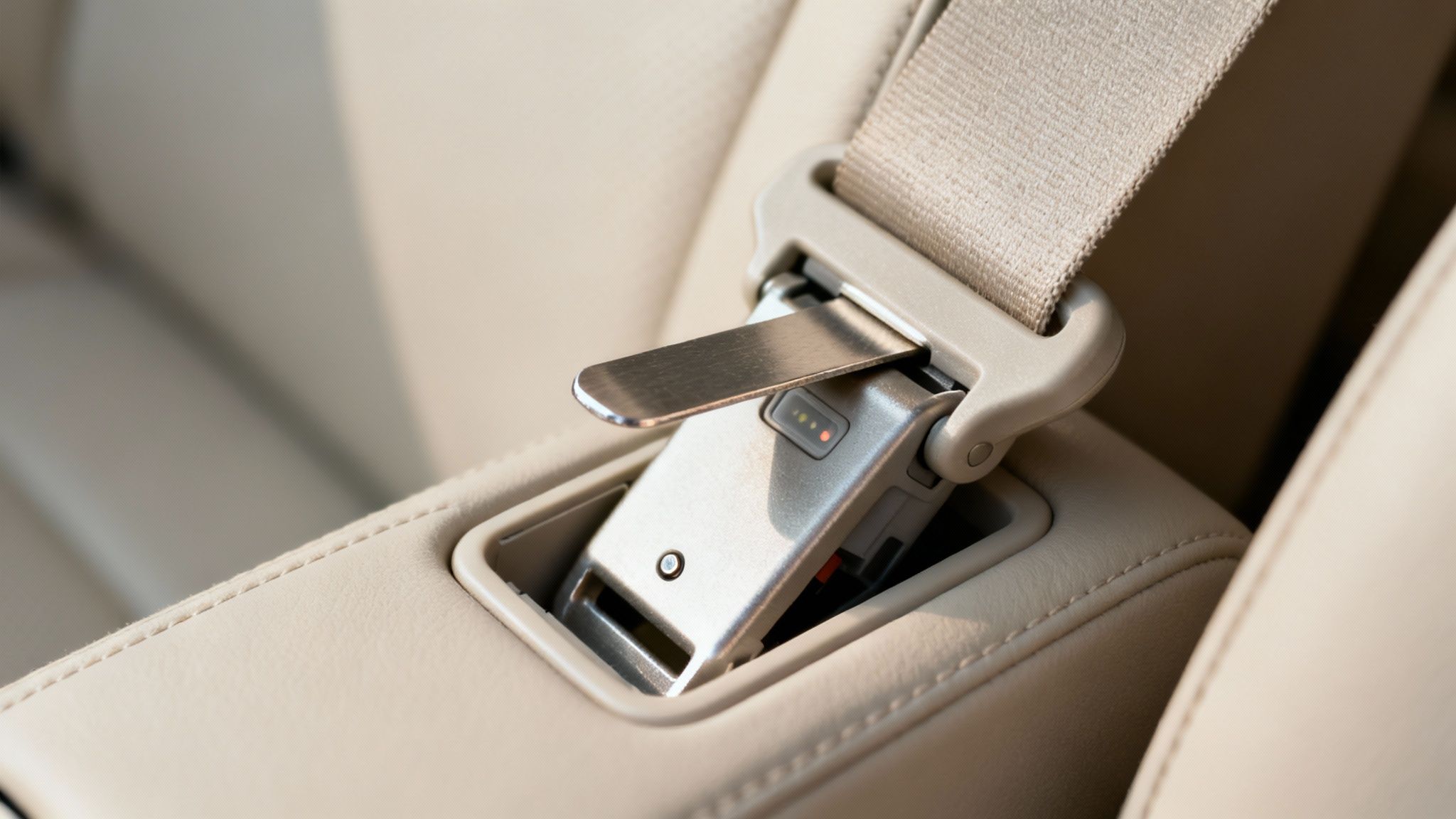
At its core, a seat belt sensor is a simple messenger. Its one job is to tell your car’s main computer whether the seat belt is clicked into the buckle. Think of it as a gatekeeper for your car's entire safety network.
How it does this depends on your vehicle's age and design. Most cars use one of two main methods to get the job done. While the end result is the same, the technology behind them is quite different, kind of like the difference between a classic doorbell button and a modern video doorbell.
Let's break down how these systems figure out if you're buckled up.
The Mechanical Switch: A Simple, Proven Approach
The most common design you'll find, especially in slightly older cars, is a basic mechanical switch. It's beautifully simple. Imagine a tiny light switch hidden deep inside the seat belt buckle.
When you push the metal tongue of the seat belt into the buckle, it physically presses down on a small, spring-loaded button. This completes a simple electrical circuit—just like flipping a switch turns on a lamp. That "on" signal travels through a wire, usually tucked away under the seat, directly to the car’s brain for safety systems, known as the Supplemental Restraint System (SRS) module. The computer now knows you're buckled in.
When you unbuckle, the tongue pops out, the spring pushes the button back, and the circuit breaks. The SRS module instantly gets the "unbuckled" message. It’s a reliable, time-tested system that gets the job done. For a deeper dive into what happens when that signal is missing, our guide explains how to disengage a seat belt alarm and the systems it controls.
The Magnetic Hall Effect Sensor: A Modern, No-Contact Solution
Newer vehicles often use a more advanced approach: the magnetic Hall effect sensor. This is a solid-state piece of technology with no moving parts, which makes it incredibly durable and less prone to wear and tear. Instead of a physical button, it uses magnetism.
Here’s how it works: the sensor in the buckle is designed to detect magnetic fields. When you insert the metal seat belt tongue, it disrupts this field. The sensor picks up on that change and generates a small voltage.
The real beauty of this design is that there's no direct physical contact needed to send the signal. The sensor simply senses the presence of the metal tongue through magnetism, which cuts down on mechanical failures and boosts reliability.
That voltage signal is its way of saying "buckled up!" to the SRS module. Because there's nothing to physically wear out, it’s the go-to choice for modern car manufacturers.
From Buckle to Brain: The Signal's Journey
Whether your car uses a mechanical switch or a magnetic sensor, the final destination is always the same: the SRS module. This module is the command center for every safety feature in your car, from the airbags to the pre-tensioners.
This constant communication is what makes the whole system work. Once the SRS module gets that "buckled" confirmation, it can make split-second decisions to keep you safe. It essentially runs a quick checklist:
- Airbag Deployment: Confirms the airbag for that seat is armed and ready.
- Pre-Tensioner Activation: Puts the seat belt pre-tensioners on standby to tighten the belt fractions of a second before an impact.
- Warning System Deactivation: Tells the dashboard to silence that annoying seat belt chime and turn off the warning light.
This steady flow of information ensures all your car's safety features are working together as one cohesive team, ready to act the moment they're needed.
Recognizing a Failing Seat Belt Sensor
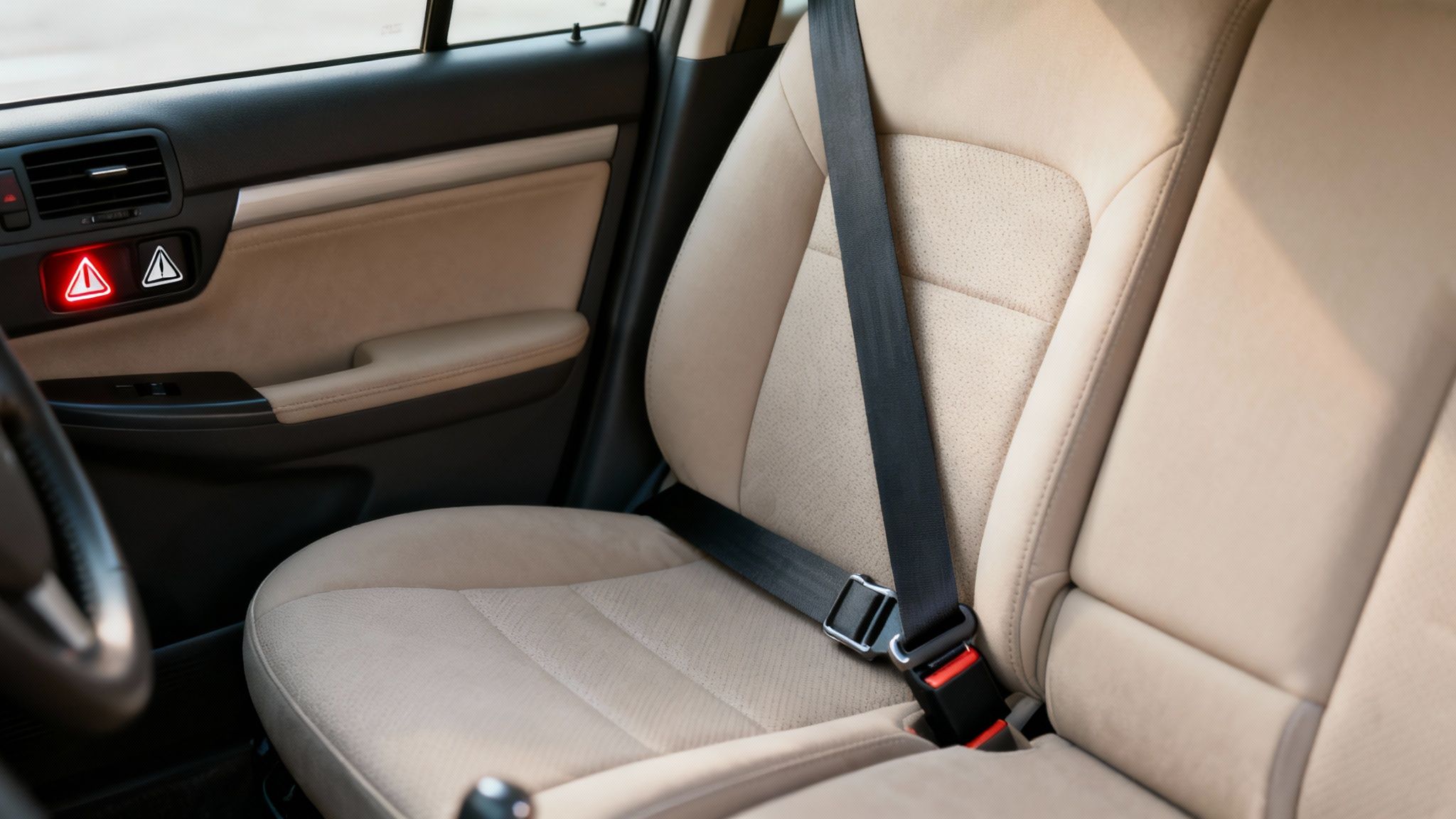
Your car is constantly talking to you. It uses a whole language of lights, chimes, and alerts to let you know what’s going on under the hood and in the cabin. When your seat belt sensor is on its way out, it sends some very clear signals. Learning to recognize these signs is the first step in keeping your car's safety features in top shape.
Just like any other electronic part, these sensors don't last forever. They can wear out from years of use, get gummed up with debris, or suffer from a loose wire or a bit of corrosion. When that happens, the sensor can no longer do its job, and your car will definitely let you know something is wrong.
The most common sign is also the hardest to miss: that little warning light on your dashboard.
The Annoying Warning Light That Stays On
You get in, buckle up, and hear that satisfying click. But the little red seat belt icon on your dash just stares back at you, refusing to turn off. This is the clearest sign that your sensor has a problem.
Even though the belt is physically latched, the sensor inside the buckle hasn't registered it. Because of this, it can't send the "all clear" signal to the car's main computer, the Supplemental Restraint System (SRS) module. The car thinks you’re still unbuckled and keeps the light on as a constant reminder. It might feel like a minor glitch, but it’s an important clue.
This problem often brings an equally annoying friend along with it.
That Unrelenting Warning Chime
Along with that stubborn light, you'll probably hear a warning chime that just won't give up. It’s designed to be impossible to ignore for a good reason—safety. When the sensor fails, the car’s computer keeps ringing the alarm because it thinks you’ve forgotten to buckle up.
This constant ding, ding, ding is more than just irritating; it's a sign of a communication breakdown between the seat belt sensor and the car's brain. Sometimes, the cause is surprisingly simple, like a frayed wire or even some sticky soda residue deep inside the buckle mechanism. For other hardware-related issues, you might find our guide on seat belt stop clips and how they work helpful.
When the Warnings Go Silent
What can be even more worrying than a warning that won't stop is one that never starts. You get in the car, forget to buckle up, and drive away in complete silence. No light, no chime. This is a huge red flag.
A silent failure often means the sensor has died completely or a wire has been totally disconnected. The car's SRS module isn't getting any signal at all, so it might assume the seat is empty. This is the most dangerous scenario, as your car has lost its ability to confirm you’re safely buckled in.
The most critical warning sign is the main airbag light (often showing an icon of a person with an airbag or the letters "SRS"). If this light comes on, your car is signaling that it cannot trust the data from the seat belt sensor and may have disabled the airbag for that specific seat as a failsafe.
When the problem escalates from a simple seat belt light to a full-blown SRS warning, it's no longer just an annoyance. It's a critical safety failure that needs immediate attention. The global demand for safer vehicles is driving major improvements in these systems. The automotive seat belt market was recently valued at USD 24.6 billion and is projected to hit USD 37.7 billion by 2035, a testament to the focus on smarter sensor technology.
If you suspect any of these issues, getting quality auto repair services can give you a proper diagnosis and ensure your car's safety systems are working exactly as they should.
A Step-by-Step Troubleshooting Guide
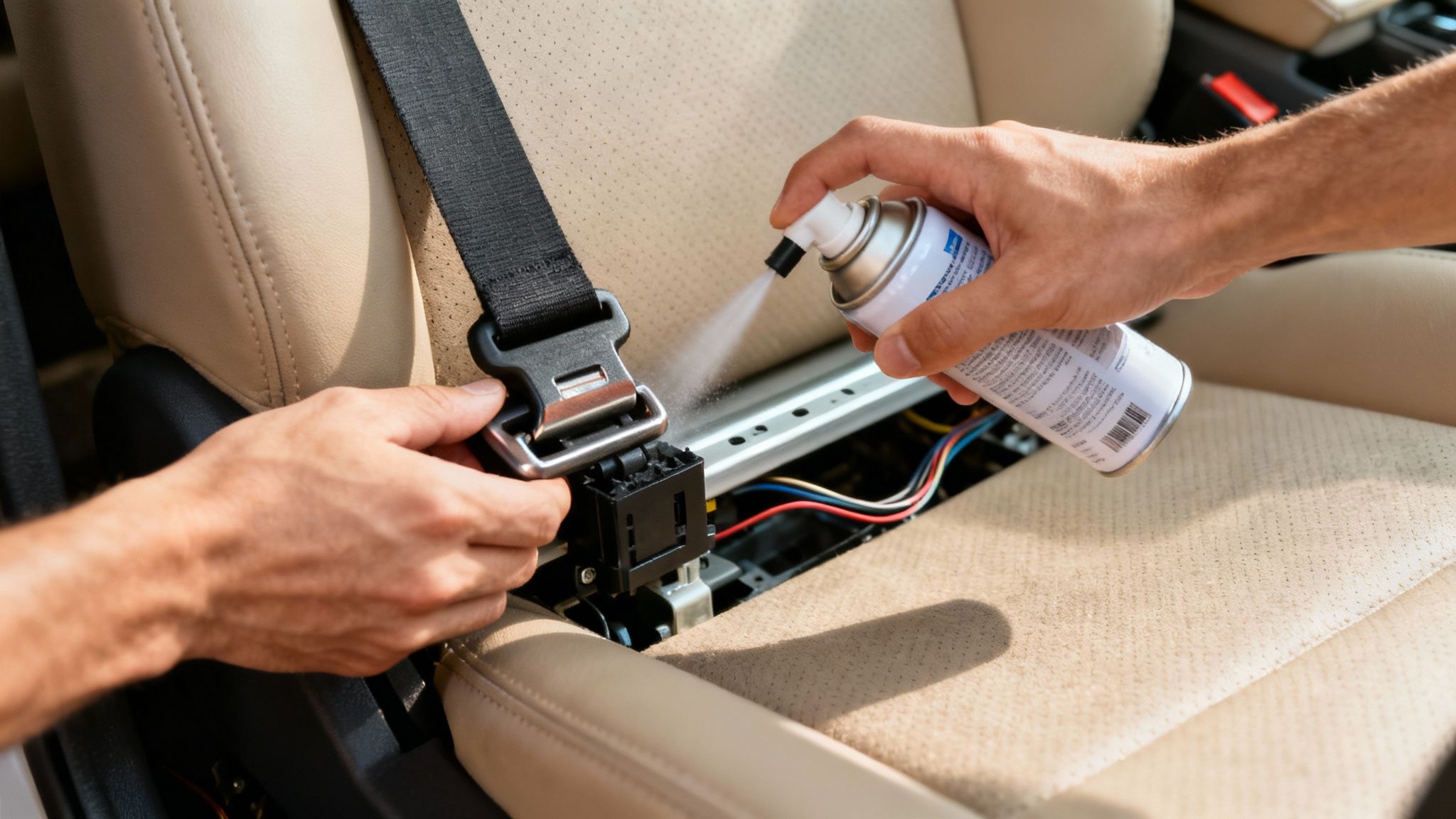
When that seat belt warning light just won't turn off, or the chime is driving you crazy, it’s easy to assume you’re in for an expensive trip to the mechanic. But hold off on making that appointment. More often than not, a faulty seat belt sensor is caused by a surprisingly simple issue you can fix yourself.
This guide walks you through the same process a pro would use, starting with the easiest fixes first. A little patience here could save you a good chunk of time and money. Just remember to turn your car's ignition off completely before you start poking around any wires.
Step 1: Start with a Thorough Visual Inspection
First things first, let's just take a look. The problem is often hiding in plain sight. The seat belt buckle is a magnet for all the little things that get dropped in a car.
Grab a flashlight and peer inside the buckle’s opening. You’re looking for anything that doesn’t belong—food crumbs, coins, lint from your pocket, or even tiny plastic bits from a broken toy. Anything wedged in there can stop the belt tongue from fully connecting with the sensor switch inside.
If you spot a culprit, a pair of tweezers or a small, non-metal pick is usually all you need to fish it out. You’d be surprised how often this simple cleanup job solves the entire problem.
Step 2: Inspect Wiring and Connections
If the buckle is clear, it's time to check the wiring. The seat belt sensor has to talk to the car’s computer, and it does that through a wire that usually runs right under the seat. That makes it a prime target for getting kicked or snagged when you move the seat.
Slide the seat all the way forward, then all the way back, using your flashlight to get a good view underneath. You're searching for a small plastic connector, typically with two or three wires running from the buckle assembly. Keep an eye out for these common issues:
- Loose Connections: Sometimes the plug just gets knocked loose. Make sure it's clicked firmly into place.
- Damaged Wires: Look for any frayed, pinched, or broken wires. The constant back-and-forth of the seat can wear them out over time.
- Corrosion: If you live in a humid place or a drink was spilled, the metal contacts can get corroded, which blocks the electrical signal.
If you find a disconnected plug, snapping it back together might be your instant fix. Frayed or broken wires, on the other hand, are a job for a professional to ensure the repair is safe.
Step 3: Clean the Buckle Mechanism
Even if you can’t see any big pieces of debris, years of dust and sticky residue from spilled sodas can gum up the internal parts of the buckle. This gunk can prevent the mechanical switch from moving freely.
Safety First: Never spray lubricants like WD-40 or water into the buckle. They can conduct electricity and short out the sensor. Stick to products made specifically for electronics.
Your best friend for this job is a can of compressed air. Use short bursts to blast out any hidden dust from deep inside the buckle. For tougher grime, an electrical contact cleaner is perfect. It's designed to clean electronics without leaving any residue behind.
Step 4: Test the Sensor's Basic Function
Alright, after your inspection and cleaning, it's time to see if your work paid off. This simple test will tell you if the problem is solved or if the sensor itself is the issue.
- Turn the ignition to the "On" position but don't start the engine. The seat belt warning light should be on.
- Buckle the seat belt. You should hear a solid "click," and the warning light on your dash should go off immediately.
- Unbuckle it. The light should pop right back on.
- Repeat this process 5-10 times. This ensures the sensor is working every time, not just randomly.
If the light behaves exactly as it should, congratulations! You've likely fixed it. But if it stays on, flickers, or doesn't react at all, the seat belt sensor has probably failed internally. At that point, it will need to be replaced. For more tips on managing your seat belt system, check out our guide on using a seat belt adjuster clip.
DIY Troubleshooting vs Professional Repair
It can be tough to know when a problem is a simple fix or when it's time to call in a certified mechanic. Here’s a quick table to help you decide.
| Symptom | DIY Action | When to Call a Professional |
|---|---|---|
| Light stays on, buckle feels gritty | Inspect and clean the buckle with compressed air and contact cleaner. | If cleaning doesn't work; the internal mechanism may be broken. |
| Light flickers when seat is moved | Check for loose connectors or pinched wires under the seat. | If you find frayed or broken wires that need a proper splice or repair. |
| Light is always on, no debris found | Perform the buckle/unbuckle test (Step 4) to check for a response. | If the sensor fails the test, it likely needs replacement. |
| Airbag warning light is also on | Stop. Do not attempt further DIY diagnostics. | Immediately. An airbag light indicates a fault in the SRS system. |
Ultimately, while these DIY steps can solve many common sensor problems, your safety is what matters most. If you're ever in doubt or the issue seems tied to the airbag system, don't hesitate to let a professional handle it.
Seat Belt Extenders and Your Car's Safety Sensors
For many people, a seat belt extender is a must-have for a safe, comfortable drive. But it's natural to wonder: will adding an extender mess with my car's seat belt sensor? The short answer is that it can, but only if you're using an extender that’s unsafe, incompatible, or not certified for your car.
Think of a quality extender as a seamless bridge. It’s built to connect the two sides perfectly, both mechanically and electronically. When you click the extender into your car’s buckle, it’s engineered to activate the sensor just like your normal seat belt tongue does. Then, you click your belt into the extender, and the car's system gets the clear signal: "We're buckled up and good to go."
The real trouble starts with the cheap, generic extenders you see all over the internet. These are often mass-produced with no regard for the precise engineering required for different car models.
The Problem with an Incompatible Extender
Using a generic or non-approved extender introduces a dangerous element of chance into your car's safety system. It's like trying to open a high-security lock with a poorly copied key—it might slide in, but it won't work right, and you could end up damaging the mechanism.
An extender that doesn't fit perfectly can cause serious communication breakdowns with the seat belt sensor:
- It can send a false "unbuckled" signal. If the extender's metal tongue isn't the exact shape needed, it won't fully engage the switch inside the buckle. Your car will think you're not wearing your seat belt, so the chime will keep going off. More importantly, this could tell the car to deactivate the airbag for your seat.
- It might send a false "buckled" signal. On the flip side, a badly made extender could get lodged in the buckle, tricking the sensor into thinking the belt is fastened when it isn't. This is incredibly risky because you won't get a warning chime, and the airbag might deploy with dangerous force in a crash.
- The connection could be intermittent. A loose fit can cause the signal to cut in and out as you drive over bumps or shift in your seat. This can confuse the car's Supplemental Restraint System (SRS), leading it to log a fault and switch on the main airbag warning light on your dash.
Your car's safety system is designed to work with clear, instant signals. A low-quality extender introduces noise and confusion, potentially compromising the split-second calculations the SRS module makes to protect you in an accident.
This is exactly why it's so critical to use only an extender that is specifically designed and approved for your car's make and model. To dive deeper into this, check out our comprehensive guide on seat belt extender safety.
How to Guarantee Compatibility and Safety
To make sure your extender and seat belt sensor work together flawlessly, you have to get it from a reputable source that matches the product directly to your vehicle. Certified or manufacturer-approved extenders are built to the exact same standards as the parts that came with your car.
This guarantees not just a physical fit but also full electronic compatibility with the SRS. As cars get smarter, this electronic "handshake" between parts is more critical than ever. The integration of advanced sensors is a huge trend, especially with electric and autonomous vehicles. The global market for these sensors was valued at USD 1.24 billion in a recent year and is expected to hit USD 1.76 billion by 2030. This growth is all about creating smarter, safer cabin intelligence platforms for modern cars. You can discover more insights about this growing market on strategicmarketresearch.com.
At the end of the day, an extender should make you safer, not introduce new risks. By choosing a certified, vehicle-specific product, you can be confident that this helpful accessory will work in perfect harmony with your car's vital safety systems.
Frequently Asked Questions
When you dig into how your car's safety features work, you're bound to have questions. The seat belt sensor, in particular, plays a bigger role than most people realize. Let's clear up some of the most common questions we hear about it.
Can a Bad Seat Belt Sensor Affect Airbag Deployment?
This is a big one, and the answer is an emphatic yes. Your seat belt sensor and airbag system are in constant communication. The car’s safety brain, known as the Supplemental Restraint System (SRS) module, relies on signals from that sensor to make life-or-death decisions in a fraction of a second.
If the sensor is on the fritz and tells the SRS that a passenger is unbuckled when they're actually not, the system might change how it deploys the airbag for that seat. For many cars, this could mean one of two things:
- Reduced Force Deployment: The airbag might pop with less force, assuming it needs to protect an unrestrained person from the full impact of the bag itself.
- No Deployment at All: In some scenarios, the system might not fire the airbag at all, since a fully deploying airbag can cause serious injury to someone who isn't properly buckled in.
Here's the most important thing to remember: If you see the main airbag or SRS warning light on your dashboard, your car is telling you it can't trust the data it's getting. As a safety precaution, it has likely disabled the airbag for that seat. This is not something to ignore—get it checked out by a professional right away.
How Much Does It Cost to Replace a Seat Belt Sensor?
The cost can swing quite a bit depending on your car's make and model, but you can generally expect to pay somewhere between $150 and $400.
So, what are you paying for?
- The Part Itself: The sensor is usually part of the seat belt buckle assembly. The component itself typically runs from $50 to $150, though it can be more for luxury or high-performance vehicles.
- Professional Labor: This isn't a job for just anyone. A certified mechanic will likely charge for one to two hours of work. With shop rates averaging $100 to $200 per hour, labor can add another $100 to $250 to your bill.
It might be tempting to try a DIY fix to save a few bucks, but anything connected to the airbag system demands real expertise. A simple mistake could damage the new sensor or, far worse, compromise the entire SRS.
Is It Legal to Bypass a Seat Belt Sensor?
Absolutely not. Let's be crystal clear on this: intentionally disabling, bypassing, or otherwise messing with any part of your car's safety system is illegal in most places. Federal safety standards exist for a very good reason, and tampering with them is a huge safety and legal risk.
Legal issues aside, it's just plain dangerous. You're essentially creating a blind spot for your car's safety computer. If you trick the system into thinking a belt is always buckled, you'll get no chime or warning light if a passenger genuinely forgets to buckle up. Even more critically, the airbag system will deploy under the false assumption that the occupant is safely restrained, which could lead to devastating injuries in a crash.
Bypassing the sensor can also lead to other headaches:
- Void Your Vehicle's Warranty: Manufacturers won't touch repairs related to unauthorized tampering with safety gear.
- Complicate Insurance Claims: An insurance company could potentially deny a claim if they find that a factory-installed safety feature was deliberately disabled.
Does the Passenger Seat Sensor Work Differently?
It sure does. The passenger side is often a lot smarter than the driver's side. While the driver's seat belt sensor is mainly concerned with whether the belt is buckled, the passenger side usually incorporates an Occupant Classification System (OCS).
Think of the OCS as a high-tech network of sensors, typically built right into the seat cushion, that figures out who or what is sitting there. It measures weight and analyzes how that weight is distributed.
Working together, the OCS and the passenger seat belt sensor give the SRS module a complete picture. The system can tell the difference between:
- A full-sized adult
- A small child
- A child seat
- Something like a backpack or groceries
- An empty seat
Based on that info, the OCS instructs the SRS module to either turn the passenger airbag on or leave it off. That's why you'll see the "Passenger Airbag Off" light illuminate when the seat is empty or just has a light bag on it. It’s a smart system designed to prevent an unnecessary and potentially dangerous airbag deployment.
At Seat Belt Extenders, we firmly believe safety is non-negotiable. Our E-4/E-8 certified extenders are designed to work perfectly with your car's existing safety systems, ensuring the seat belt sensor functions exactly as the manufacturer intended. You can find the right, secure fit for your vehicle at https://seatbeltextenders.com and drive with total peace of mind.