
There's a massive disconnect between the feeling of freedom an RV gives you and the reality of its safety features. Many people jump behind the wheel assuming the seat belts work just like the ones in their family car. That's a dangerous mistake. RV seat belts are a completely different animal, and true road safety starts with understanding how a home on wheels is designed to protect you—or in many cases, how it isn't.
Why Your RV Seat Belts Are Not Like Your Car's
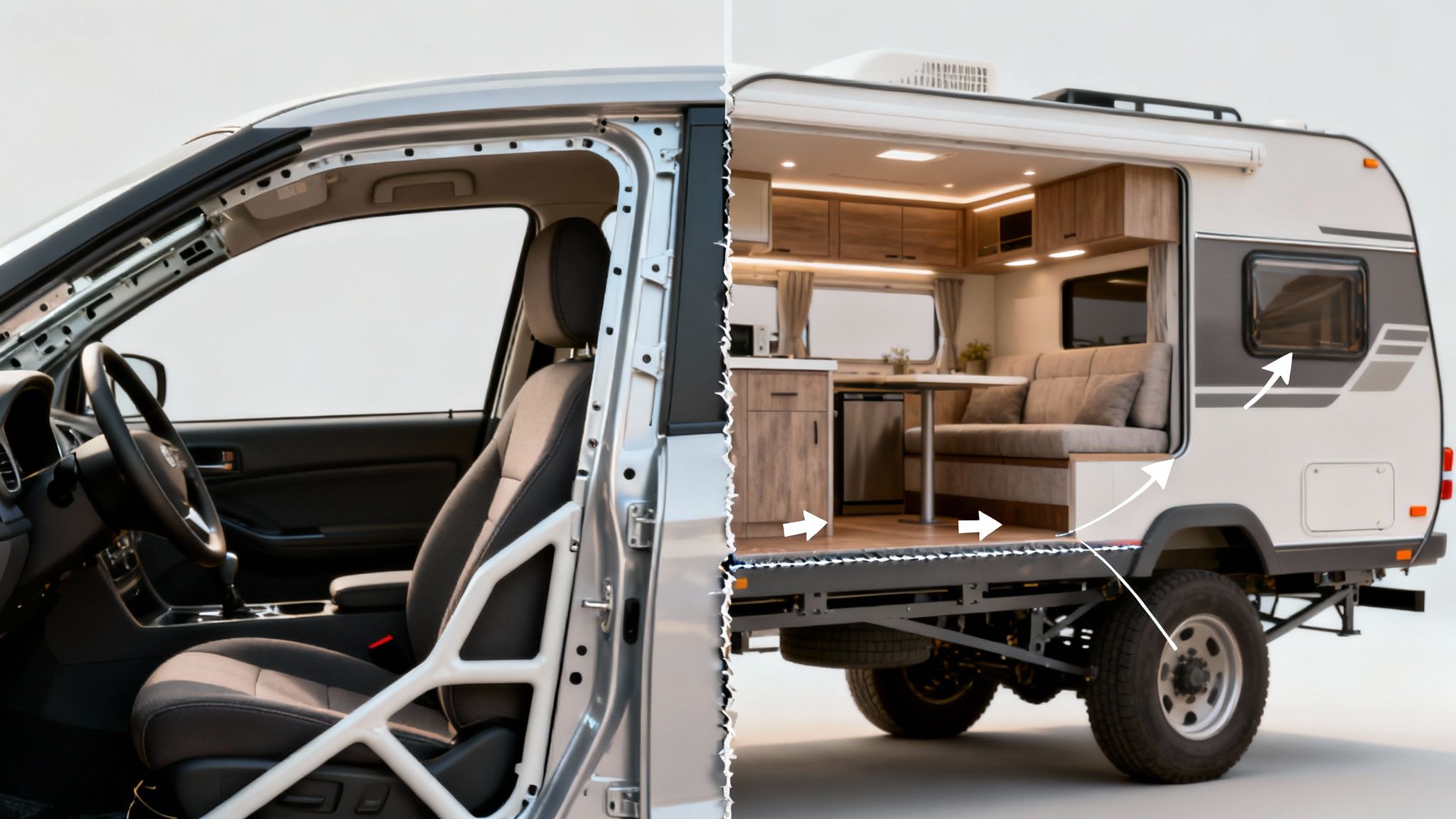
Picture your car for a moment. It's essentially a unibody safety cage, where the frame, body, and seats are all engineered to work together. They’re a single, integrated system designed to absorb impact and keep you safe.
Now, think about most Class A and Class C motorhomes. They’re built completely differently. You've got a heavy-duty truck chassis, and then a separate living space—basically a small house—is built right on top of it.
This "house-on-chassis" design is the root of the problem. The living area, with its comfy dinettes and sofas, just doesn't have the steel-reinforced structure of a car. When a collision happens, the forces don't get distributed through a purpose-built safety cage. Instead, they hit the wooden and fiberglass cabin in ways that can be catastrophic.
A Tale of Two Structures
In your car, the seat belts are bolted directly to the high-strength steel frame, working in tandem with airbags and crumple zones. It’s a complete system. In an RV's living area, however, many RV seat belts are simply anchored into the plywood floor of the coach or a wooden bench. In a crash, those anchor points can easily rip right out, giving you a terrifyingly false sense of security.
The core issue is structural integrity. An RV's living space is designed for comfort and amenities, not crash survivability. Belts anchored to this structure can fail under the immense forces of a collision, turning furniture and passengers into deadly projectiles.
The Weight Factor
Don't forget the sheer mass we're dealing with. An RV can easily weigh 15,000 pounds or more, and all that weight creates an incredible amount of momentum. The forces involved in stopping a vehicle that heavy are exponentially greater than in a normal car crash, putting unimaginable stress on any restraint system.
This is where details like proper seat belt tension become critically important. We know that seat belts are incredibly effective in passenger cars, reducing the risk of fatal injury by 45%. But you can’t apply that statistic directly to an RV without understanding the physics at play. This isn't just about clicking the buckle; it's about knowing exactly what you're buckled into. For more on how seat belts work, check out this great report from the National Safety Council.
Navigating the Patchwork of RV Seat Belt Laws

Figuring out the rules for RV seat belts can feel like you're trying to navigate a road trip without a GPS. The regulations are a tangled mess of federal standards and state laws that often don't line up, leaving even seasoned RVers scratching their heads about what’s legal and what’s safe.
The confusion starts with the dual nature of your motorhome. Up front, the driver and passenger seats are part of the "cab," which is built on a standard vehicle chassis. These seats fall under strict federal motor vehicle safety standards, just like any truck on the road. That means they must have properly installed, chassis-mounted seat belts.
But the second you step back into the living area, you enter a legal gray zone. The rules for who needs to be buckled up at the dinette or on the sofa are mostly decided state-by-state. This creates a confusing patchwork of laws that can change the moment you drive across a state line.
Federal Rules vs. State-by-State Differences
Unlike regular passenger cars, RVs weighing over 10,000 pounds don't have a federal mandate for seat belts in all rear seating positions. This creates a massive safety loophole. Even when manufacturers do install belts in the back, they may not be anchored to the vehicle's steel frame, which is a critical safety issue you can learn more about at procarseatsafety.com.
This lack of federal oversight means what’s perfectly legal in one state could get you a ticket in the next.
Here’s a quick look at how much the rules can vary:
- Some states are strict. Places like California and Washington require every single passenger to be buckled up, no matter where they’re sitting or how old they are.
- Others base it on age. States like Florida and Texas often only require passengers under 18 to wear a seat belt in the rear of the motorhome.
- A few are very lenient. There are still states with no specific laws requiring passengers in the living quarters to buckle up at all.
Given this wild inconsistency, the smartest and safest rule of thumb is simple: everyone buckled up in a forward-facing seat while the RV is in motion. Every time.
Legality is not a guarantee of safety. A seat belt might satisfy a state law, but if it's just bolted to a wooden dinette bench instead of the steel chassis, it offers a false sense of security that can fail completely in a crash.
To help clarify this, here’s a breakdown of what’s generally required versus what’s actually safe for different seats in your RV.
RV Seat Belt Requirements by Seating Position
This table summarizes the typical legal standards and safety best practices for passengers in a motorhome.
| Seating Position | Common Legal Requirement | Safety Best Practice |
|---|---|---|
| Driver & Front Passenger | Required by federal law. Must always be worn. | Always wear the factory-installed 3-point belt. Ensure proper fit. |
| Forward-Facing (Rear) | Varies by state. Often required for children. | Use only if factory-installed and chassis-mounted. The safest option for passengers. |
| Rear-Facing (Rear) | Rarely addressed by law. Generally not recommended. | Avoid, as these seats and belts are not designed for crash forces in this direction. |
| Side-Facing (Sofa) | Almost never required. Prohibited for children in many states. | Never use while moving. Lap belts on side-facing seats can cause severe injury. |
Ultimately, just because a seat has a belt doesn't automatically make it safe. The direction it faces and how it's anchored to the vehicle are what truly matter.
Forward-Facing vs. Side-Facing Seats
The direction a seat points is a huge factor in passenger safety. When state laws do mention rear passengers, they almost always specify that belts must be used in forward-facing seats. There's a very good reason for this.
Side-facing sofas, a common feature in many RV floor plans, are incredibly dangerous during a collision.
In an accident, a simple lap belt on a side-facing seat can cause devastating spinal and internal injuries. Your body is thrown sideways in a way the belt was never designed to restrain. Always prioritize seating that faces the front of the vehicle. It's also important to know the rules for accessories; our guide explaining whether seat belt extenders are legal can clarify their proper use in your RV's cab.
Getting to Know Your RV's Seat Belts
It's easy to assume all seat belts are the same, but in an RV, that’s a dangerous mistake. The belts in your motorhome are a mix of different designs, and knowing what you're dealing with is the first step toward keeping everyone safe on the road.
You'll almost always find two main types: the familiar 3-point belts and the much simpler 2-point lap belts.
-
3-Point Belts (Lap and Shoulder): These are the ones you're used to from your everyday car. You'll find them in the driver and front passenger seats. They're designed to spread the force of a crash across your body's strongest points—your pelvis and chest—and are anchored directly to the RV’s heavy-duty steel chassis.
-
2-Point Belts (Lap Only): These are the simple lap belts you typically see at the dinette or on a sofa. As the name implies, they only go across your lap, leaving your head, neck, and chest completely unrestrained in a crash.
Why Are Lap Belts So Common in the Back?
It’s a fair question: if 3-point belts are so much safer, why are there lap belts in the living area? It’s not about cutting costs; it’s a matter of structural reality. For a 3-point shoulder belt to work, it needs a super-strong anchor point high up on a pillar. In your truck or car, that pillar is part of the steel frame.
But your RV's living area is built differently. The walls are usually a combination of wood, aluminum, and fiberglass. These materials are great for keeping the weight down and insulating your space, but they simply aren't engineered to handle the thousands of pounds of force an accident generates. Trying to anchor a shoulder belt to one of these walls would be like tying a boat to a flimsy post—it would just rip right out when you need it most.
Since the cabin walls can't support a shoulder anchor, manufacturers are stuck with lap belts. They can bolt these directly to the floor or seat frame, which meets the bare minimum legal requirements but falls far short of modern safety standards.
Spotting the Difference and Understanding the Risk
Take a quick tour of your rig right now and look at every single seat belt. The 3-point systems up in the cab are built and tested to meet strict federal safety standards. Full stop. They are the safest seats in the entire vehicle.
The 2-point lap belts in the back, however, are a totally different ballgame. Even when they’re bolted to the RV's floor, the wooden dinette or sofa frame they're attached to can splinter and disintegrate in a collision. While a lap belt might keep someone from flying across the cabin, it does nothing to prevent their head or chest from slamming into the table in front of them.
Recognizing this critical difference is key. It allows you to make smart, informed choices about who sits where on your next family trip.
The Hidden Dangers of Adding RV Seat Belts
It’s a question I hear all the time from RV owners who want to bring more friends or family along for the ride: "Can I just add more rv seat belts?" The heart is in the right place, but the answer is a firm, unequivocal no. This isn't a simple weekend DIY project. Adding a seat belt is a serious structural engineering task, and getting it wrong can be far more dangerous than having no belt at all.
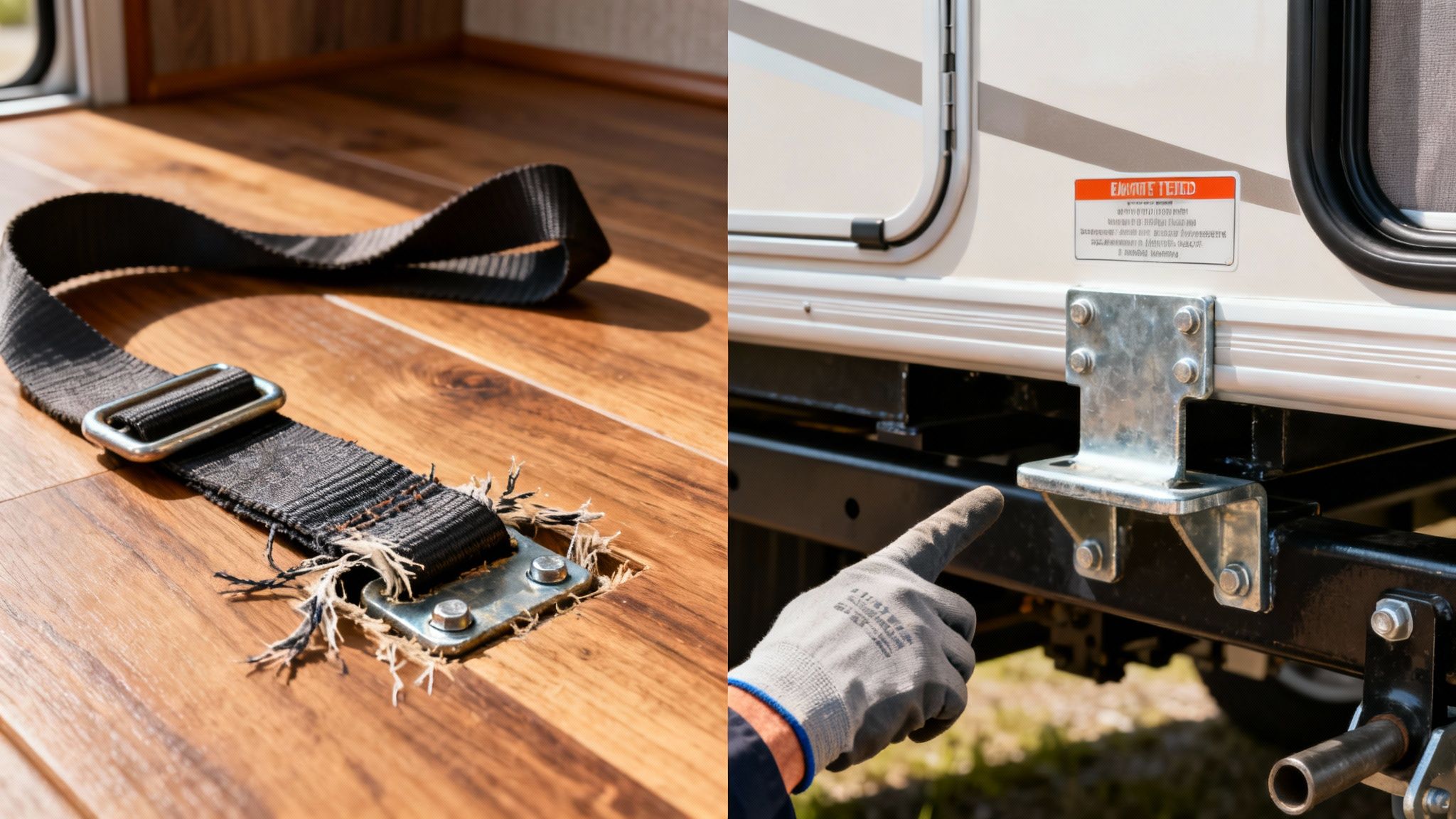
An improperly installed belt gives you a false sense of security. Just picture it: you bolt a seat belt anchor straight into the plywood floor under your dinette bench. It feels solid when you tug on it. But in a crash, the forces are astronomical. That plywood floor will splinter and tear like cardboard, launching the seat—and the person in it—forward. It's a recipe for disaster.
Real, effective seat belts get their strength from one place: the vehicle’s steel chassis. The factory-installed belts in the driver and passenger seats are anchored directly to this high-strength frame, which is why they can handle thousands of pounds of force. Any belt you add has to meet that same standard, and that's where things get complicated.
The Problem with Aftermarket Installations
The fatal flaw in almost every DIY or aftermarket seat belt installation is the failure to connect to the RV's steel skeleton. The entire living area of your motorhome—the "coach" part—is built with wood, aluminum, and fiberglass. These materials are great for keeping you comfortable and dry, but they simply aren't designed to take the immense forces of a collision.
Bolting a seat belt to the coach's floor or a wooden bench is like anchoring a ship to a Styrofoam buoy. The moment a real force is applied, the anchor point will fail completely, rendering the belt useless and potentially causing more harm.
It's not just the anchor point, either. Even the furniture itself is a hazard. Crash tests have shown that dinette benches can collapse or completely disintegrate during an impact, even those with factory-installed lap belts. When the seat structure fails, the occupant can be thrown from their restraint, leading to catastrophic injuries. You can see some sobering examples of these RV-specific risks in studies on procarseatsafety.com.
Questions to Ask a Certified Professional
If you're still determined to explore adding seats and belts, you absolutely must consult a certified RV technician or, even better, a structural automotive engineer. Don't take this job to your regular mechanic. A true professional who understands vehicle dynamics will be able to answer these critical questions:
- How will you anchor the belts to the steel chassis? They need to show you a concrete plan for bypassing the wood floor and tying directly into the vehicle's frame.
- What kind of reinforcement will be used? A proper installation almost always involves adding steel reinforcement plates to distribute the load and stop the anchor from tearing through the frame in a crash.
- Can the seat structure itself handle crash forces? It's not just about the belt. The seat it's attached to has to be strong enough to withstand the same incredible stress.
Adding seat belts is a major modification that gets to the very core of your vehicle's safety design. It’s vital to understand every component of your restraint systems, including how accessories interact with them. A great starting point is learning the essentials of seat belt extender safety to ensure every passenger is as secure as possible.
Ultimately, without professional engineering and a solid connection to the chassis, a DIY seat belt is just a dangerous illusion of safety.
Protecting Children with Car Seats in an RV

When you’re traveling with kids, their safety is everything. It's easy to get lulled into a false sense of security in the cozy, home-like feel of an RV, but the reality is that the laws of physics don't change just because you're on vacation. A collision in a motorhome is just as violent as one in a car.
That’s why the rules for car seats in an RV are so direct and strict. There's simply no room for error. When it comes down to it, there’s only one truly safe place to install a child’s car seat or booster.
The only safe location for a child safety seat is a forward-facing, manufacturer-installed vehicle seat where the seat belt is bolted directly to the RV’s steel chassis.
This almost always means the front passenger seat is your only option. Some Class C motorhomes might have a forward-facing seat right behind the cab that also meets this requirement, but that’s the exception, not the rule.
Every other spot—like those charming dinette booths or comfy side-facing couches—is dangerously unsuitable for a car seat. Let's break down exactly why.
Why Dinettes and Sofas Are Unsafe Zones
Think of the seats in your RV’s living area as furniture, not vehicle safety equipment. They’re built for comfort, usually with wood and lightweight materials, not for withstanding the immense forces of a crash.
Here’s a closer look at why these common seating areas are definite no-gos for kids:
- Side-Facing Seats: Car seats are engineered and crash-tested to protect against frontal impacts. On a side-facing couch, a child's body gets thrown in a twisting motion during a crash, which is a movement the car seat was never designed to handle.
- Rear-Facing Dinettes: While you might think these are better than side-facing, they are still not tested or approved for car seat installation. The dynamics of a crash are completely unpredictable from this position.
- Structural Failure: As mentioned before, the wooden frames of dinette benches can—and do—splinter and collapse in an accident. An rv seat belt bolted to a weak wooden structure is useless. It will fail right when you need it most, making the car seat completely ineffective.
Keeping your entire restraint system in good working order is key. For more on how to care for the individual components, our guide on using a seat belt protector has some great advice.
Safer Travel Alternatives for Families
So, if the living area is off-limits, what’s a family to do? The safest solution often means changing your travel strategy. One of the most practical options is to tow a passenger car behind your motorhome.
This setup allows your children to ride safely buckled into a vehicle that meets all federal crash-test standards. One adult drives the tow vehicle with the kids, while another drives the RV. Not only does this solve the safety issue while you're on the road, but it also gives you a smaller, more convenient vehicle for running errands or exploring once you’ve parked the rig.
Your Pre-Trip RV Seat Belt Inspection Checklist
A seat belt is only as good as the condition it’s in. Before you fire up the engine for your next big trip, taking a moment to inspect your RV seat belts should be as automatic as checking the tire pressure. This quick, 5-minute safety check can help you catch a potential failure before it becomes a tragedy, giving you real peace of mind on the open road.
Think of it like a pilot's pre-flight checklist. It's not about being paranoid; it's about being proactive. By taking a few minutes to look everything over, you're actively confirming your safety gear will actually do its job if you ever need it to.
The Webbing and Stitching Inspection
Start by getting your hands on the belt itself. Pull the entire length of the webbing out from the retractor and run it through your fingers. You're looking for anything that feels "off."
Here's what to keep an eye out for:
- Fraying or Cuts: Check the edges very carefully. Even a tiny nick can seriously weaken the belt's ability to handle the immense force of a crash.
- Sun Damage: Look for faded spots, stiffness, or a brittle texture. Years of sunlight beating down on the webbing can break down the fibers, making them dangerously weak.
- Worn Stitching: Zero in on the stitching, especially where the belt is sewn to the buckle and anchor points. Any thread that's loose or broken is a huge red flag.
Buckle and Retractor Function Test
Next up are the mechanical parts. These are just as crucial as the belt material.
- Buckle Integrity: Click each seat belt into its buckle. You should hear a solid, crisp "click" and it should feel secure when you give it a good tug. Now press the release button—it should pop right out without any hesitation or sticking.
- Retractor Lock-Up: Here's the most important test. Grab the shoulder belt and give it a short, sharp yank. The retractor mechanism needs to lock up instantly, stopping any more webbing from coming out. If there's any delay or it doesn't lock at all, that belt is unsafe and needs immediate attention from a professional.
A seat belt that doesn't lock on demand is a critical failure. This locking function is what holds you in place during a sudden stop or impact. A slow or non-functioning retractor offers zero protection.
Don't forget the little things, either. That small plastic button on the webbing might seem insignificant, but it's what stops the buckle from sliding all the way down to the floor. To understand why this matters for both convenience and safety, you can learn about the function of a seat belt stop clip. If you find any of these issues, that seat is off-limits until the belt has been professionally replaced.
Your Top RV Seat Belt Questions Answered
When it comes to hitting the road in your RV, safety questions always come up. It's smart to ask them! Getting clear, straightforward answers is the only way to make sure you're keeping your family safe. Let's dig into some of the most common—and critical—questions we hear about RV seat belts.
Can Passengers Hang Out in the Back Without a Seat Belt?
This is one of the biggest points of confusion, and for good reason—the laws are all over the map. While federal law is clear about the driver and front passenger needing belts, the rules for the "house" part of the RV can change the minute you cross a state line.
Some states demand that every single person is buckled up, no matter where they're sitting. Others have zero laws for the living area. But here’s the thing: just because something is legal doesn't make it safe. In a crash, an unbelted person becomes a projectile, creating a life-threatening risk for everyone inside. The only way to be truly safe is to have every passenger in a forward-facing seat with a proper seat belt buckled anytime you're in motion.
Are the Seat Belts on the Side-Facing Couch Actually Safe?
Plain and simple: no. Crash test data and safety experts are all in agreement on this one. Side-facing seats offer dangerously poor protection in an accident.
Think about what happens in a typical front-end collision. Your body is thrown forward, but the lap belt on a side-facing couch is positioned to restrain you from the side. This causes your torso and head to whip around violently, putting immense, unnatural force on your spine and internal organs.
While you might find these belts in older RVs, they are not a safe choice for travel. The most secure spot will always be a forward-facing seat with a manufacturer-installed, chassis-mounted 3-point belt.
Is It Okay to Use a Seat Belt Extender in My RV?
This is a critical one. For the front cab seats, you should only use an extender that comes directly from the chassis manufacturer, like Ford, Mercedes-Benz, or Freightliner. They've designed and crash-tested these extenders specifically for their seats and belt systems.
Stay away from the universal, one-size-fits-all extenders you see online. They aren't safety-rated for your specific vehicle and could fail when you need them most. You should also never use an extender on the seat belts installed by the RV coach builder in the living area, as those systems weren't designed or tested to work with any modifications. The right move is to always contact the chassis brand directly for an approved extender.
At Seat Belt Extenders, we offer E-4/E-8 certified extenders that are matched to your vehicle's specific make and model. This ensures you get a secure, factory-grade fit for the cab seats. Find your perfect fit and travel with confidence by visiting us at https://seatbeltextenders.com.