
Getting back behind the wheel can feel like a huge step, but it's one that can restore a profound sense of freedom. Vehicle modifications for disabled drivers are the key to making that happen. These aren't just gadgets; they're thoughtfully engineered solutions that rebuild independence, boost confidence, and ensure safety on the road. The whole process is about figuring out what you need, getting a professional evaluation, and then finding the right equipment to match.
Your Roadmap to Driving Independence
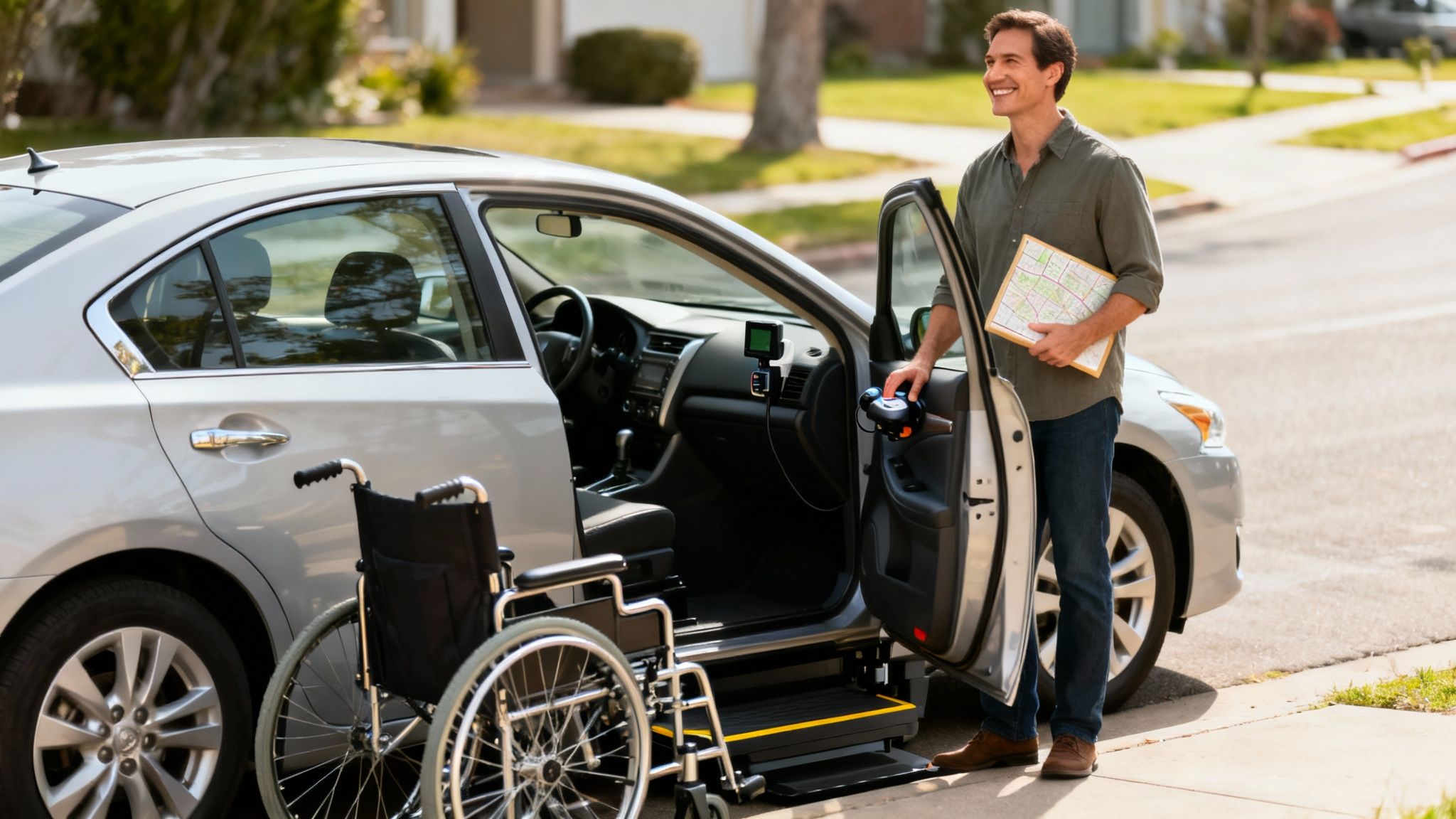
Starting the journey toward an adapted vehicle can seem like a lot to take in, but it helps to think of it as a clear, step-by-step map. This guide is here to break it all down, giving you the information you need to move forward with confidence. It’s less about mechanics and more about regaining your mobility.
At its heart, the challenge is simple: finding the right tools that make driving safe, comfortable, and independent. Thankfully, technology has come a long way, offering practical solutions for almost any physical limitation.
Understanding the Possibilities
The world of adaptive driving equipment is surprisingly vast and always evolving. From straightforward aids to high-tech electronic systems, there's a solution out there for specific mobility needs. The trick is to match the technology to your unique abilities and what you want to achieve with driving.
Some common modifications include:
- Primary Driving Controls: These are things like hand-operated controls for the gas and brake pedals.
- Steering and Secondary Aids: Think spinner knobs for one-handed steering or even voice-activated controls for things like turn signals and wipers.
- Vehicle Access Equipment: This category includes transfer seats, ramps, and lifts that make getting in and out of your car or van a smooth process.
- Essential Safety Components: This also covers specialized devices like the many seat belt extender types that provide a secure and proper fit.
The demand for these solutions is growing fast. The global market for these vehicle modifications was valued at around $5 billion in 2025 and is expected to more than double by 2033. This isn't just a statistic; it shows a real shift in awareness and innovation, making driving accessible to more people than ever before.
The Importance of a Tailored Approach
Every driver is different, and that means every vehicle modification plan should be, too. The entire process starts and ends with you—your specific needs, your lifestyle, and your driving goals. That’s why a professional assessment is such a crucial first step. It ensures that any changes made to your vehicle are not just helpful, but completely safe.
Your vehicle should adapt to you, not the other way around. The goal of any modification is to create a driving environment that feels natural, safe, and empowering, removing barriers so you can focus on the road ahead.
This guide will walk you through it all, from understanding different accessibility tools to figuring out costs and finding certified professionals for installation. We want to give you a clear, encouraging roadmap to help you reclaim your independence and get back on the road.
Understanding the Main Types of Adaptive Equipment
The world of adaptive driving equipment can feel a little intimidating at first, but the goal behind it all is simple: to give you the right tools for safe, independent travel. Instead of seeing them as complex machinery, think of these modifications as custom-fit solutions. They're built to bridge the gap between a physical challenge and the freedom of hitting the road.
We can group the most common vehicle modifications for disabled drivers into a few key areas, with each one designed to solve a specific set of challenges.
To help you get a quick overview, this table breaks down the most common types of equipment and who they're for.
Common Vehicle Modifications and Their Primary Functions
| Modification Type | Primary Function | Ideal For Drivers With |
|---|---|---|
| Hand Controls | Operates the accelerator and brake using hands instead of feet. | Limited or no lower body mobility, leg amputations, or spinal cord injuries. |
| Steering Aids | Reduces the effort required to turn the steering wheel, often enabling one-handed operation. | Limited upper body strength, grip issues, or use of one arm for driving. |
| Transfer Seats | Eases the transition from a wheelchair to the driver's or passenger's seat. | Difficulty standing or transferring, wheelchair users, or limited mobility. |
| Ramps and Lifts | Allows a wheelchair or scooter to be loaded into the vehicle. | Wheelchair and scooter users who need to transport their mobility device. |
| Seat Belt Extenders | Provides extra length for the seat belt to buckle securely and comfortably. | Larger body types, use of mobility aids, or limited reach and dexterity. |
This table is just a starting point. Now, let's dig into what these modifications actually look and feel like in practice.
Mastering Primary Driving Controls
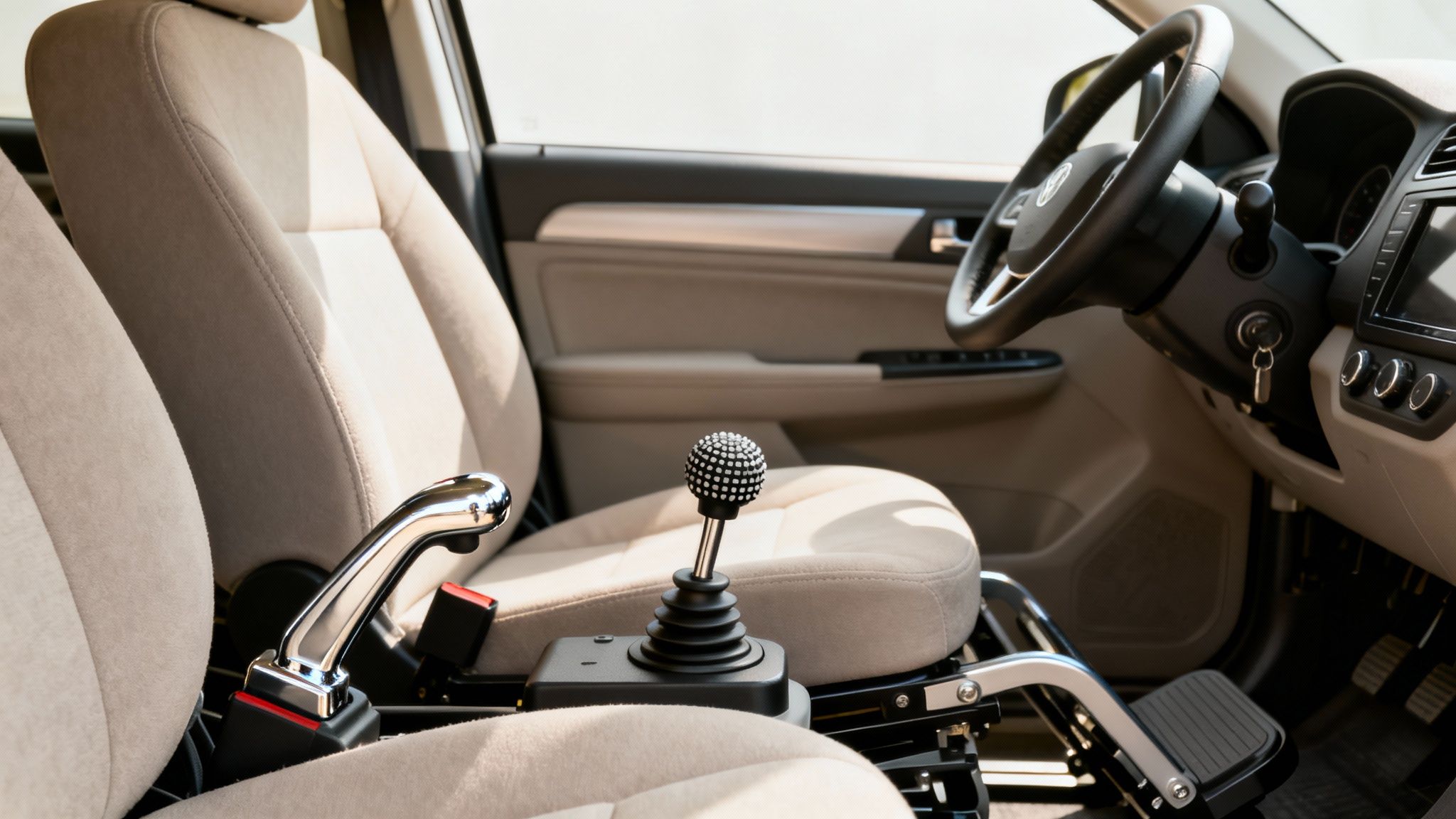
For anyone who has limited or no function in their legs, hand controls are the go-to solution. They elegantly transfer the job of the gas and brake pedals to a hand-operated lever, which is usually installed right next to the steering column.
Think of it like a joystick that controls your car's speed. The most common design is a simple push-pull mechanism:
- Push Forward: This action applies the brakes, giving you smooth and predictable stopping power.
- Pull Backward: This motion hits the accelerator, allowing you to manage your speed with precision.
These systems feel surprisingly intuitive, and with a bit of practice, they become complete second nature. Of course, there are other variations, like levers that you twist to accelerate, which can be better for people with different levels of hand strength. The end goal is always the same: providing a rock-solid, reliable way to control the car's movement.
Enhancing Steering and Secondary Functions
Steering a car demands a good amount of upper body strength and coordination, which can be a real hurdle for some drivers. That’s where steering aids come in—they're designed to make turning the wheel feel effortless, even if you’re driving with one hand.
The most popular tool for this is the spinner knob. This device clamps right onto the steering wheel and gives you a secure, rotating grip. It allows you to spin the wheel through its entire range of motion with one hand, which frees up your other hand to work the hand controls.
A spinner knob is like a power handle for your steering wheel. It multiplies your leverage, making tight turns and tricky parking jobs way easier to handle. It's a simple device that makes a huge difference in control and confidence.
Beyond steering, you also have secondary controls to think about—things like turn signals, wipers, and the horn. These can be integrated directly into the hand control lever or set up on a small keypad that’s easy to reach, so you never have to take your hands off the main controls.
Ensuring Easy Vehicle Access
Sometimes, the biggest challenge isn't driving the car but just getting into it. Accessibility modifications are all about making that process smooth and strain-free, whether you use a wheelchair or have other mobility limits.
Transfer seats are a fantastic solution here. These powered seats can rotate, slide out from the vehicle, and lower to the perfect height. This makes moving from a wheelchair into the driver's seat much safer and less physically demanding.
For wheelchair users who need to bring their chair along, ramps and lifts are absolutely essential.
- Ramps: Typically found in minivans, these can be folded or slid out to create a gentle slope, allowing a wheelchair to roll right into the vehicle.
- Lifts: These are powerful mechanical platforms that raise a wheelchair and its occupant into a larger van or truck—perfect for heavier power chairs.
These kinds of modifications truly transform a vehicle, removing the physical barriers that can keep you from getting behind the wheel.
Prioritizing Safety and Comfort
A truly accessible vehicle is one that considers every detail of your safety and comfort, and that includes the seat belt. A standard belt might not fit correctly or be easy to buckle if you're using modified seating or have limited reach.
For example, getting the shoulder strap to sit in the right place is a common issue. You can learn more about how to use seat belt adjusters for adults to ensure the belt lies flat and comfortably across your body without sacrificing safety.
A proper fit isn't just a comfort issue; it's a critical part of your vehicle's safety system. These small but vital adjustments ensure every driver is secure before the journey even begins.
Getting a Professional Driving Assessment: Your First and Most Important Step
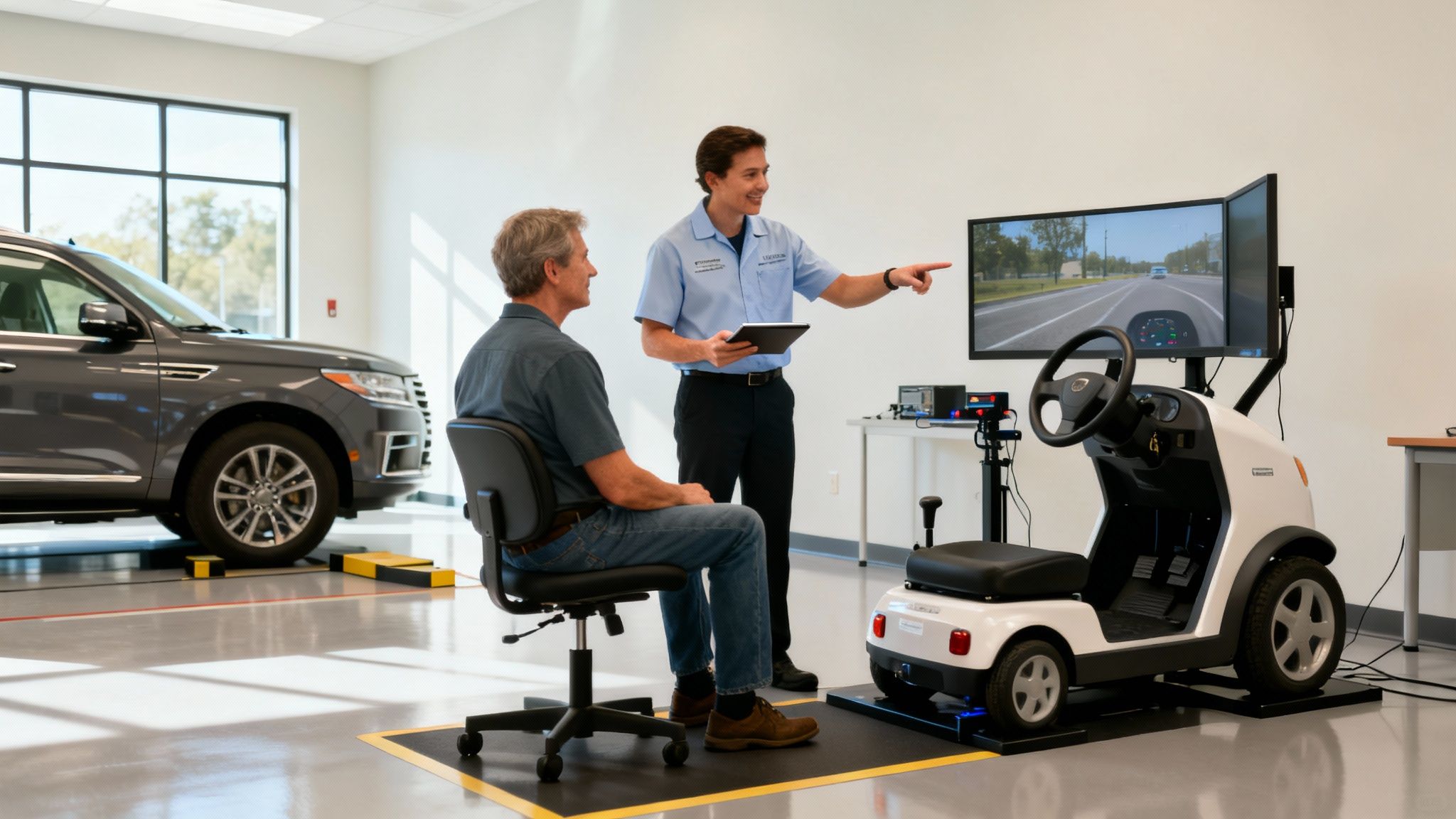
When it comes to vehicle modifications for disabled drivers, this isn't like picking out floor mats or a new sound system. This process is deeply personal, and it all starts with a professional driving assessment. Honestly, this is the single most important step you can take—it’s the foundation for everything that follows.
Think of the assessment as your roadmap. It's where an expert sits down with you to figure out exactly what works for your body, what challenges you might face, and which specific pieces of equipment will get you on the road safely and confidently. It removes all the guesswork.
The person guiding you through this is a Certified Driver Rehabilitation Specialist (CDRS). These are highly trained pros, often with a background in occupational therapy, who specialize in connecting a person's physical abilities with the right adaptive driving technology.
What Happens During a Driving Assessment?
A professional driving assessment is a thorough, two-part evaluation. The whole point is to get a complete picture of your capabilities—first in a clinical setting and then behind the wheel of a specially equipped vehicle.
First up is the in-clinic or off-road evaluation. This is where the specialist really gets to know your physical and cognitive skills.
This initial phase usually covers:
- Vision Screening: Making sure your eyesight is up to par with legal driving standards.
- Physical Function Tests: A hands-on look at your range of motion, muscle strength, coordination, and reaction time.
- Cognitive Evaluation: Checking on the mental skills essential for driving, like attention, memory, and split-second problem-solving.
This process often uses methods from a functional capacity evaluation to get objective, data-driven measurements of your physical abilities. That way, every recommendation is based on solid evidence of what you can safely handle.
The in-clinic assessment isn't a pass-or-fail test. It’s a discovery process designed to understand your specific abilities so the specialist can identify the tools that will work best for you.
Once the specialist has a clear picture of your baseline abilities, you’re ready for the fun part.
The On-Road Evaluation
The on-road assessment is where the rubber meets the road—literally. You’ll get in a vehicle already kitted out with different types of adaptive equipment. With the CDRS and a certified driving instructor right there with you, you get to test-drive various solutions in a real-world setting.
During the drive, you might try out a few things:
- Different Hand Controls: You could test a push-pull lever, then a push-rock system, to see which one feels more natural and intuitive for you.
- Various Steering Aids: The specialist might swap out a spinner knob for a tri-pin grip to find the perfect match for your hand strength and control.
- Other Modifications: Depending on the in-clinic results, you might also try left-foot accelerators or pedal extensions.
Getting to physically try the equipment is invaluable. Seeing a hand control in a brochure is one thing, but feeling how it responds as you navigate a turn is something else entirely. The CDRS will watch how you handle the car, merge into traffic, and tackle maneuvers like parking.
Your Final Prescription for Driving Freedom
After you’ve completed both parts of the assessment, the CDRS puts together a detailed report. This document is essentially your "prescription" for vehicle modifications. It will clearly list the specific equipment recommended just for you.
This report becomes your official proof of need, something you can take to funding agencies, insurance companies, and certified mobility installers. It’s the key that unlocks a safe, reliable, and perfectly customized driving experience, ensuring you get exactly what you need to regain your independence.
Navigating Costs and Finding Financial Assistance
The road to driving independence is an exciting one, but let’s be honest—the cost of adaptive equipment can feel like a major roadblock. Getting a handle on the financial side of vehicle modifications for disabled drivers is one of the most important steps you can take to make your driving goals a reality.
The good news is you don’t have to go it alone. This section is your financial roadmap, designed to break down the typical costs and, more importantly, point you toward the many avenues for funding. From government programs to automaker rebates, you have options.
Understanding the Investment
The cost of modifying a vehicle can swing wildly, from just a few hundred dollars for simpler aids to tens of thousands for complex conversions. It all circles back to what your professional assessment recommended for your specific needs.
Here’s a quick look at what goes into the total price tag:
- Equipment Costs: This is the hardware itself—the hand controls, transfer seat, or wheelchair lift—and it usually makes up the biggest chunk of the expense.
- Installation Fees: Getting everything installed safely by a certified technician isn't just a good idea; it's essential. This professional labor adds to the overall cost.
- Driver Training: Learning to drive with new adaptive gear often involves specialized training sessions to make sure you're both safe and confident behind the wheel.
It helps to think of this as an investment in your freedom and mobility, not just a one-time purchase. Breaking down the costs this way makes the total figure feel less intimidating and helps you target specific funding sources for each part.
Exploring Key Funding Avenues
Once you have a clear picture of the costs, it's time to start looking for financial help. A lot of organizations and programs are out there specifically to help people with disabilities get the tools they need for independent living.
The most effective strategy is often to combine a few different funding sources. Don't just pin your hopes on one application—cast a wide net to cover all the different pieces of your vehicle modification project.
A great starting point is learning how to apply for accessibility grants, which are created precisely for this purpose. From there, you can branch out into these other key areas.
Government and State-Level Programs
Government programs are often the backbone of financial support for vehicle modifications. In the United States, every state has a Vocational Rehabilitation (VR) agency. If you need your vehicle to get to a job, these agencies can be an incredible resource for funding.
This kind of support is making a huge difference globally, too. In India, for example, over 96,000 adapted vehicles have hit the road since 2020, thanks to supportive government policies. Similarly, governments across North America and Europe often help with easier financing and other perks, proving that official support directly helps more people get the modifications they need.
Manufacturer Rebates and Non-Profit Grants
Don't overlook the automakers themselves. Many car manufacturers offer mobility rebate programs to help with the cost of adaptive equipment. When you buy a new vehicle, companies like Ford, Toyota, and General Motors often give rebates up to $1,000 or more to cover the installation of modifications.
Beyond that, countless non-profit organizations offer grants for assistive technology. Start by looking for national groups related to your specific disability, but don't forget to check out local community foundations that might offer financial aid as well. And remember, for any modification to work properly, every part of the vehicle's safety system has to be right. For instance, our guide on finding the perfect seat belt adapter can help ensure your entire setup works together seamlessly.
Getting Your Modifications Installed Safely and Properly
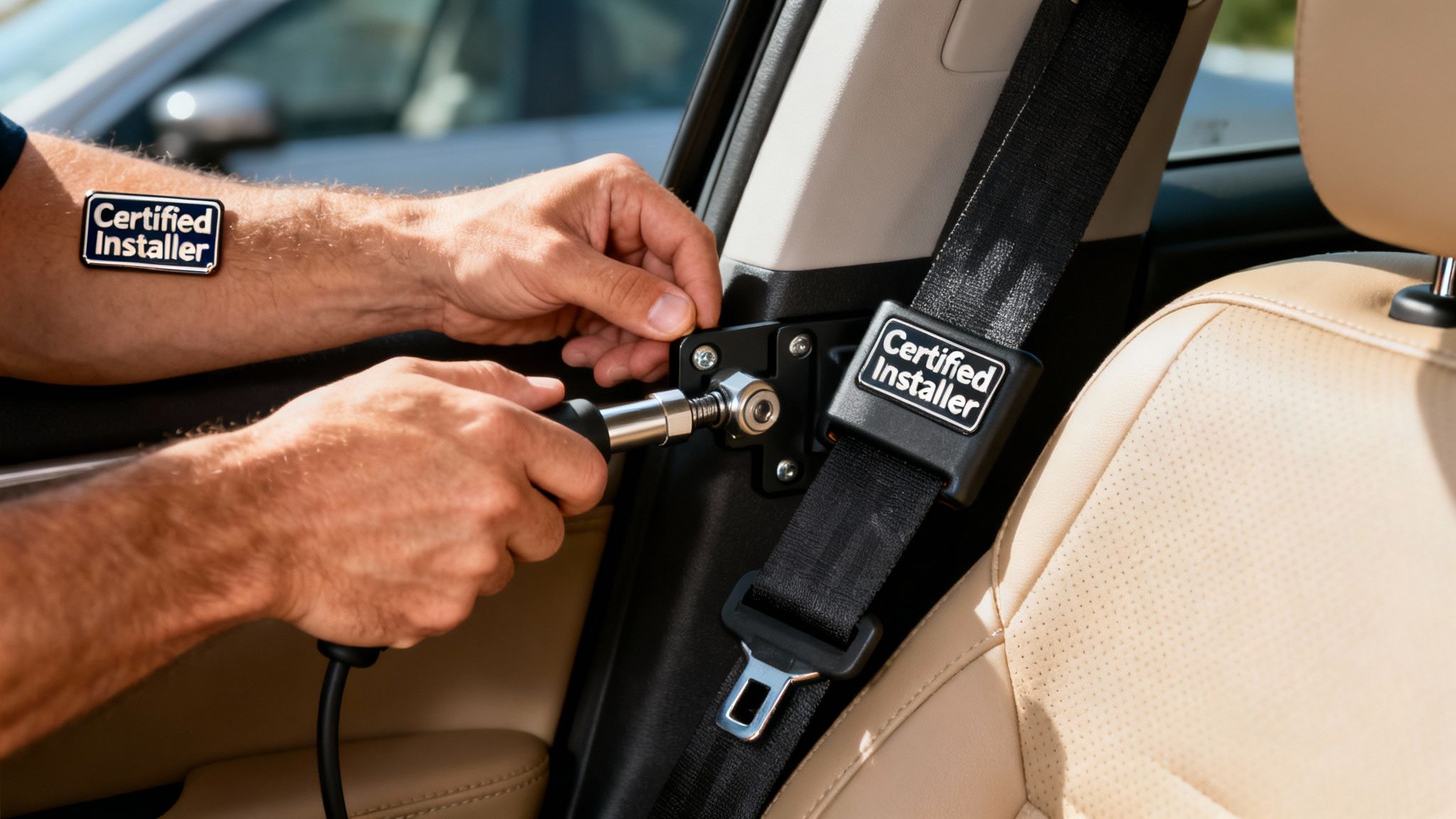
You've done the hard part—you've figured out what you need and how you're going to pay for it. Now comes the most important step: the installation. This is where the rubber meets the road, literally. Getting your vehicle modified isn't a DIY job for a Saturday afternoon; it's a specialized task that directly impacts your safety every time you drive.
Think of it this way: you wouldn't let just anyone perform surgery, and modifying your car's core functions—steering, braking, accelerating—is just as serious. A tiny error in installation can have huge consequences. That’s why finding a certified professional isn't just a recommendation; it's a necessity.
The Gold Standard: Finding a NMEDA-Accredited Dealer
When you start looking for someone to install your equipment, there’s one name you should look for above all others: the National Mobility Equipment Dealers Association (NMEDA). This organization is the benchmark for safety and quality in the adaptive vehicle industry.
Choosing a dealer with NMEDA accreditation means you're hiring a team that has met incredibly high standards. Their technicians are more than just mechanics—they're specialists who are constantly trained on the newest adaptive technology and installation methods. They know how to integrate these complex systems into your vehicle without compromising its original safety features.
A NMEDA-accredited dealer doesn't just give you a quality installation; they give you peace of mind. You can drive away knowing your vehicle meets or exceeds all safety standards, keeping you and your passengers safe on every trip.
A certified pro will also walk you through how to use all your new equipment. They won't just hand you the keys; they'll make sure you're completely comfortable and confident before you head out on your own.
Making Sure Everything Meets Safety Regulations
It’s not just about the installer—the equipment itself has to be up to snuff. In the U.S., the National Highway Traffic Safety Administration (NHTSA) sets the rules with its Federal Motor Vehicle Safety Standards (FMVSS). These regulations cover everything in your car, from the brakes to the seat belts.
Any reputable manufacturer of adaptive equipment designs and tests its products to meet these rigorous standards. When you use a NMEDA-accredited installer, you can be sure they will install that equipment correctly, without interfering with your car’s built-in safety features like airbags or crumple zones.
A compliant, professional installation always includes:
- Following Manufacturer Guidelines: Technicians stick to the precise instructions from the equipment maker.
- Preserving Factory Safety Systems: They ensure the car’s original safety features work exactly as they did before the modification.
- Final Quality Checks: Before you get your car back, they perform a comprehensive inspection to make sure everything is working perfectly.
Don't Overlook Certified Safety Components
A truly safe vehicle modification is about the whole package, right down to the smaller details. Items like seat belt extenders might seem minor, but they are absolutely critical. If you have a transfer seat or limited mobility, the factory seat belt might not fit properly anymore, which means it can't protect you in a crash.
It is essential that you only use a certified, vehicle-specific seat belt extender. Those cheap, universal extenders you see online are a huge risk—they often haven't been safety tested and can easily fail when you need them most. A compliant extender is engineered to match your car's specific buckle, creating a secure connection just like the original.
It's also smart to know the rules. If you're unsure, you can learn more about whether seat belt extenders are legal and compliant where you live. This knowledge ensures you make a safe choice, putting the final, crucial piece of your vehicle's accessibility puzzle into place.
Common Questions About Vehicle Modifications
Diving into the world of adaptive driving can feel a bit overwhelming at first. It makes sense—you're not just picking out new floor mats; you're making crucial decisions about your safety, independence, and finances. Let's walk through some of the most common questions that come up when people start looking into vehicle modifications for disabled drivers.
We'll clear up the big concerns right away, from who can install the equipment to how it affects your car's warranty. The goal here is to give you solid, reliable answers so you can move forward with confidence.
Can I Install Adaptive Driving Equipment Myself?
This is easily one of the most asked questions, and the answer is a hard no. You should never attempt to install adaptive driving equipment yourself. This isn't like bolting on an aftermarket accessory. We're talking about modifying your vehicle's core systems—the very controls for steering, accelerating, and braking.
For safety and liability reasons, a certified technician has to do the job. The best-case scenario is having the work done at a dealer accredited by the National Mobility Equipment Dealers Association (NMEDA).
A professional installation guarantees a few critical things:
- The equipment is a perfect fit for your specific make and model.
- It will work reliably every single time you drive.
- Your car's built-in safety features, like airbags and crumple zones, remain fully functional.
Will Vehicle Modifications Affect My Car Warranty or Insurance?
It's a smart question, and the short answer is yes, modifications can potentially affect both. The key is to be proactive. You’ll want to have conversations with your vehicle manufacturer and your insurance agent before any work gets started.
Many automakers have mobility programs that not only approve certain modifications but may even offer rebates to help with the cost. This is the best way to ensure your factory warranty stays intact. Just call your dealer or the manufacturer's customer service line to find out their policies.
When it comes to insurance, you must inform your provider about every modification. This new equipment adds value to your vehicle, and your policy needs to cover that. Your premium might go up slightly, but failing to disclose these additions could lead to a denied claim if you're ever in an accident.
How Do I Know if a Seat Belt Extender Is Safe and Compliant?
When you’re dealing with safety equipment like a seat belt extender, there's absolutely no room for guesswork. A safe, compliant extender is one that's been put through the wringer with professional testing and certification. Look for products that meet E4 or E8 certification standards—these are tough European safety benchmarks that are recognized worldwide as a sign of quality.
But safety isn't just a label. A truly safe extender has to be designed specifically for your vehicle's make and model. That’s the only way to guarantee it clicks in securely and performs just like the buckle that came from the factory.
Please, avoid the generic, one-size-fits-all extenders you see on huge online marketplaces. These uncertified products are a major safety risk. They haven't been tested to withstand crash forces and can fail when you need them most. A reputable seller will always match the extender to your exact car to ensure a secure, factory-like fit.
What Is the Difference Between a Ramp and a Lift?
Both ramps and lifts get a wheelchair user into a vehicle, but they work in completely different ways. Think of a ramp as a simple, sloped surface that unfolds or slides out, allowing someone to roll their wheelchair straight into the vehicle. You’ll most often see them on minivans with lowered floors.
A lift, on the other hand, is a powered platform that does the heavy work, raising the wheelchair and its occupant up to the vehicle's floor level. Lifts are usually necessary for heavier power wheelchairs and are installed in bigger vehicles like full-sized vans or trucks where the floor is much higher off the ground.
The right choice really comes down to the user's upper body strength, the kind of wheelchair they use, and the vehicle itself.
Sometimes, modifications can set off pesky in-car warnings. If you run into that, you can learn how to disengage a persistent seat belt alarm and restore some peace and quiet to your drive.
At Seat Belt Extenders, we believe getting the safety and accessibility you need shouldn't be complicated. Our E4/E8 certified, vehicle-specific extenders are designed to give you a secure, reliable fit and the peace of mind that comes with it. Find your perfect match and drive with confidence by visiting us at https://seatbeltextenders.com.