
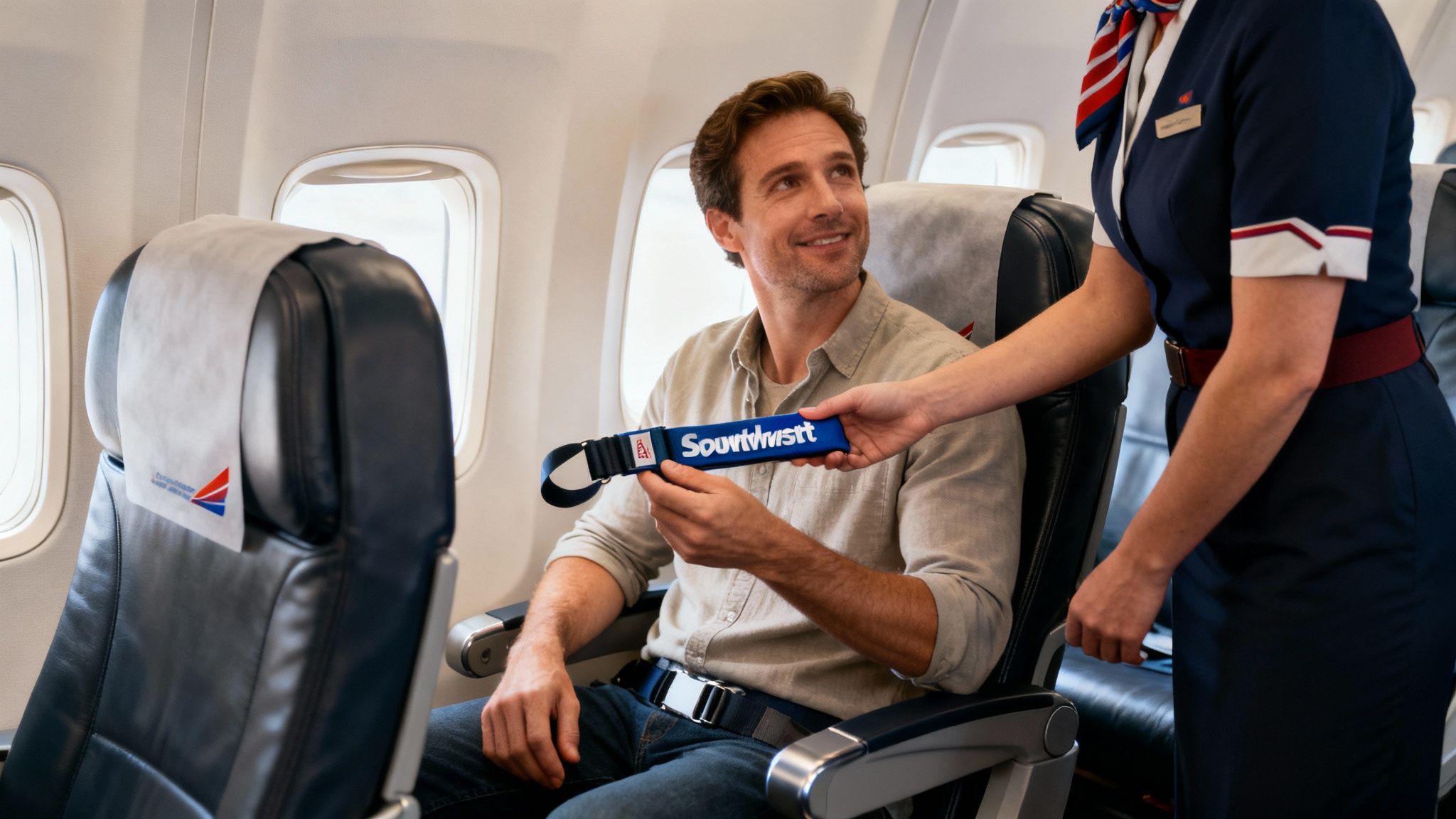
Flying can be stressful enough without worrying if the seat belt will fit. If you're flying Southwest, you can put that concern to rest. Southwest Airlines provides FAA-approved seat belt extenders on every single flight, and they are always free of charge.
Flight crews are completely accustomed to these requests, so asking for one is a simple, no-fuss part of ensuring everyone is buckled in safely.
Your Guide to Comfort and Safety on Southwest
Airline rules can feel like a maze, but when it comes to a Southwest seat belt extender, the process is refreshingly simple. My goal here is to walk you through everything you need to know, swapping any travel anxiety for confidence. By the time you're done reading, you'll know exactly what to do from booking to landing.
A little preparation goes a long way. Knowing the specifics of how to ask for and use an extender can make your entire travel day feel smoother and more relaxed.
What This Guide Covers
Think of this as your complete playbook for seat belt extenders on Southwest. We’ll cover all the bases so there are no surprises when you get on the plane.
Here's a quick preview of what we'll get into:
- Southwest's Official Policy: We’ll break down the airline's rules for extenders, including their "Customers of Size" policy.
- How to Ask for an Extender: I’ll share some easy, discreet ways to request one from the flight attendant once you're on board.
- Safety and Certification: This is a big one. We'll explain why you can only use the extender provided by the airline and what makes them safe.
- Extra Comfort Tips: Beyond the extender, we'll offer a few other tips to help make your flight as comfortable as possible.
Having all this information in one spot means you can focus on your trip, not on worrying about the small stuff.
The bottom line is this: your safety is non-negotiable. Flight attendants handle requests for seat belt extenders all day, every day. It's a standard part of their job to make sure every passenger is safely secured.
To get a clearer picture of the hardware involved, our general guide on the different types of plane seat belts offers some great background info. It really highlights why using the airline's specific equipment is so important for your safety.
For a quick reference, here's a table summarizing the key points for using an extender on Southwest.
Southwest Seat Belt Extender Quick Facts
This table gives you an at-a-glance summary of everything you need to remember for your next flight.
| Attribute | Details |
|---|---|
| Availability | Provided for free on every Southwest flight. |
| How to Request | Ask any flight attendant as you board or once you find your seat. |
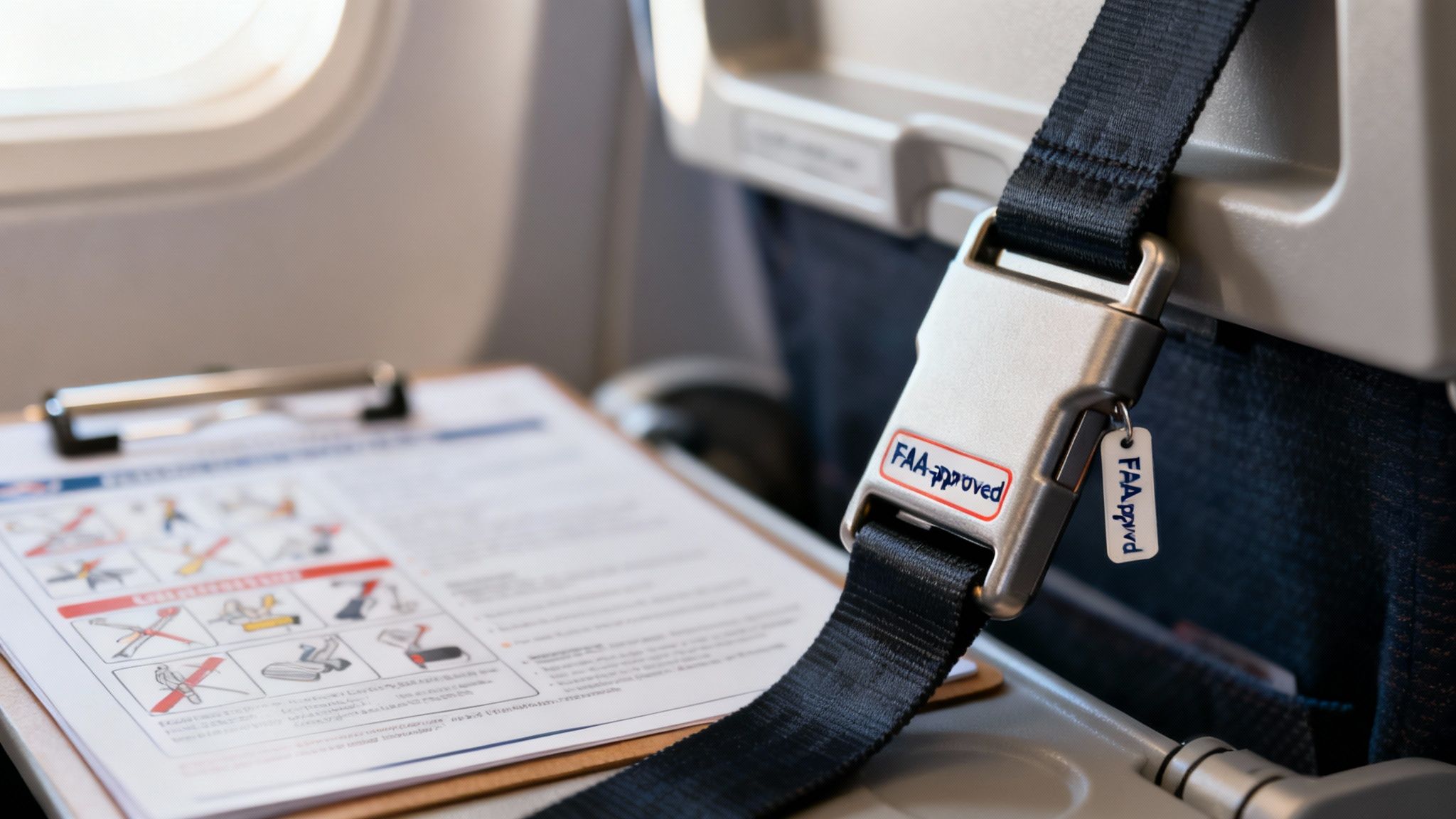
| Can I Bring My Own? | No. Only extenders provided by Southwest are FAA-approved for their aircraft. |
| Safety Certification | Southwest extenders are certified with a TSO-C22g or E-8 tag for safety. |
| Typical Length | Adds approximately 25 inches to the standard seat belt. |
| When to Use | Must be used for taxi, takeoff, landing, and whenever the seat belt sign is on. |
Knowing these facts ahead of time helps ensure your travel day is as smooth and worry-free as possible.
Understanding Southwest's Official Policies
Airline policies can feel a bit overwhelming, but Southwest keeps its rules on passenger safety refreshingly simple. The number one rule is that every single passenger must be safely buckled in. For anyone who needs a southwest seat belt extender, the airline has a clear and easy process to follow.
It all comes down to the flight crew. The only extenders you can use on a Southwest flight are the ones provided directly by a flight attendant. This isn't just Southwest's preference—it’s a non-negotiable safety rule tied directly to Federal Aviation Administration (FAA) regulations.
Think of it this way: the airline is responsible for every piece of safety gear on that plane, from the seat belts to the life vests under your seat. The extenders they hand out are part of that same rigorously inspected system, so they know for sure that it's compatible and in perfect working order.
The FAA's Rule on Personal Extenders
A question I hear all the time is, "Why can't I just bring my own extender?" The answer is simple: federal law. The FAA strictly prohibits passengers from using their own third-party seat belt extenders on any commercial flight. This isn't a Southwest rule; it's a rule for all U.S. airlines.
The reason is all about safety and accountability. An extender you buy online, even if it looks exactly the same, has no verifiable maintenance history. The airline has no way to know its age, its condition, or if it's been under stress that could cause it to fail when you need it most.
When you use an extender provided by the airline, you’re using a piece of equipment that is guaranteed to meet the strict safety standards for that specific aircraft. It's a critical difference, as federal guidelines make clear. You can dive deeper into the legal side of this in our article explaining if seat belt extenders are legal.
Connecting Seat Belts to the 'Customer of Size' Policy
Southwest's focus on passenger accommodation goes beyond just the seat belt. The airline is well-known for its "Customer of Size" policy, which is designed to make sure every traveler has a safe and reasonably comfortable flight. This policy comes into play when a passenger can't comfortably lower both armrests and fit into a single seat.
The guidelines are meant to be proactive. If you think you might need more room, Southwest encourages you to purchase an extra seat when you book your ticket. This way, you can guarantee you'll have the space you need without encroaching on another passenger's seat.
What really makes Southwest stand out is its refund process for that second seat.
While plus-size passengers may need to purchase an additional seat, Southwest has a long-standing practice of refunding the cost of that second seat if the flight is not sold out. This compassionate approach sets it apart from many other carriers. You can learn more about the FAA's stance on personal extenders and why airline-provided equipment is mandatory in this insightful report from ABC News.
This policy offers a practical solution, allowing travelers to secure their space with the peace of mind that comes from a potential refund.
How These Policies Work Together
The seat belt extender rule and the Customer of Size policy are really two sides of the same coin: ensuring everyone can fly safely and with dignity. They work hand-in-hand to address different passenger needs.
- Seat Belt Extender: This is a safety device handed out by the crew to make sure your belt fastens securely.
- Customer of Size Policy: This is a comfort and space policy that ensures you have enough room, which in turn allows the seat belt and any needed extender to work correctly.
At the end of the day, both policies show Southwest's commitment to accommodating passengers while sticking to the strict safety standards set by the FAA. By understanding how they work, you can board your flight with confidence, knowing exactly what to expect.
How to Discreetly Request a Seat Belt Extender
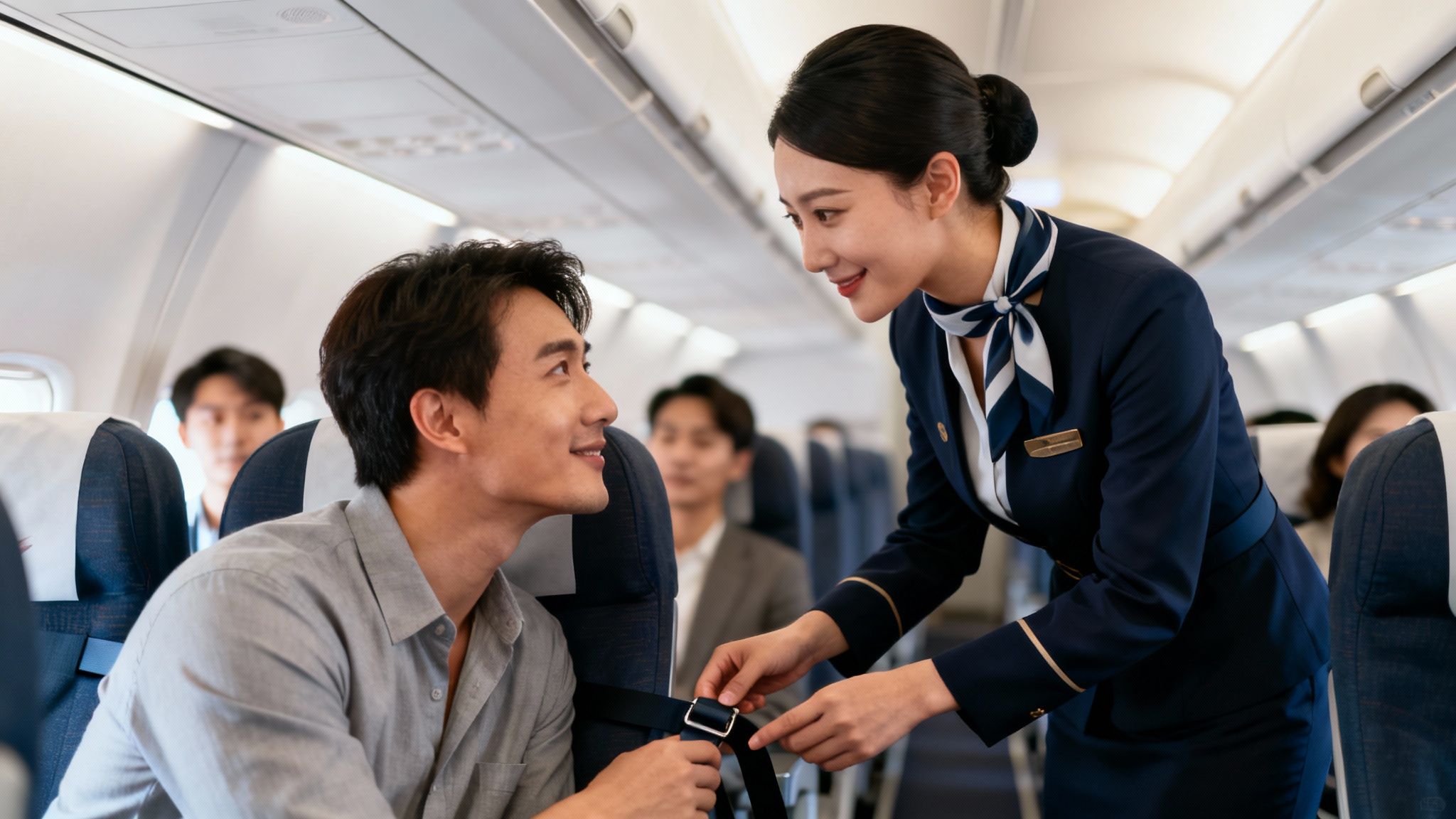
Let's be honest, asking for a southwest seat belt extender can feel a bit awkward, even though it's purely a matter of safety. Many travelers worry about feeling singled out, but the reality is quite different. For flight attendants, this is a routine part of their job, something they handle multiple times on any given day. To them, it’s just another safety check, like making sure your tray table is up.
The trick to a smooth and stress-free experience is all in the timing and approach. With a little forethought, you can get what you need quickly and privately, ensuring you’re buckled in safely without any fuss.
Best Times to Make Your Request
Timing really is everything. You want to catch a flight attendant when they aren't swamped and can help you without an audience. Trying to flag someone down in a crowded aisle during the main boarding rush is probably not your best bet.
Here are the two moments that work best:
- As You Board the Aircraft: When you first step onto the plane, there's almost always a crew member greeting passengers at the door. This is the perfect opportunity to quietly make your request before you even find your seat.
- After You Find Your Seat: Once you're settled in, just catch a flight attendant’s eye as they move through the cabin. A simple, low-key request from your seat is easy, especially before the plane is completely full.
Choosing one of these windows makes the whole interaction quick and seamless, keeping it between you and the crew member.
Simple and Effective Phrases to Use
You don’t need to overthink what to say. A short, polite, and direct phrase is all it takes. Flight attendants hear this all the time and will know exactly what you need.
Try one of these simple lines:
- "Hi, could I please get a seat belt extender?"
- "Excuse me, I'll need an extender for my seat when you have a chance."
- "May I have a seat belt extender, please?"
Remember, you're taking a responsible step for your own safety. The flight crew sees it that way, too. Their number one priority is making sure every single passenger is securely buckled in before takeoff.
On the rare occasion an extender isn't immediately handy, they’ll make a mental note and bring one to you as soon as they can. The plane won't—and can't—depart until you are safely secured. It's a non-negotiable part of their safety protocol, and providing a southwest seat belt extender is part of that commitment.
For more general tips that apply across airlines, our guide on using a seat belt extender for airplanes is a great resource to help you feel prepared for any flight.
Why FAA Safety Certifications Are Non-Negotiable
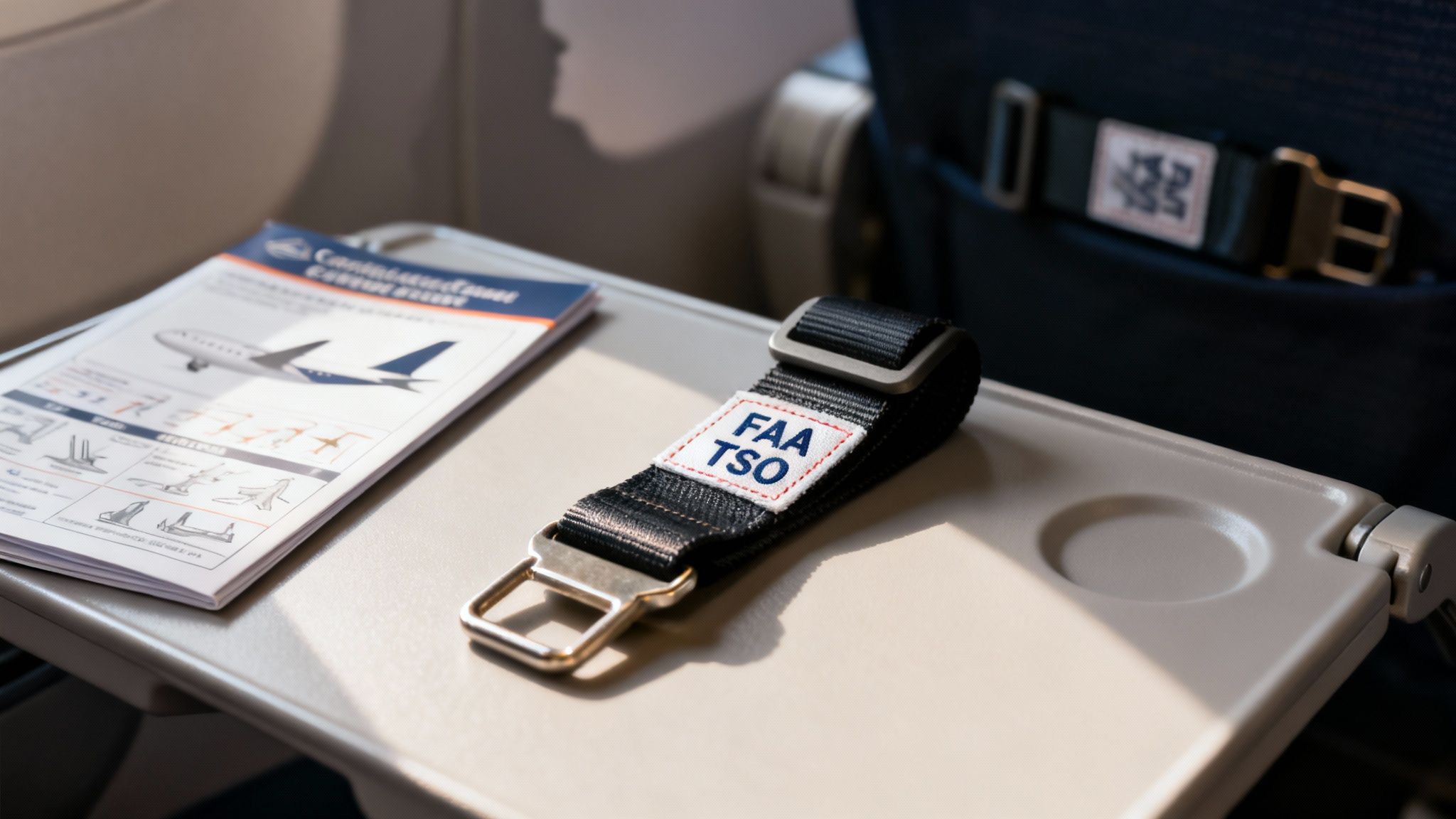
Ever wondered why you can't just bring your own seat belt extender on a plane? It seems simple enough. But the reason is all about safety science, not just airline policy. This isn't an arbitrary rule—it's a federal mandate put in place to protect every single person on board.
When a Southwest flight attendant hands you an extender, you're getting a piece of equipment that has been rigorously tested, inspected, and certified to meet the highest safety standards in aviation. It's a critical part of the plane's safety system.
Think of it like this: an airline's extender is like a prescription medication from a pharmacy. It’s regulated, verified, and guaranteed to be exactly what it claims to be. A personal extender you buy online is more like an unregulated supplement. It might look the part, but there’s no official guarantee of its strength or effectiveness when it matters most.
Decoding FAA Technical Safety Orders
At the heart of this safety-first approach are Technical Safety Orders, or TSOs. These are the minimum performance standards set by the Federal Aviation Administration (FAA) for every part and appliance used on civil aircraft. When a seat belt or extender has an FAA TSO tag, it means it has passed a whole battery of intense tests.
This certification is your assurance that the device can handle immense physical stress. During severe turbulence or an emergency landing, the forces pulling on a seat belt system can be thousands of pounds. A TSO certification ensures the extender won't break, deform, or unlatch under those extreme conditions.
An FAA TSO certification is not just a label; it's a promise of reliability. It confirms that the equipment has been manufactured under strict quality control and can perform its life-saving function without failure when subjected to incredible force.
Because personal extenders don't have this verifiable certification and maintenance history, airlines have no way to confirm their safety. This is the core reason the FAA and, by extension, Southwest prohibit their use. To learn more about this critical distinction, you can explore our detailed guide on what makes a seat belt extender FAA approved.
The Science of Strength and Reliability
The materials and construction of airline-provided extenders are engineered for one thing: extreme durability. For example, the Southwest-compatible seat belt extenders they use often carry an E-9 safety certification, meaning they are tested to withstand up to 3,000 pounds of pressure.
This incredible strength, usually achieved with high-tensile polyester webbing, is essential for keeping you secure during unexpected, high-G-force events. That level of tested reliability is something a third-party product from an unknown manufacturer simply cannot guarantee. The airline's equipment is part of a closed-loop system of maintenance, inspection, and replacement, ensuring every extender in service is airworthy.
A side-by-side comparison makes the difference crystal clear.
Airline-Provided vs Personal Seat Belt Extenders
While bringing your own might seem convenient, the differences in safety and compliance are significant. This table breaks down why airlines only trust their own equipment.
| Feature | Airline-Provided Extender | Personal (Third-Party) Extender |
|---|---|---|
| Certification | FAA TSO-C22g or equivalent | Unverified or none |
| Maintenance History | Tracked and logged by the airline | Unknown |
| Material Strength | Tested to withstand thousands of pounds of force | Unguaranteed and potentially substandard |
| Airline Acceptance | Universally accepted on their own aircraft | Prohibited by all U.S. carriers |
| Liability | Covered by the airline's safety program | Passenger assumes all risk |
Ultimately, using the airline's extender is the only way to ensure the entire seat belt system—from the buckle in the seat to the extender's latch—functions as a single, certified safety device. It removes all the guesswork and puts your well-being first.
Making Your Flight More Comfortable
Getting a Southwest seat belt extender is a great first step for safety, but real in-flight comfort is about more than just the buckle. With a little planning, you can turn a potentially cramped flight into a genuinely pleasant experience. It’s all about knowing how to work with Southwest’s unique system and making a few smart choices before you even leave for the airport.
Think of it like building a personal comfort kit for your journey. You wouldn't forget your headphones or a good book, right? In the same way, planning your seating and even what you wear can make a world of difference.
Making Southwest's Open Seating Work for You
Southwest is famous for its open seating policy—no assigned seats here. While it might seem chaotic, it's actually a golden opportunity if you know how to play the game. Your boarding group (A, B, or C) dictates when you get on, and an earlier group means you get the pick of the litter.
If you snag an early boarding position, you can scout out a spot that gives you a little extra breathing room.
- Aisle Seats: A classic choice for a reason. You can get up and stretch without climbing over anyone, and you get a bit more elbow room on one side.
- Bulkhead Rows: These are the seats right at the front. They often have more legroom because there's no seat in front of you. Just be aware that the tray table is in the armrest, which can make the seat feel slightly narrower.
- The Back of the Plane: Most people rush to fill the front seats first. If you have a later boarding group, make a beeline for the back. You're more likely to find an open row or at least an empty middle seat back there.
The trick to a good boarding spot? Set an alarm and check in exactly 24 hours before your flight. It’s the best way to get ahead without paying extra.
How to Guarantee Your Space
For many travelers, the best way to eliminate any anxiety about space is to handle it head-on. This is where Southwest's "Customer of Size" policy is a game-changer. It allows you to book a second seat, guaranteeing you’ll have the room you need.
What's really incredible about this policy is that you can get a full refund for the second seat after your trip, as long as the flight wasn't sold out. This takes all the guesswork out of the equation. No more hoping for an empty middle seat—you've already secured it.
By using the Customer of Size policy, you’re not leaving your comfort to chance. You're taking control and ensuring a stress-free flight for yourself and the passengers around you.
Simple Tips for a Better Flight
Beyond specific airline policies, a few universal tricks can improve any flight, no matter where you're headed.
- Dress in Layers: Cabin temperatures are notoriously unpredictable. Wearing a t-shirt with a sweater or light jacket means you can easily adjust if you get too hot or cold.
- Fly During Off-Peak Times: If you have some flexibility, flying on a Tuesday, Wednesday, or Saturday usually means emptier planes. Fewer people on board means a better chance of scoring an empty seat next to you.
- Hydrate, Hydrate, Hydrate: The recycled air on planes is incredibly dry. Sipping water throughout your flight will keep you from feeling sluggish and headachy when you land.
Combine these simple habits with a solid understanding of Southwest's seating, and you’ll be set for a much more comfortable journey. And to feel even more prepared, you can check out our deep dive into airline seat belt sizes across different carriers.
Your Questions About Southwest Extenders, Answered
Even when you know the rules, a few specific questions always pop up when you're getting ready to fly. Let's clear up any lingering concerns you might have about using a Southwest seat belt extender so you can board with confidence.
Think of this as a quick chat to go over the fine print. I'll give you straightforward answers to the most common questions people ask.
Can I Use an Extender in an Exit Row Seat?
This is a big one, and the answer is a firm no. Federal Aviation Administration (FAA) rules are crystal clear on this: seat belt extenders are prohibited in exit rows on all airlines, including Southwest.
There’s a critical safety reason for this. Passengers in an exit row are there to help, if needed, during an emergency evacuation. An extender, while a safety device in any other seat, could unfortunately become a tripping hazard or slow things down in a crisis.
If you’re sitting in an exit row and let a flight attendant know you need a Southwest seat belt extender, they will politely help you find a new seat. It's a non-negotiable safety protocol designed to keep everyone safe.
Your safety is the top priority. While exit rows offer fantastic legroom, they come with real responsibilities. Following this rule ensures the path to the exit remains clear for everyone in the unlikely event of an emergency.
What If I Feel Embarrassed Asking for an Extender?
It's completely natural to feel a little self-conscious asking for something that feels like a special accommodation. But I encourage you to reframe it: you're not asking for a favor, you're following a standard safety procedure. Your safety, and the safety of others, depends on you being buckled in securely.
Think about it from the flight attendant's perspective. They are seasoned professionals who handle these requests on every single flight. For them, handing you an extender is as routine as getting someone a drink of water or a blanket. It's a normal part of their job, and they are there to help you, not to judge.
Here are a few tips to make it feel more comfortable:
- Ask Early and Quietly: The best time is as you’re boarding. Just catch the eye of the flight attendant greeting passengers at the door and make a quiet request.
- Keep it Simple: A discreet, "Could I please have a seat belt extender when you have a moment?" is all it takes.
- Remember Their Role: Their main job is to ensure the cabin is safe for takeoff. By asking for what you need, you're actually helping them do their job.
Their focus is on safety, not on making anyone feel awkward. They'll appreciate you speaking up so they can make sure you're properly secured.
Does Southwest Charge for Seat Belt Extenders?
Absolutely not. Southwest Airlines provides FAA-approved seat belt extenders to any passenger who needs one, completely free of charge. This is standard practice across every major U.S. airline.
Seat belt extenders are considered essential safety equipment, right up there with the life vests under your seat and the oxygen masks. Airlines are required to have them on hand and can't charge you to use one. You’ll never be asked to pay for this crucial piece of safety gear.
Are All Airline Seat Belt Extenders the Same Size?
This is a really sharp question. While most airlines, including Southwest, use what’s known as a "Type A" buckle, there can be slight variations in the design from one aircraft to another, or even between seats on the same plane. Luckily, Southwest’s fleet is made up almost entirely of Boeing 737s, which creates a lot of consistency.
But this is exactly why you must use the extender provided by the flight crew. The Southwest seat belt extender they give you is guaranteed to be the correct, FAA-approved model for that specific aircraft's seat belt system. It’s been tested and certified to work perfectly with that buckle, eliminating any guesswork or safety risks.
Bringing your own extender, even if it looks identical and seems to click in, introduces a dangerous unknown. You simply can't be sure it will hold under the incredible forces of severe turbulence or an emergency. The airline's extender removes all doubt and ensures the entire system works as a single, certified unit.
Here at Seat Belt Extenders, we’re dedicated to providing safe, reliable, and certified solutions for your car. While airline rules mean you need to use their extenders in the sky, we’ve got you covered for the drive to the airport and every other journey. Find your perfect fit for over 65 car makes by visiting us at https://seatbeltextenders.com.