
That quiet moment of panic as you pull the two ends of the seat belt together... will they click? It’s a silent stress that millions of travelers face, and it has nothing to do with them and everything to do with the fact that airline seat belt length is surprisingly inconsistent.
This lack of standardization creates a real problem, impacting not just comfort and dignity, but the fundamental safety of passengers on virtually every flight.
Why Airline Seat Belt Length Can Be So Stressful
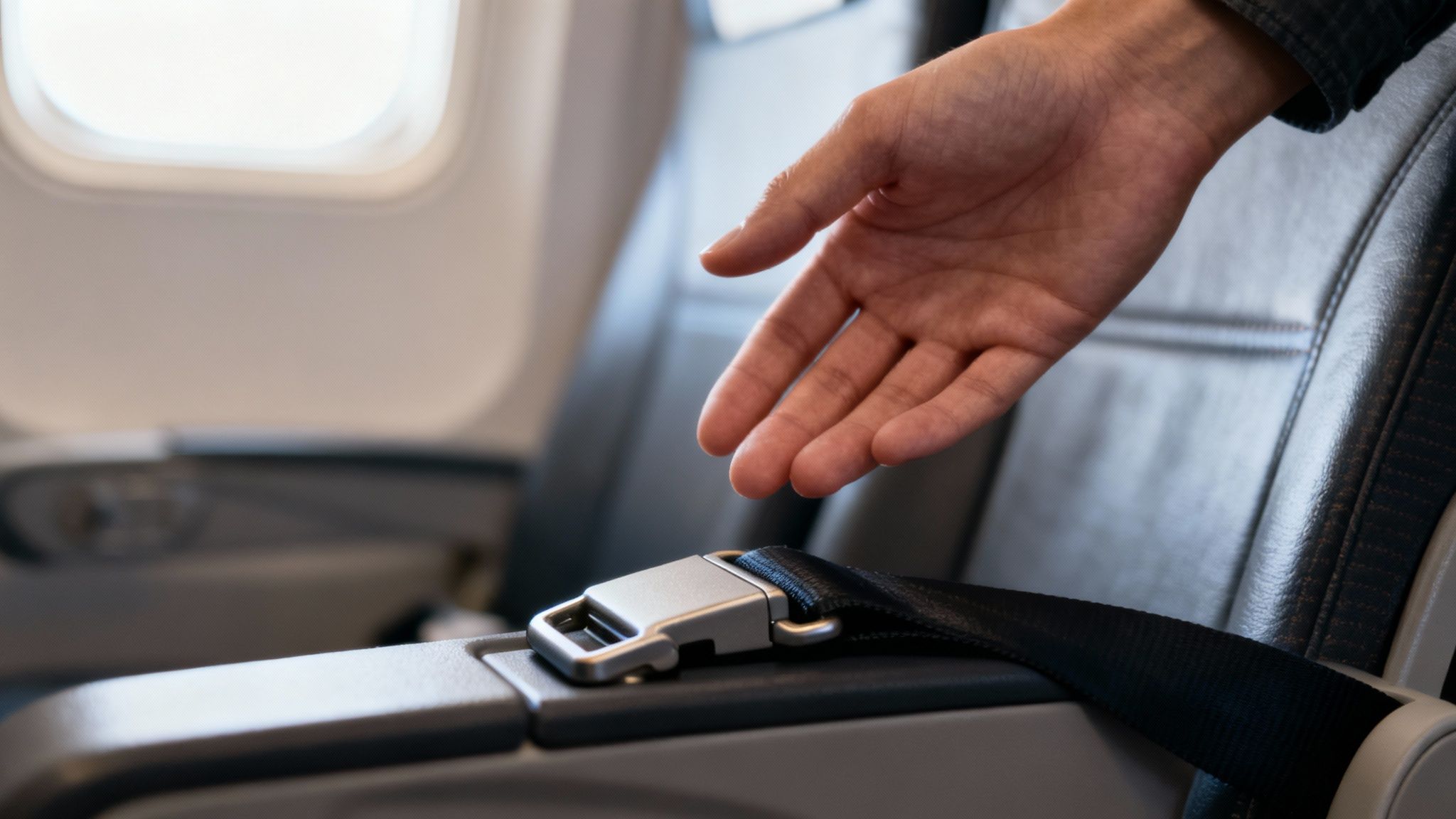
For a lot of people, the pre-flight routine involves more than just stowing a bag. It includes a moment of quiet worry about the seat belt. Let's be clear: if the belt doesn't fit, it's not a personal failure. It’s a direct consequence of inconsistent manufacturing standards and airline policies that simply haven't evolved to accommodate the reality of today's diverse passengers.
This isn't just a minor inconvenience. Across the globe, airline seat belt lengths can vary wildly, typically falling somewhere between 31 to 49 inches (78 to 125 cm). Unfortunately for many travelers, a lot of major airlines—especially in the US—tend to use belts on the shorter end of this spectrum. This variability isn't just about comfort; it's a critical safety issue. Passengers who can't buckle up face a tenfold higher risk of injury during unexpected turbulence.
This Isn't a Niche Problem—It's a Common Concern
The need for a bit of extra room in a seat belt is far more widespread than most people realize. What feels like a personal issue is actually a shared experience for a growing number of travelers who find standard belts just don't cut it.
This affects a wide range of people, including:
- Passengers of size, who are most directly impacted by shorter belts.
- Pregnant travelers who need more room for both safety and comfort.
- Passengers with medical devices that need to be secured on their lap.
- Parents flying with a lap infant, who often need a little extra slack to hold their child safely.
The real issue here is that people are put in the position of having to ask for a seat belt extender, a request that can feel very public and even a bit embarrassing. Feeling safe and secure shouldn't come with a side of anxiety.
Ultimately, getting familiar with the realities of airline seat belt length is your first step toward flying with more confidence. You can also dive deeper into the specifics of various plane seat belts in our other guides. By simply knowing what to expect, you can take control of the situation and focus on your trip, not the buckle.
A Trip Back in Time: The Evolution of the Modern Airplane Seat Belt
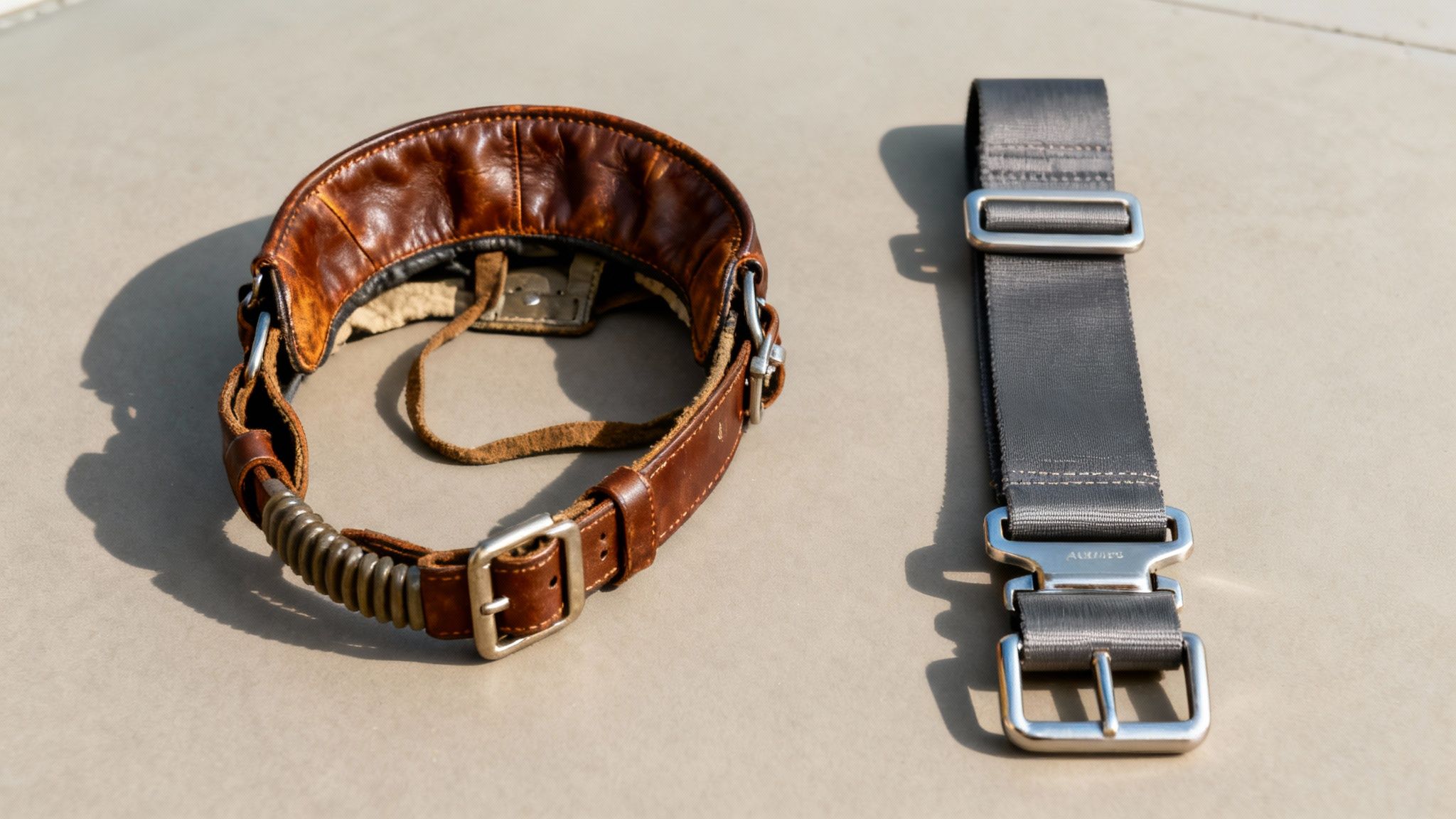
To really get why airline seat belt lengths are all over the map today, you have to rewind to the very beginning of commercial flying. The first "seat belts" were about as basic as you can imagine—just simple leather straps. Their main job was to keep pilots from tumbling out of open-cockpit biplanes during adventurous turns. Safety was a distant second thought, and comfort wasn't even on the radar.
As flying started to catch on, the need for actual safety rules became obvious. The first official seat belt mandate showed up in the US Air Commerce Act of 1926. It called for 'safety belts or equivalent apparatus' for anyone in an open-cockpit plane. By 1931, the rules got a bit more serious, demanding that belts and their anchors be able to withstand a hefty 1,000 pounds of force. You can dig deeper into the evolution of these aviation safety rules to see just how far things have progressed.
This early history laid the groundwork for the belts we use today, but it also introduced a problem that still affects passengers decades later.
A Design That Never Quite Grew Up
Here’s the thing: those early standards were built around the "average" person from the 1920s and 1930s. Back then, people were generally smaller and lighter than the global population is today. The entire point of the belt was to hold you in place during a rough ride, not to comfortably fit the wide variety of body shapes and sizes you'll find on any given flight.
This isn't just a fun fact; it's the root cause of why so many standard seat belts feel uncomfortably short. The core design has never really been rethought to keep up with how much our bodies have changed over the last century.
The modern airplane seat belt is essentially an upgraded version of a century-old concept. While materials and buckle technology have improved dramatically, the core assumption about passenger size has remained largely unchanged, leading to the fit issues many people experience.
From Leather Straps to High-Tech Systems
The jump from a basic leather strap to the fabric-and-metal buckle we all know didn't happen overnight. As planes got faster, flew higher, and packed in more passengers, the demand for stronger, more reliable safety gear grew right along with them.
Several key steps marked this journey:
- Standardized Buckles: The lift-lever buckle, which you still see on most flights, was a game-changer. It made fastening and—more importantly—releasing the belt in an emergency much faster and easier.
- Tougher Materials: Old-school natural fibers like cotton gave way to high-tech synthetics like nylon and polyester. These new materials were far stronger, more durable, and less likely to stretch under pressure.
- Intense Testing: Agencies like the Federal Aviation Administration (FAA) brought in tough-as-nails testing standards. Every belt had to prove it could handle the incredible forces of severe turbulence or a crash landing.
But even with all these crucial safety upgrades, one thing was strangely overlooked: a universal standard for airline seat belt length. That oversight created the patchwork of inconsistent belt sizes we have today, setting the stage for the challenges—and solutions—we're about to cover.
Comparing Seat Belt Lengths Across Major Airlines
If you've ever flown, you know the feeling. You settle into your seat, grab the two ends of the seat belt, and hope they click without a struggle. But that simple click can be a source of real anxiety because the length of an airline seat belt is one of aviation's best-kept secrets.
The hard truth is there's no universal standard. The belt on your American Airlines flight to Chicago might feel completely different from the one on your British Airways flight to London. This inconsistency is a huge headache for travelers. Generally, I've found that many domestic and budget carriers stick to shorter belts, often in the 31 to 46-inch range, while some international airlines give you a little more room to work with. Knowing this can make a world of difference when you're booking your next trip.
Airline Seat Belt And Extender Lengths: A Comparison
To give you a clearer picture, I've put together some hard numbers from the big players in the airline industry. This data is a solid starting point, but always remember that things can change. A newer plane or a first-class seat might have a different belt than an older aircraft in the same fleet.
Think of this table as your cheat sheet.
| Airline | Standard Seat Belt Length (Inches) | Airline-Provided Extender Length (Inches) | Notes |
|---|---|---|---|
| American Airlines | 31" – 52" | 25" | A wide range, depends heavily on the aircraft. |
| Delta Air Lines | 40" – 45" | 25" | Generally consistent, but always good to check. |
| United Airlines | 31" – 46" | 25" | Similar to American, older planes may have shorter belts. |
| Southwest Airlines | 39" – 45" | 24" | The extender is just a touch shorter than most. |
| JetBlue | ~45" | 25" | Fairly standard across their fleet. |
| Spirit Airlines | ~35" | 25" | Notoriously short belts, so plan ahead. |
| British Airways | ~47" | 10" | Longer belt, but a surprisingly short extender. |
| Emirates | ~46" | 11" | Similar to BA, longer belt but smaller extender. |
What's really interesting here is the give-and-take. An airline like Spirit might have a very short standard belt but provides a generous 25-inch extender. On the other hand, British Airways gives you more belt to start with, but their extender is less than half the length of what US carriers offer. It's a real mixed bag. If you're a frequent Delta flyer, for instance, it's worth diving deeper into their specific rules with a guide like this one on Delta's seat belt extender policy.
The key takeaway is simple: never assume consistency. A comfortable fit on your last flight is no guarantee for your next one, making it crucial to be prepared.
What This Data Means For Your Travel Plans
So, what do you do with this information? You use it to take control.
If you know you're flying on an airline with shorter belts, you can be the first to discreetly ask a flight attendant for an extender as you board. Don't wait until the cabin doors are closing. This knowledge also highlights why so many seasoned travelers invest in their own FAA-compliant extender. It’s about peace of mind—knowing you'll have a safe, comfortable fit no matter the airline, the aircraft, or where you're sitting.
How to Know If You Need a Seat Belt Extender
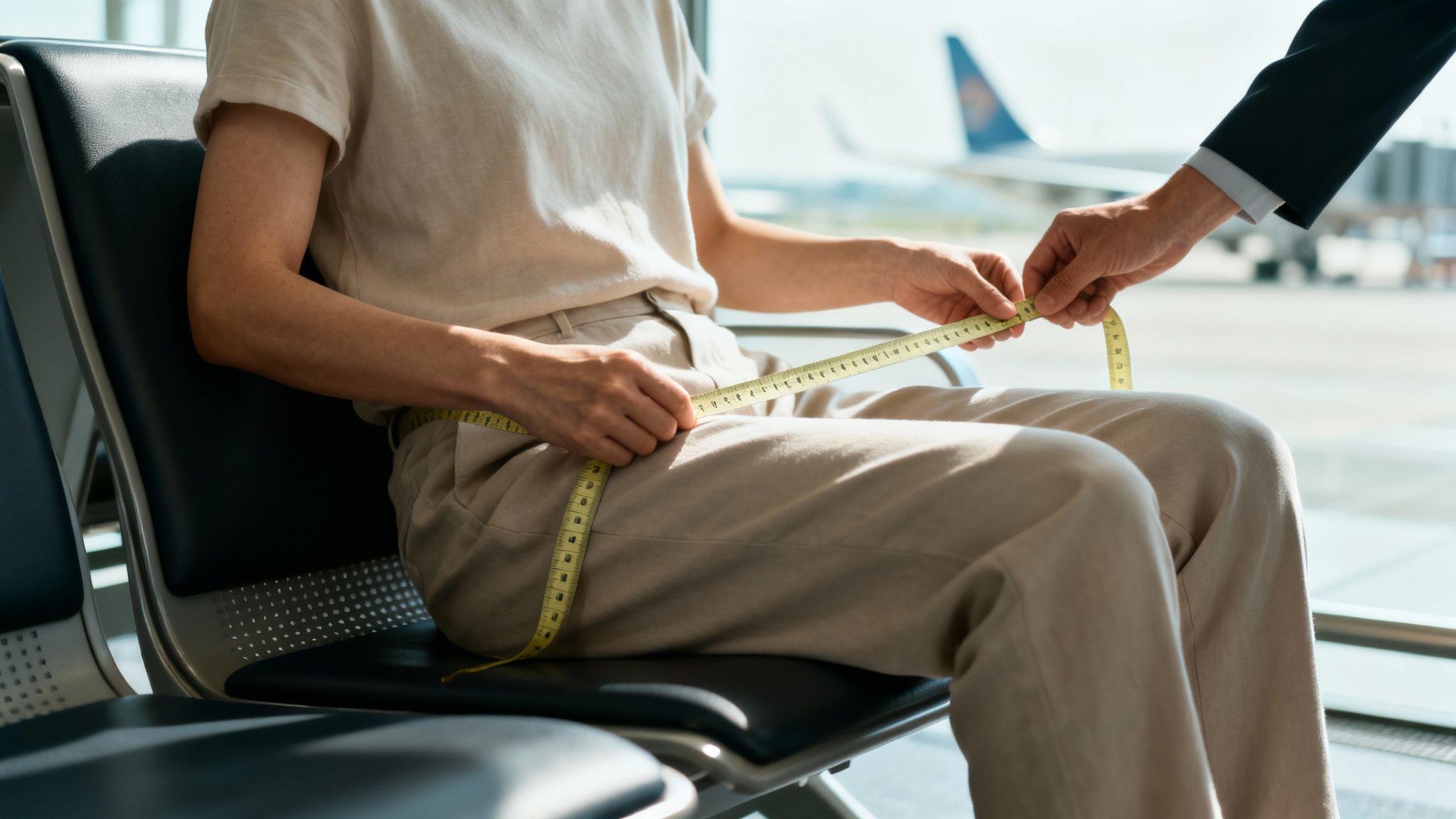
The best way to guarantee a smooth, stress-free flight is to figure out what you need before you even leave for the airport. Instead of leaving it to chance, you can take a quick, private measurement at home to know for sure if an extender will make your trip safer and more comfortable.
It’s just like checking your measurements for a new pair of pants. Grab a flexible tape measure, sit down on a firm chair (something like an airplane seat), and wrap the tape across your lap where the seat belt would go. Just jot down the number in inches.
Most airline seat belts are somewhere between 31 and 47 inches long. If your measurement is getting close to 45 inches or more, it’s a pretty safe bet that an extender would be a good idea. Having one ready means no last-minute surprises or awkward conversations.
More Than Just a Number
While that tape measure gives you a solid starting point, your lap size isn't the only reason you might need a bit of extra slack. An extender can be a huge help for safety and comfort in a few other situations, too.
For instance, an extender is often essential for:
- Pregnant Travelers: It helps position the belt properly and safely below the belly, which is exactly where it’s supposed to be.
- Passengers with Medical Devices: If you need to secure a device on your lap, an extender gives you room to do so without a tight belt causing pressure or damage.
- Travelers with Limited Mobility: That little bit of extra length can make a world of difference when you’re trying to buckle or unbuckle without having to twist or reach uncomfortably.
Knowing your needs beforehand is about empowerment. It shifts the focus from uncertainty to preparation, allowing you to board with the confidence that you will be safe and comfortable.
Understanding the typical airline seat belt length is the first step, and knowing your own fit is the second. If you realize an extender is the right call for you, it's also helpful to learn about the different types of seat belt extenders available. Taking a few minutes to prepare now can completely eliminate any hassle once you're on the plane.
How to Get an Extender on Your Flight
Figuring out you might need a seat belt extender is one thing. Actually asking for one can bring on a whole new wave of travel anxiety. But here's the good news: for flight crews, this is a completely routine request. The trick is to handle it smoothly and proactively to keep your travel day stress-free.
The absolute best time to ask is right as you’re getting on the plane. You’ll see flight attendants standing near the entrance greeting everyone—that’s your moment. You can catch their attention without an audience of the entire plane.
Just make eye contact and quietly say, “Could I please have a seat belt extender?” That’s all it takes. It’s private, professional, and gets the job done before you even get to your seat.
When and How to Ask
Timing really is everything here. If you wait until everyone's seated and the cabin doors are about to close, you're putting a lot of last-minute pressure on the crew (and yourself). Asking during the boarding process gives the flight attendant plenty of time to grab one for you while people are still stowing their bags and getting settled.
Here are a few easy, polite ways to phrase it:
- “Hi, could I get a seat belt extender for seat 14A, please?”
- “Excuse me, I’ll need a seat belt extender when you have a moment.”
- “May I have an extender, please?”
Simple and direct is the way to go. Flight attendants hear this every day, and they’ll usually bring one to your seat without any fuss.
Relying on the airline means you're dependent on their limited supply. On a full flight, it’s possible they may not have enough extenders to go around, which can create a stressful and unsafe situation.
The Downside of Airline-Provided Extenders
While asking the crew is straightforward, it’s not always a guaranteed solution. Airlines only carry a limited number of extenders on each flight. On a packed plane, they can and do run out, which can leave you in a real bind. That uncertainty is exactly why so many travelers decide to take matters into their own hands.
This brings us to the best way to guarantee your peace of mind: bringing your own FAA-compliant extender. Owning your own takes all the guesswork out of the equation. It means you have a certified, safe device ready to go, and you never have to ask anyone for anything.
If you want to explore this option, you can learn more about finding the right seat belt extender for airplanes before your next trip. It completely changes the experience from a moment of potential awkwardness into a simple, confident click.
Why Owning Your Own Certified Extender Is the Smartest Move
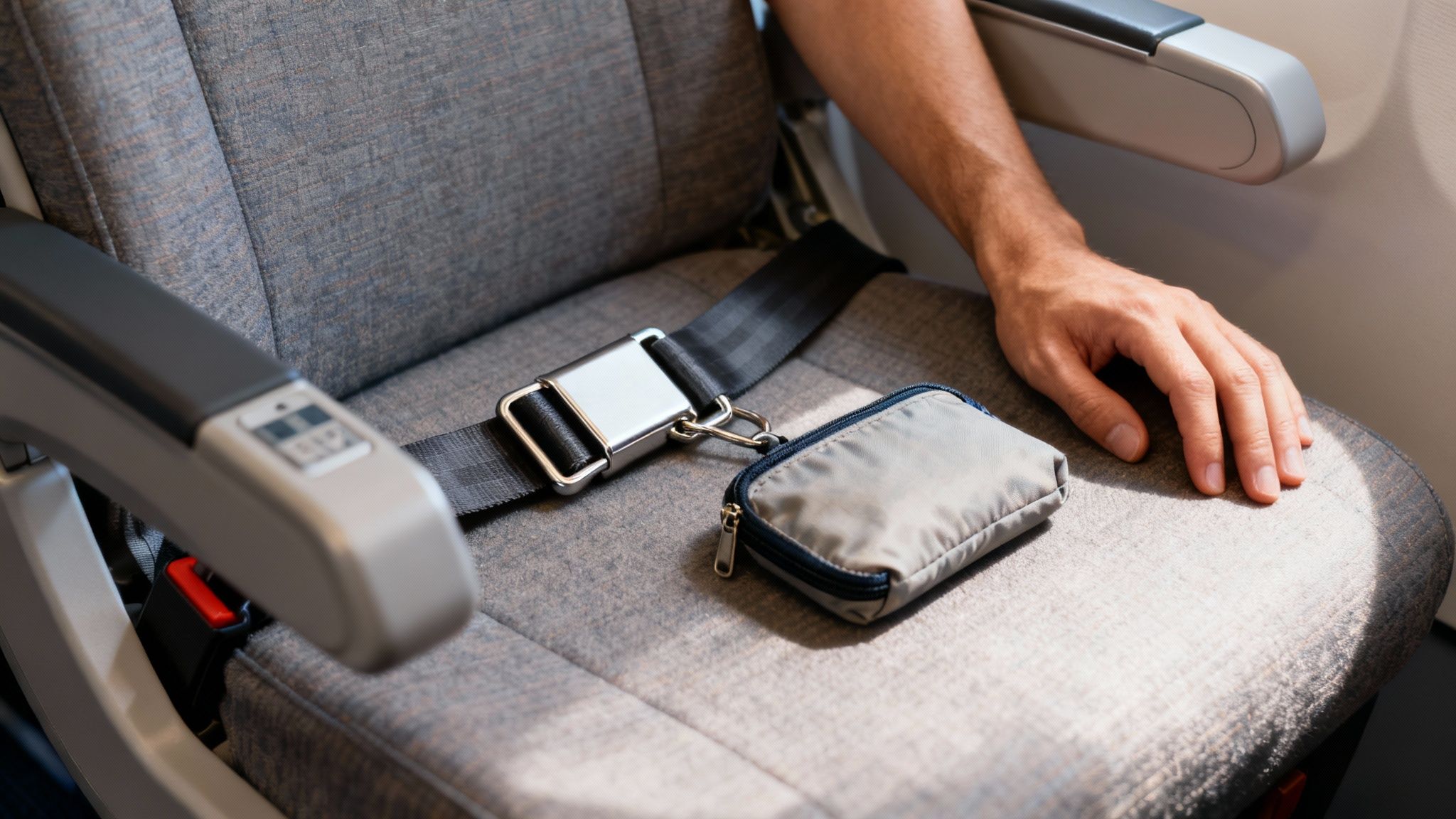
For anyone who flies regularly, buying your own certified seat belt extender is one of those simple upgrades that completely transforms the travel experience. It’s the difference between hoping the airline has one for you and knowing you have a solution right in your carry-on. That kind of peace of mind is priceless.
Relying on the airline's supply leaves way too much to chance. What if they run out on a packed flight? Owning your own extender eliminates that worry. More than that, it gives you privacy and dignity by removing the often-uncomfortable need to ask a flight attendant for help in front of other passengers. It’s a small, personal item that puts you back in control.
Why Certification Is Non-Negotiable
Here’s the thing: not just any extender from the internet will work. For both safety and airline acceptance, everything hinges on official certification. When you see a label like E-4 or E-8 certified, it’s your assurance that the extender has been through the wringer, tested to meet the same tough safety standards as the seat belts installed by the aircraft manufacturer.
This certification guarantees a few critical things:
- A Secure Connection: A certified extender is engineered to click into the plane's buckle with that same satisfying, secure feel, creating a connection you can trust.
- Built-Tough Materials: It’s made from the same high-strength webbing and forged components as the aircraft's own belts, meaning it can handle extreme forces.
- Regulatory Peace of Mind: It meets strict aviation safety regulations, making it a legitimate piece of safety equipment you can use with confidence.
Owning a certified extender isn't just about getting more length. It’s about preserving the integrity of the aircraft’s safety system. It ensures your belt works exactly as designed, giving you a secure, factory-spec fit every single time.
Certified airplane extenders are built specifically for this job. Many are E-4/E-8 approved and click right onto the existing belt to add 20+ inches of length—no tools or fuss needed. They’re compatible with over 65 types of aircraft, and with more than 500,000 units sold in the U.S. alone, they've become a travel essential for many.
Ultimately, getting your own extender is an investment in a smoother, less stressful journey. If you want to dive deeper, you can learn all about what to look for in our guide on FAA-approved seat belt extenders. It’s about shifting from asking for a solution to carrying one with you.
Your Top Questions About Airplane Seat Belt Extenders, Answered
Let's be honest, figuring out the rules for airplane seat belts and extenders can feel a bit confusing. You just want to fly comfortably and safely. To clear things up, I've put together answers to the most common questions travelers ask.
Are Personal Seat Belt Extenders Even Allowed On Planes?
Yes, you can absolutely bring your own seat belt extender on a plane. The key, however, is that it must be FAA-compliant, with a safety rating like E-4 or E-8 certification. This isn't just a suggestion; it ensures the extender is built to the same safety standards as the belt already on the seat.
While most airlines are fine with you using your own compliant extender, remember that the flight crew always has the final word. A few carriers, like Southwest Airlines for instance, have a specific policy that requires you to use the extenders they provide.
Can I Just Use My Car Seat Belt Extender?
No, and this one is a hard no. You should never try to use a car seat belt extender on an airplane. They might look similar, but their locking mechanisms are completely different and not designed to work together.
Think of it like trying to use the wrong key for a lock. A car extender simply won't click securely into an airplane buckle. It creates a massive safety hazard that could easily fail during turbulence or, worse, an emergency. Always stick to an extender made specifically for aircraft.
How Do I Know Which Extender to Buy?
Here’s the good news: the airline industry is pretty standardized when it comes to seat belts. The vast majority of airlines around the globe use what's known as a “Type A” buckle.
This means that if you buy a high-quality, E-4/E-8 certified extender from a reputable seller, it’s going to work on almost any flight you take. Before you buy, just double-check the product description to see if they list any known airline exceptions. A quick look can save you a headache at 30,000 feet.
What if a Flight Attendant Says I Can't Use My Extender?
This doesn't happen often, especially if you have a properly certified extender. But it’s crucial to remember that flight attendants have the final say on all safety equipment used in the cabin. If they tell you not to use your personal extender, you must follow their instructions, no questions asked.
If this happens, just politely ask them if you can have one of the airline's extenders instead. They carry them on every flight. It’s a good reminder that while having your own is great, the crew’s word is law when it comes to safety.
At Seat Belt Extenders, we provide E-4/E-8 certified airplane extenders designed for a secure, factory-like fit, giving you peace of mind on every journey. Find your perfect travel companion at https://seatbeltextenders.com.