
Here's the simple truth: You cannot bring your own seat belt extender on a Southwest Airlines flight. It’s a common question, and the answer is all about safety. If you need a bit of extra room, you’ll need to ask a flight attendant for one of theirs, as only airline-provided equipment is certified for their aircraft.
Your Guide to the Southwest Seat Belt Extender Policy
Navigating airline rules can sometimes feel like a maze, but Southwest's policy on seat belt extenders is refreshingly straightforward. It all boils down to one thing: your safety. The reason you have to use an extender provided by the airline comes directly from strict Federal Aviation Administration (FAA) regulations.
Think of it like the life vest tucked under your seat. You wouldn't bring one from home, right? That’s because the airline's safety gear is specifically designed, tested, and maintained for that exact aircraft. The very same logic applies to a Southwest Airlines seat belt extender. Each one is part of a tightly controlled inspection and maintenance program, guaranteeing it works flawlessly when it matters most.
Understanding the Official Rules
This policy isn't about causing inconvenience; it's a critical safety measure. Even extenders you can buy online that are advertised as "FAA-approved" don't have the specific TSO (Technical Standard Order) certification and maintenance records that an airline needs to see for use on its planes. The crew has no way to know the history, material quality, or even the compatibility of a device you bring from home.
To make sure your flight is both safe and comfortable, just keep these key points in mind:
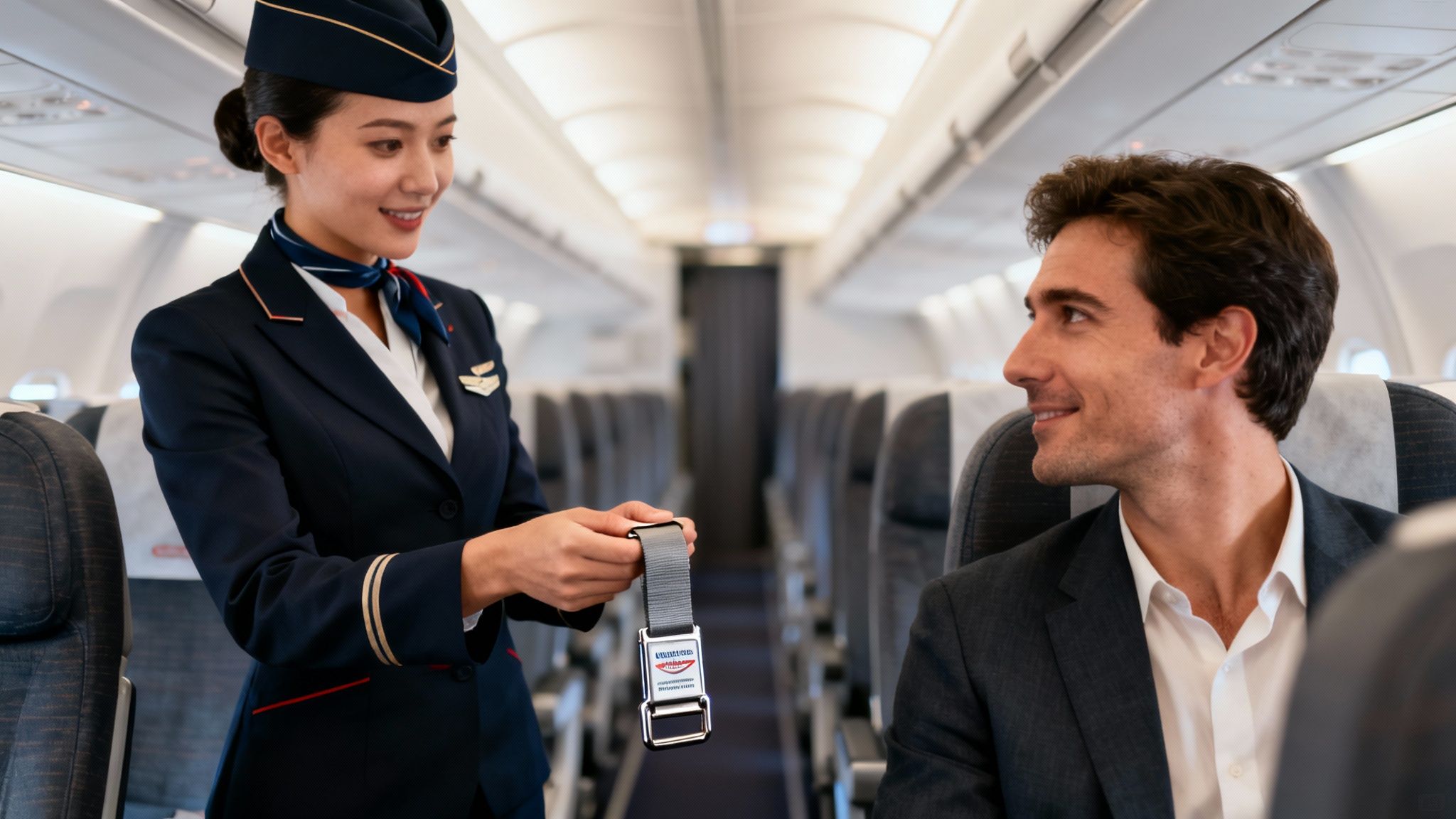
- Request, Don't Bring: As you're boarding or getting settled, simply ask a flight attendant for an extender. They are more than happy to provide one discreetly.
- Always Complimentary: There is never a charge for using an airline-provided seat belt extender.
- Safety First: Using the airline's own equipment ensures you're fully compliant with federal safety regulations and, more importantly, that you're secure in your seat.
Knowing the standard airline seat belt size can also help you anticipate whether you might need an extender before you even get to the airport.
The rule is simple: If it wasn't provided by the airline for that specific flight, it cannot be used to secure your seat belt. This policy protects both you and the airline by ensuring every piece of safety equipment meets certified standards.
To break it down even further, here’s a quick summary of the essentials.
Southwest Seat Belt Extender Policy at a Glance
This table gives you a quick snapshot of Southwest's rules so you can feel confident and prepared for your flight.
| Policy Aspect | What You Need to Know |
|---|---|
| Personal Extenders | Strictly prohibited. You must use one provided by Southwest. |
| How to Get One | Just ask any flight attendant during boarding or after you're seated. |
| Cost | Completely free for any passenger who needs one. |
| Why This Rule Exists | To comply with FAA regulations and ensure passenger safety with certified equipment. |
Ultimately, Southwest's policy is designed to remove any guesswork and ensure every passenger is safely secured with equipment the airline can stand behind.
Why Your Personal Extender Is Not Allowed on Flights
It might seem like a no-brainer to bring your own seat belt extender on a flight for convenience. However, Southwest Airlines—and every other U.S. carrier—strictly prohibits passengers from using their own. This isn't just an arbitrary rule. It’s a crucial safety policy grounded in federal regulations and a serious commitment to keeping you safe.
The heart of the issue boils down to two things: certification and accountability.
Think about it like this: if you needed to replace a critical part in your car's engine, you wouldn't just grab any part off the shelf. You'd use one approved by the manufacturer to ensure it works correctly when you need it most. Airlines operate under a much, much stricter version of that same principle. Every single component on an aircraft, right down to the Southwest Airlines seat belt extender a flight attendant hands you, is a tracked and certified piece of a larger safety system.
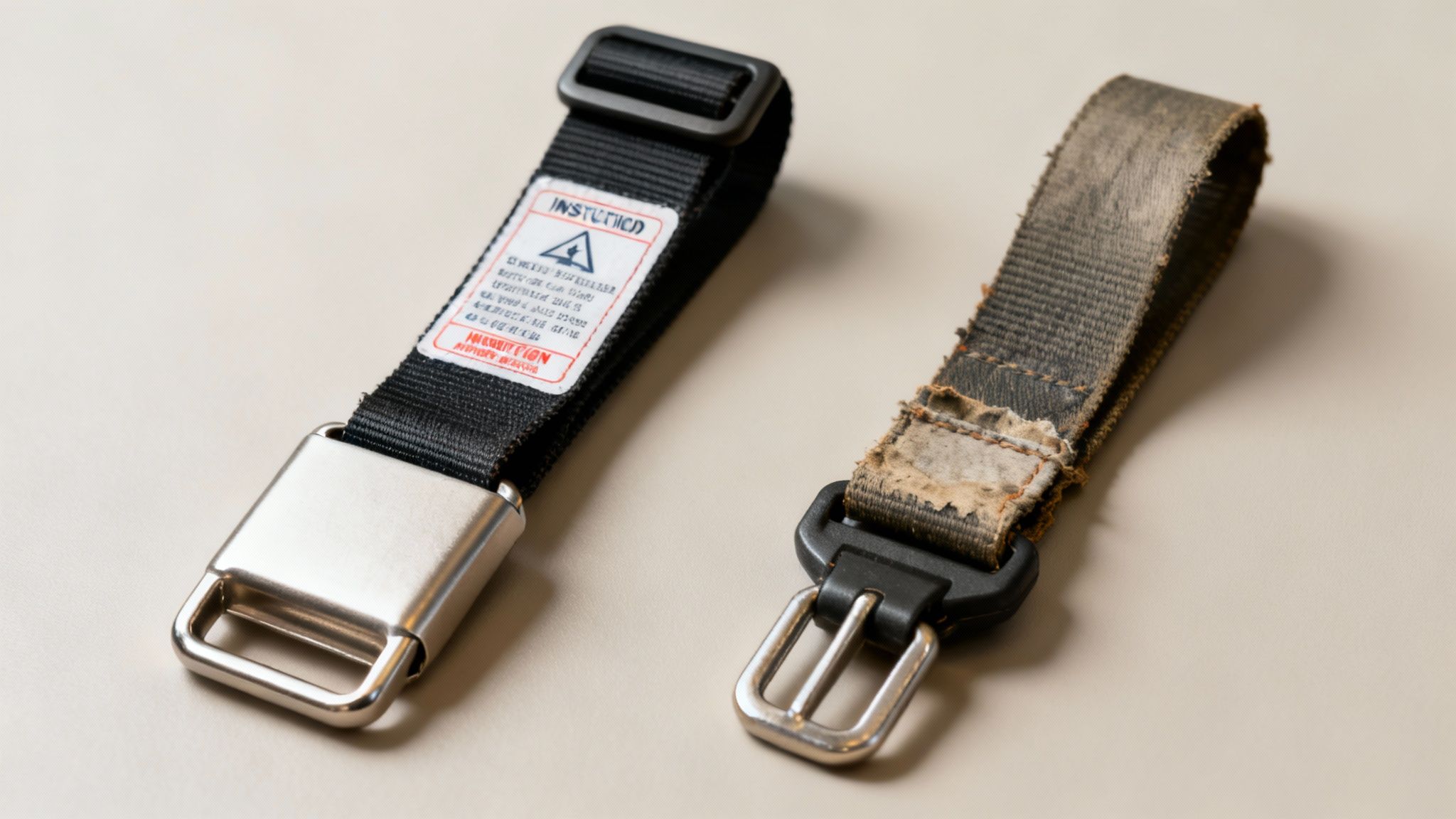
Your personal extender, on the other hand, is a total unknown. The airline has no way to verify its manufacturing quality, the materials used, or its maintenance history. That unknown variable introduces a risk they simply can't take.
The FAA Mandate and Maintenance Standards
The rule became official across the board back in 2012. That’s when the Federal Aviation Administration (FAA) issued a memo making it clear that passengers could no longer use their own seat belt extenders on flights.
The FAA's directive underscored that only airline-provided extenders are permitted because they fall under each carrier’s Continuous Airworthiness Maintenance Program. This is the same program that ensures every other part of the plane is regularly inspected for safety and wear. It means the extender you get from the crew has a documented service life, guaranteeing its integrity.
A personal extender, even if it's marketed as "FAA-approved," doesn't have the specific maintenance records and traceability required for use on a commercial aircraft. If you're curious about the rules for other situations, you can check out our guide on whether seat belt extenders are legal for uses outside of air travel.
Traceability Is Your Safety Net
Ultimately, this all comes down to traceability. In the unlikely event of an emergency, investigators need to be able to trace every single aircraft component back to its certified source. A personal extender bought online breaks that critical chain of safety.
By providing their own equipment, airlines like Southwest guarantee that the seat belt extender you use is fully compatible with their seats and has passed the same strict safety checks as the rest of the aircraft.
Here’s a quick look at why this matters so much:
- Certified Strength: Airline extenders are rigorously tested to withstand incredible forces—a standard that can't be confirmed with a personal device.
- Known Maintenance History: Each airline-owned extender is regularly inspected for frays, buckle defects, and other signs of wear and tear.
- Guaranteed Compatibility: They are designed to work flawlessly with the specific buckle mechanisms used on Southwest's fleet.
Following this policy ensures your safety is never a question mark. When you ask a flight attendant for an extender, you're getting a device that is a known, trusted, and fully integrated part of the plane's safety ecosystem.
How to Confidently Request and Use Your Extender
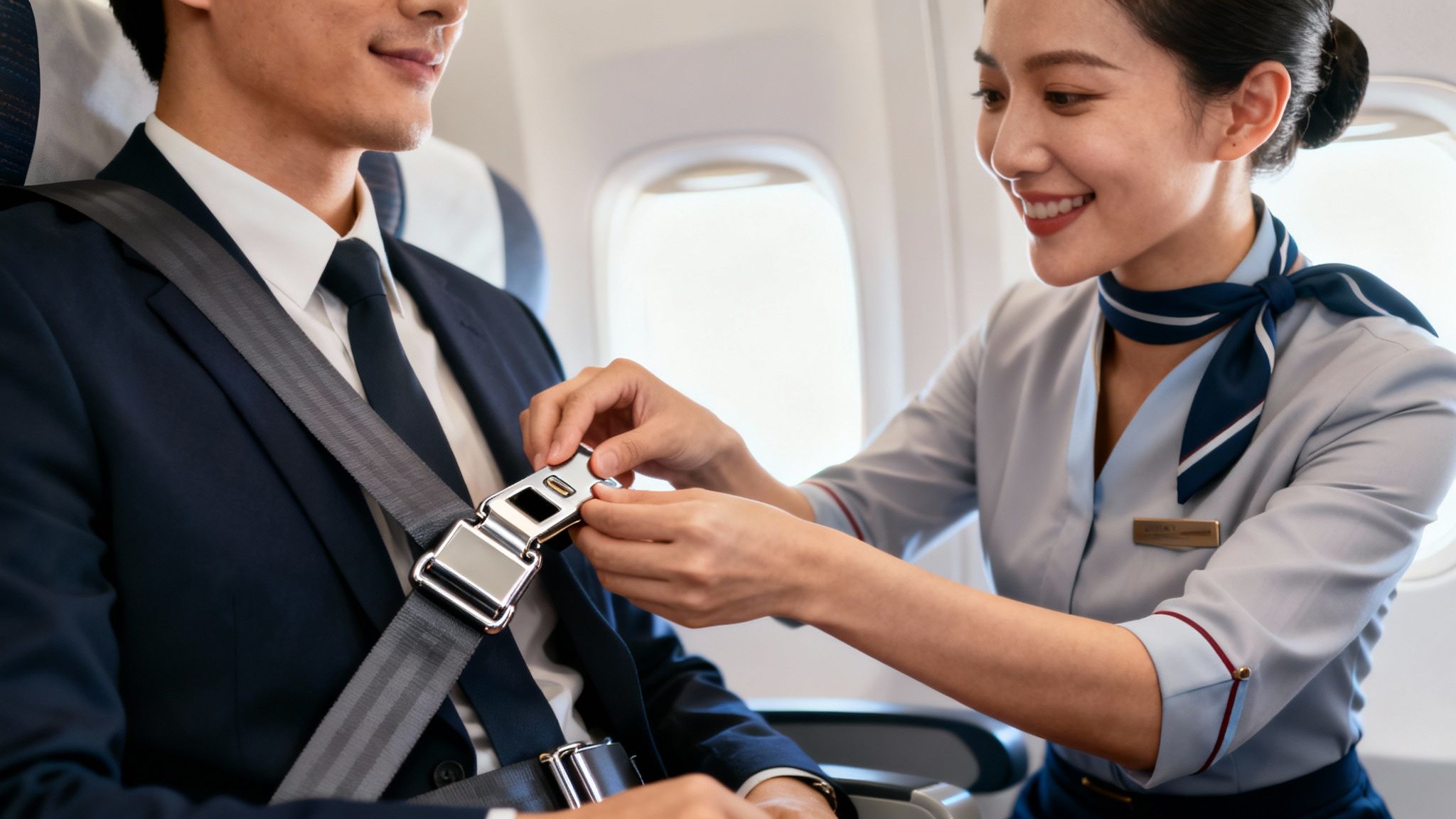
I get it—asking for a seat belt extender can feel a bit awkward, especially if it’s your first time. But let me put your mind at ease. For a Southwest flight attendant, this request is as routine as getting someone a blanket or a ginger ale. They handle it all day, every day.
The secret is to ask at the right time, making it a quick and discreet interaction. You've got two perfect windows of opportunity: either as you're first stepping onto the plane or just after you've settled into your seat.
All it takes is making eye contact with a crew member and quietly saying, "Could I have a seat belt extender, please?" That's it. They'll know exactly what you need and will bring one right over, no big deal. Their job is to keep you safe and comfortable, and this is just one part of that.
When and How to Ask
Picking the right moment can make the whole process feel completely seamless. Here are a couple of easy ways to do it:
- As You Board: While a flight attendant is greeting passengers at the door, you can lean in and make your request. They might give you one on the spot or simply note your seat number and bring it by in a minute.
- After You Sit Down: Once you're in your seat and see that the belt won't quite reach, just press your call button. Or, you can simply catch a flight attendant’s eye as they move through the cabin.
This simple, direct approach works every time and eliminates any potential awkwardness. It’s just standard procedure, and the crew is trained to be professional and discreet. Knowing a bit about how a seat belt extender works on airplanes ahead of time can also give you an extra boost of confidence.
Your request for a Southwest Airlines seat belt extender is a matter of safety, not an inconvenience. The flight crew views it as a necessary step to ensure you are securely fastened for takeoff and landing.
Attaching and Using the Extender Correctly
Got the extender? Great, the rest is a piece of cake. It's designed to be completely intuitive—if you can use a regular seat belt, you can use this.
- Find the Ends: You'll see the extender has a buckle on one side and a metal tongue on the other, just like the belt on your seat.
- Click into Place: First, click the metal tongue of the plane's seat belt into the extender's buckle. You should hear that satisfying "click" to know it's locked in.
- Fasten as Normal: Now, take the metal tongue from the extender and click it into the buckle that's attached to your seat.
- Adjust for a Snug Fit: Pull the loose strap to tighten the belt. You want it to sit low and snug across your hips, but still be comfortable.
And that's it! Following these simple steps ensures you're buckled in safely, so you can sit back, relax, and get ready for your flight.
Why One Extender Doesn't Fit All Southwest Planes
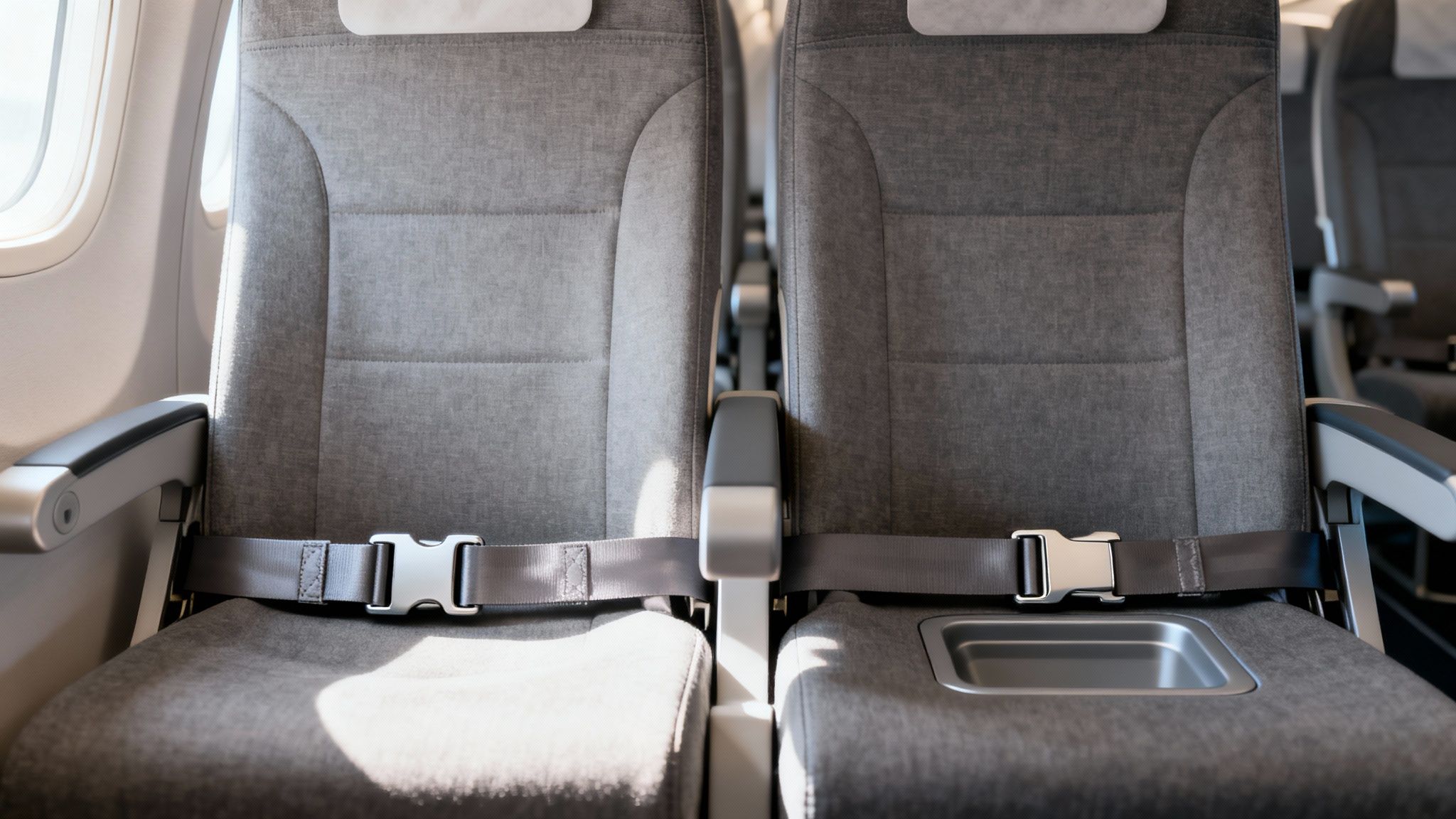
You'd think a seat belt extender from Southwest would work on any Southwest plane, right? It’s a reasonable assumption, but it’s not always the case. Just like car models get updated with new features, so do aircraft. This means the standard Southwest Airlines seat belt extender you're handed might not be a perfect match for every single seat across their fleet.
Knowing this little detail can make a big difference, setting your expectations before you even step on the plane. While Southwest’s fleet is known for its consistency, some newer jets come with updated seat designs and different buckle technology. It’s a subtle but important change that directly affects whether an extender will click into place.
This isn't something you'll run into often, but it’s good to be aware of, especially as the airline continues to modernize its planes. If it happens, you'll be able to communicate clearly with the flight crew about what's going on.
The Problem with Newer Buckles
So, why wouldn't an extender fit? The issue comes down to the evolution of airplane seat designs. Southwest's fleet is made up of different Boeing 737 models. For the most part, the airline provides what’s known as a 'Type B' extender, which works like a charm on the vast majority of these planes.
However, some of the newer aircraft—specifically certain Boeing 737-800s and all 737 MAX 8 models—are fitted with more modern seat belt mechanisms. A good way to think about it is like trying to plug an old USB-A cable into a new USB-C port. They both do the same job, but the physical connections are completely different. The buckle and tongue on these newer seats just aren't designed to mate with the older style of extender.
This is a perfect example of why it's absolutely critical to only use the extender provided by the airline. Southwest's extenders are tested to be compatible with their Boeing 737s, but they won't work on the newer 737-800s (those introduced after 2012) and the 737 MAX 8s. As of 2025, these newer planes make up roughly 40% of Southwest's 800+ aircraft fleet.
What This Means for Your Flight
What happens if a flight attendant tells you the standard extender won't work in your seat? First off, don't panic. The crew is trained for exactly this situation, and they will figure out a solution.
Your safety is the crew's number one priority. If a standard extender doesn't fit your seat's buckle, they will immediately look for other options to make sure you are safely secured for the flight.
Here are a few things they might do:
- Move you to a different seat: Often, the easiest fix is to find you another seat on the plane where the buckles are compatible with the extender.
- Check for alternate extenders: It’s less common, but some flights might carry a different type of extender for this very reason.
- Rebook you on another flight: In the rare event that the flight is completely full and no compatible seat is available, the crew will help you get booked on the next flight.
Simply understanding that this can happen helps you stay calm and work with the crew to find the best solution. To get a better sense of how belt sizes can vary across the industry, take a look at our article on general airplane seatbelt length.
Connecting Extenders and the Customers of Size Policy
Sometimes, realizing you need a Southwest Airlines seat belt extender is the first sign you might need to look into their broader policies for passenger comfort and safety. An extender adds valuable length to the seat belt, but what happens if it's still not enough to get buckled in safely?
This is exactly where Southwest's "Customers of Size" policy comes in. The rule of thumb is pretty simple: if you can't lower both armrests and securely buckle your seat belt (even with one of the airline's extenders), you will likely need an extra seat. Think of it less as a penalty and more as a crucial safety protocol. It ensures every single person is properly secured for their own protection and doesn’t unintentionally spill over into their neighbor's space.
What This Policy Means for You
At its heart, the policy is about making sure everyone gets the space they paid for—a non-negotiable for both comfort and, more importantly, safety. If you do need that extra room, Southwest has been known for its customer-friendly approach, historically providing an extra seat at no cost. But be aware, big changes are coming that will require a bit more planning on your part.
While Southwest’s policy has long been a standout for offering a complimentary extra seat, they’ve announced a major shift. Starting in August 2025, for travel from January 2026 onward, passengers needing more space will have to buy the extra seat when they book. The good news is that you can still get a refund for that seat after your flight if the plane wasn't completely full.
This change is all about predictability. It puts the planning in the passenger's hands to ensure a comfortable fit on a full flight, rather than leaving things to chance at the gate.
Understanding this connection is key. It’s not just a matter of fitting into the seat; it’s about being safely buckled, which brings us right back to the seat belt extender. It's also smart to know how other airlines handle this. For instance, our guide on the Delta seat belt extender policy provides a good point of comparison.
Knowing these rules before you book helps you avoid any last-minute stress at the airport. You can travel with confidence, knowing your journey will be as smooth and comfortable as possible.
Your Top Questions About Southwest Seat Belt Extenders, Answered
Alright, so we've covered the official policies, but I know from experience that real-world travel always brings up more questions. It's one thing to read the rules, and another to be standing in the jetway wondering about the little details. Let's tackle some of the most common questions flyers have about using a Southwest Airlines seat belt extender.
Think of this as the practical advice you'd get from a seasoned traveler. We'll clear up any lingering confusion about costs, availability, where you can (and can't) sit, and what to expect from the extender itself. The goal is to get you on that plane feeling confident and ready to go.
Are Southwest Seat Belt Extenders Free?
Yes, they are 100% free. No strings attached.
Think of it this way: a seat belt extender is a piece of safety equipment, just like the oxygen masks or life vests. Southwest provides them to any passenger who needs one, completely free of charge, because ensuring you can buckle up safely is their top priority. You'll never be asked to pay a fee for one.
What if They Run Out of Extenders on My Flight?
This is a fair question, but honestly, it’s something you likely won't ever have to worry about. It's an extremely rare scenario. Southwest planes carry a healthy stock of extenders, and flight crews are trained to make sure all essential safety gear is on board before departure.
But let's play out the "what if." In the incredibly unlikely event a flight runs out, the crew is trained to handle it.
The flight crew’s number one job is the safety of every single person on the plane. If a passenger can't be safely buckled in, the aircraft isn't going anywhere. The crew would find a solution, which might mean moving people around or, in the rarest of cases, rebooking you on the next flight at no cost.
Again, this is highly improbable, but it shows how seriously they take the "everyone buckled up" rule.
Can I Use an Extender in an Exit Row?
That’s a firm no. This isn't a Southwest rule; it's a Federal Aviation Administration (FAA) mandate that applies to all airlines. The reasoning is purely about safety.
Passengers in an exit row need to be able to assist in an emergency without any potential obstructions. An extender, with its extra length, could easily get tangled or create a tripping hazard during a high-stress evacuation when every second is critical. If you need a Southwest Airlines seat belt extender, a flight attendant will simply and politely find you a different, non-exit row seat.
How Much Extra Length Does a Southwest Extender Provide?
While there isn't a single, universally published number, a standard airline seat belt extender generally adds about 24 to 25 inches to the belt.
This is usually plenty of extra length to ensure a comfortable and secure fit for passengers who need it. For context, the regular seat belts on Southwest planes are typically between 39 and 45 inches long. So, an extender can increase the total belt length by more than 50%, accommodating a very wide range of body types.
At Seat Belt Extenders, we know that feeling secure is just as important on the road as it is in the air. While you must use the airline-provided extender on your Southwest flight, we are America's most trusted source for certified, vehicle-specific seat belt extenders for your car. Find the right extender for your vehicle.